Pradhan shares Sanskrit subhashita on diligence and learning

Synopsis
Union Education Minister Dharmendra Pradhan posted a Sanskrit subhashita on 23 June 2026, linking diligence to knowledge, wealth, and happiness under #ShikshaSubhashitam. The verse aligns with NEP 2020's push to integrate Indian classical thought into education, continuing the Ministry's sustained campaign to foreground traditional wisdom in public discourse.
Key Takeaways
Dharmendra Pradhan shared a Sanskrit subhashita on 23 June 2026 under the hashtag #ShikshaSubhashitam .
The verse states that laziness blocks knowledge, and without knowledge there is no wealth, friendship, or happiness.
The post is part of the Ministry of Education's ongoing practice of circulating classical Indian verses on social media.
The messaging directly supports the National Education Policy 2020 , which mandates integration of Indian knowledge systems into curricula.
Students and teachers are the primary audience, with the verse carrying a motivational and value-education dimension.
Observers will watch for further roll-out of NEP 2020 value-education modules and any parliamentary debate on Sanskrit and moral education.
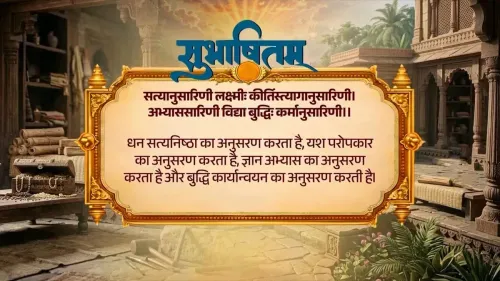
Union Education Minister Dharmendra Pradhan on Tuesday, 23 June 2026, shared a classical Sanskrit subhashita on social media, underscoring the connection between diligence, knowledge, wealth, friendship, and happiness — framing the ancient verse as a timeless lesson for students and learners across India.
Context
The verse, posted under the hashtag #ShikshaSubhashitam, reads in Hindi: 'Aalasi vyakti ko vidya nahin milti, bina vidya ke dhan nahin, bina dhan ke mitra nahin aur bina mitra ke sukh nahin milta' — meaning, 'A lazy person does not attain knowledge; without knowledge, there is no wealth; without wealth, no friends; and without friends, no happiness.' The post was accompanied by a video.
The subhashita presents a chain of consequence rooted in personal diligence, positioning hard work and the pursuit of learning as the foundational step toward a fulfilled life. It is drawn from the broader tradition of Sanskrit didactic verses that have been part of India's educational and moral heritage for centuries.
Policy Backdrop
The post reflects a sustained practice by the Ministry of Education of circulating traditional subhashitas to draw public attention to the links between classical Indian thought and contemporary education values. This messaging aligns closely with the National Education Policy (NEP) 2020, which explicitly calls for the integration of Indian knowledge systems, value education, and classical-language sources into school and higher-education curricula.
Since 2014, the Ministry has made the foregrounding of classical Indian wisdom within public education discourse a visible part of its communication strategy. Pradhan, who took charge of the Education portfolio in 2021, has continued and expanded this approach, using social media to reach students, teachers, and parents directly.
Stakeholders and Impact
Students and teachers are the primary audience for such messaging. For students preparing for competitive examinations or navigating academic pressures, the verse carries a motivational undertone: that consistent effort — not circumstance — is the gateway to learning and, by extension, to social and economic well-being.
For educators and curriculum planners, the post signals continued ministerial support for embedding value education and classical references within teaching frameworks. The NEP 2020 framework provides the institutional scaffolding for such integration, and ministerial social-media messaging reinforces the policy direction at a public level.
What's Next
Attention will now turn to the roll-out of NEP 2020 value-education modules across states, and to any parliamentary or policy discussion on Sanskrit-language promotion and moral-education components in the national curriculum. The #ShikshaSubhashitam series, if continued, may serve as a platform for the Ministry to build a broader public conversation around India's classical pedagogical traditions ahead of the next academic year.
As the government pushes deeper implementation of NEP 2020, such cultural messaging is likely to intensify, shaping how Indian education policy is communicated to a mass audience beyond formal policy documents.
Point of View
The Ministry reinforces a broader ideological arc that seeks to legitimise traditional knowledge systems alongside modern pedagogy. The #ShikshaSubhashitam framing suggests an attempt to build a serialised, recognisable campaign rather than a one-off post. If sustained, this approach could shape how value education is perceived by parents and students well before formal curriculum changes reach classrooms.
NationPress
23 Jun 2026
Frequently Asked Questions
What is the Sanskrit subhashita shared by Dharmendra Pradhan?
The verse states that a lazy person does not attain knowledge; without knowledge there is no wealth; without wealth, no friends; and without friends, no happiness — emphasising diligence as the root of all well-being.
What is #ShikshaSubhashitam?
#ShikshaSubhashitam is the hashtag used by Union Education Minister Dharmendra Pradhan to share classical Sanskrit didactic verses on education, diligence, and values on social media.
How does this post relate to NEP 2020?
The National Education Policy 2020 calls for integrating Indian knowledge systems and value education into school and higher-education curricula; Pradhan's subhashita posts publicly reinforce that policy direction.
Why does the Education Ministry share Sanskrit verses on social media?
Since 2014, the Ministry has used classical Indian wisdom in its public communication to highlight the links between traditional thought and contemporary education values, reaching students, teachers, and parents directly.
What should students take away from this subhashita?
The verse urges students to avoid laziness and pursue learning diligently, presenting knowledge as the foundation for financial stability, social relationships, and personal happiness.