Khattar pays tribute to ISRO legend Prof. Satish Dhawan on birth anniversary
Synopsis
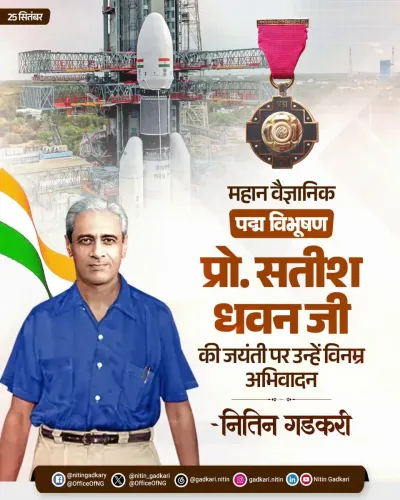
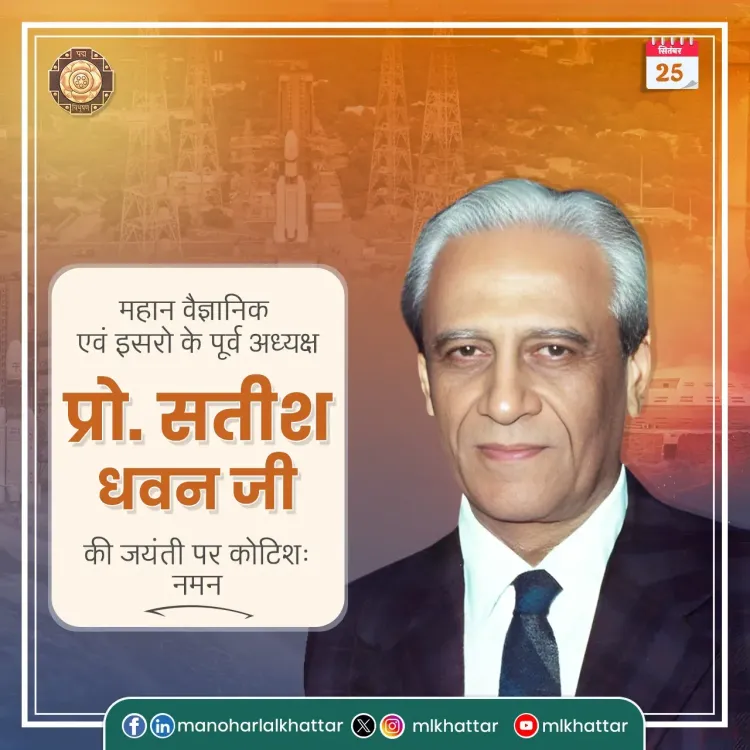
Union Power Minister Manohar Lal Khattar paid tribute to Padma Vibhushan Prof. Satish Dhawan, former ISRO Chairman (1972-1984), on his birth anniversary, calling his contributions to Indian space and science unparalleled and an inspiration for future generations.
Key Takeaways
Manohar Lal Khattar paid tribute to Prof.
Satish Dhawan on his birth anniversary on September 25, 2026 .
Dhawan received the Padma Vibhushan , India's second-highest civilian honour, for his contributions to science.
Dhawan served as ISRO Chairman from 1972 to 1984 , overseeing landmark missions including India's first satellite, Aryabhata .
Under Dhawan's leadership, India developed the SLV-3 launch vehicle , establishing indigenous launch capability.
The primary launch facility at Sriharikota is named the Satish Dhawan Space Centre in his honour.
ISRO is currently advancing the Gaganyaan crewed-flight programme — a direct descendant of Dhawan-era institutional foundations.
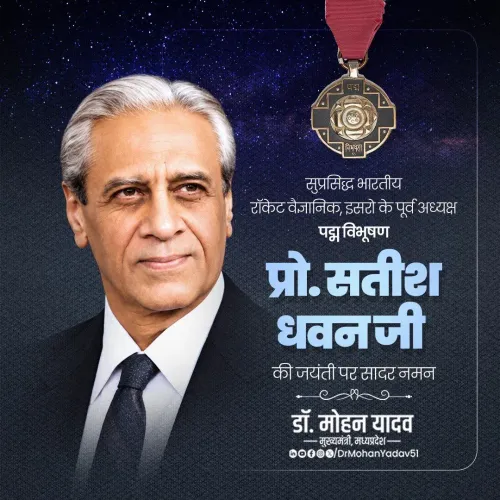
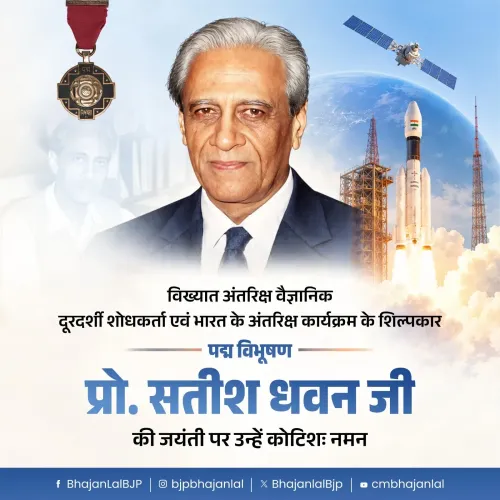
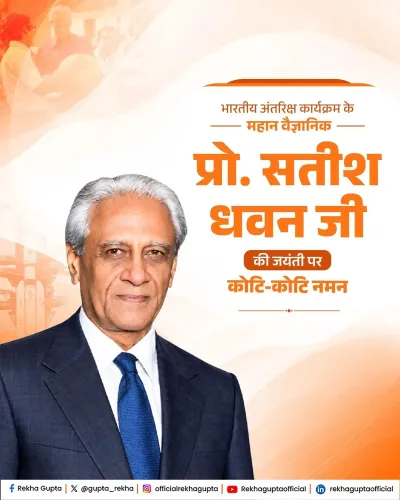
On the birth anniversary of one of India's greatest scientific minds, Union Power Minister Manohar Lal Khattar on Friday, September 25, 2026, offered his homage to Prof. Satish Dhawan — the Padma Vibhushan-decorated former Chairman of ISRO whose visionary leadership shaped the very foundation of India's space programme.
Posting in Hindi, Khattar wrote: 'भारतीय अंतरिक्ष कार्यक्रम को नई दिशा देने वाले महान वैज्ञानिक' ['the great scientist who gave a new direction to the Indian space programme'] — and saluted Dhawan's contribution as 'अतुलनीय' ['unparalleled'], adding that his visionary leadership, remarkable research, and relentless hard work would remain a source of inspiration for generations to come.
The architect of ISRO's formative decade
Prof. Satish Dhawan took charge as ISRO Chairman in 1972 and helmed the organisation through its most consequential early phase, right until 1984. Under his watch, India launched Aryabhata — the country's first satellite — and developed the SLV-3 launch vehicle, both milestones that proved India could build and fly its own space hardware. He was not just an administrator; he was a world-class fluid-dynamicist who brought rigorous scientific culture to an institution still finding its footing.
Dhawan's legacy is also one of institutional humility. When India's first SLV-3 mission failed in 1979, he stood before the press and took personal responsibility. A year later, when SLV-3 succeeded, he stepped aside and let his team — including a young A.P.J. Abdul Kalam — take the credit. That culture of accountability and shared ownership defined ISRO for decades after him.
Why this tribute lands differently in 2026
Indian ministers regularly mark the birth anniversaries of pioneering scientists, and the practice carries deliberate messaging: a reminder that the self-reliance India now pursues in space technology has deep roots. The tribute comes as ISRO presses ahead with its Gaganyaan crewed-flight programme and prepares for future lunar sample-return missions — ambitions that trace a direct line back to the institutional scaffolding Dhawan erected half a century ago.
The space agency Dhawan nurtured now operates in a vastly different strategic environment — commercial launch contracts, deep-space probes, and an expanding private space sector. Yet every rocket that climbs from the Satish Dhawan Space Centre at Sriharikota — named in his honour — carries a reminder of whose shoulders it stands on.
Point of View
A senior BJP leader, invoking Dhawan reinforces the government's 'Atmanirbhar Bharat' (self-reliant India) narrative in science and technology. The timing is also quietly poignant: as India's crewed spaceflight programme edges toward reality, the name of the man who built the organisational culture that makes it possible gains fresh resonance. Such anniversary tributes may be ceremonial in form, but they serve a durable function in anchoring institutional memory.
NationPress
25 Sept 2026
Frequently Asked Questions
Who was Prof. Satish Dhawan?
Prof. Satish Dhawan was a pioneering Indian aerospace scientist and fluid-dynamicist who served as Chairman of ISRO from 1972 to 1984. He oversaw India's early satellite missions and the development of the SLV-3 launch vehicle, and was awarded the Padma Vibhushan for his contributions.
When is Satish Dhawan's birth anniversary?
Prof. Satish Dhawan's birth anniversary falls on September 25. Union Power Minister Manohar Lal Khattar paid tribute to him on this date in 2026.
What is Satish Dhawan's contribution to ISRO?
Dhawan guided ISRO through its most formative years (1972-1984), overseeing the launch of India's first satellite Aryabhata, the development of the SLV-3 launch vehicle, and establishing a strong scientific and institutional culture at the organisation.
Why is the Sriharikota space centre named after Satish Dhawan?
India's primary rocket launch facility at Sriharikota in Andhra Pradesh was renamed the Satish Dhawan Space Centre in honour of his foundational role in building ISRO's launch capabilities during his tenure as Chairman.
What did Manohar Lal Khattar say about Satish Dhawan?
Khattar called Dhawan's contribution to Indian science and space research 'unparalleled' and said his visionary leadership, remarkable research, and relentless hard work would remain a source of inspiration for future generations.