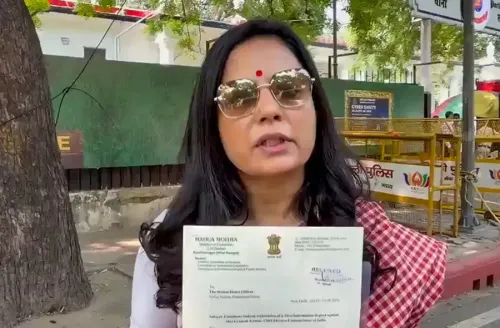
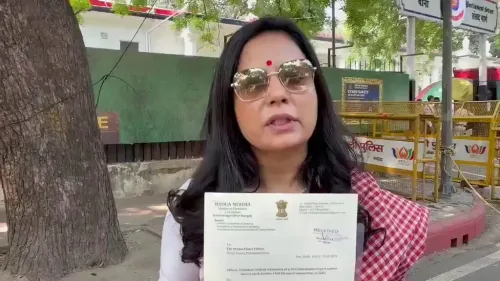
Mahua Moitra flags judge's son on govt panels, questions bench conduct

Synopsis
TMC MP Mahua Moitra publicly alleges that a Supreme Court judge's son occupies four government panel positions, and that the same judge muted audio in a related hearing, stayed a fine, and dissented on the constitutionality of the Chief Election Commissioner's appointment process.
Key Takeaways
Mahua Moitra posted on 25 September 2026 alleging that 'Justice Sharma's' son holds posts on four top government panels .
She claims the same judge muted audio during a hearing involving the Chief Election Commissioner's daughter , stayed a fine, and dissented against Justice Datta on the CEC appointment process.
Her closing argument: 'Judiciary is protector — cannot be predator.' In 2023 , the Supreme Court mandated a three-member committee — Prime Minister, Leader of Opposition, Chief Justice — for CEC appointments; Parliament later replaced the Chief Justice with a Cabinet Minister, triggering ongoing legal challenges.
NationPress could not independently verify the specific procedural details cited in the post, which appear to concern a recent proceeding.
A pointed allegation about judicial conflict of interest landed on Indian social media on Friday, 25 September 2026, when TMC MP Mahua Moitra posted a pointed series of charges against a sitting Supreme Court judge — claiming the judge's son holds positions on four top government panels and that the same judge's recent courtroom conduct has, in her view, followed a suspiciously convenient pattern.
Moitra's post reads: 'Justice Sharma's son on 4 top government panels. No wonder he mutes audio of Gyanesh Chor's daughter's hearing, stays her fine and also dissents with Justice Datta and does not hold CEC appointment process illegal. Judiciary is protector — cannot be predator.'
The 'Gyanesh Chor' reference and what it signals
The phrase 'Gyanesh Chor' — a derogatory nickname — is a reference to Chief Election Commissioner Gyanesh Kumar, whom sections of the opposition have repeatedly targeted over his appointment and conduct. Moitra's post ties three distinct judicial acts together as a single pattern: the muting of audio during a hearing involving his daughter, the staying of a fine, and a dissent against Justice Datta on whether the CEC appointment process is constitutionally valid.
NationPress cannot independently verify the specific procedural details — the muted audio, the stayed fine, or the dissent outcome — which appear to concern a recent proceeding not yet in the public domain. The broader institutional dispute, however, is well documented.
The 2023 Supreme Court ruling that started this fight
The CEC appointment controversy has deep roots. In 2023, a five-judge Supreme Court of India Constitution Bench ruled that the Chief Election Commissioner and Election Commissioners must be appointed by a committee comprising the Prime Minister, the Leader of the Opposition, and the Chief Justice of India — explicitly to insulate the Commission from executive capture. Parliament subsequently passed legislation replacing the Chief Justice with a Cabinet Minister, a move opposition parties argued nullified the court's intent. Challenges to that law have been pending before the Supreme Court ever since.
It is within that live litigation that Justice Datta — identified in the research as a judge who has sat on constitutional benches addressing executive appointments — and the unnamed 'Justice Sharma' appear to have disagreed. Moitra's allegation is that the dissent was not jurisprudential but instrumental, shaped by the judge's son's government-panel positions.
Conflict of interest in the judiciary — a recurring flashpoint
Allegations of this kind are not new to Indian public life. The question of whether judges with relatives in government-linked roles should recuse themselves from cases touching executive power has surfaced repeatedly, most visibly during controversies over collegium appointments and post-retirement jobs. What gives Moitra's post its particular charge is the specificity: she names a number (four panels), names a proceeding, and names a dissenting colleague — creating a testable, documentable claim rather than a general grievance.
Her closing line — 'Judiciary is protector — cannot be predator' — frames the allegation not as an attack on the institution but as a defence of it: the argument that exposing alleged conflicts is itself a form of judicial protection.
Whether the Supreme Court's administrative machinery or the parliamentary standing committee on law takes cognisance of a sitting MP's public charge against a sitting judge is now the question every constitutional watcher will be tracking.
Point of View
A specific number of government posts, and specific courtroom acts, she has shifted the conversation from abstract institutional concern to a concrete, falsifiable claim. The post lands at a moment when the Supreme Court's credibility on electoral matters is already under intense scrutiny, making it politically potent regardless of what verification ultimately shows. The establishment response — or pointed silence — will itself become part of the story.
NationPress
25 Sept 2026
Frequently Asked Questions
What is Mahua Moitra alleging about Justice Sharma?
Moitra alleges that a Supreme Court judge identified as 'Justice Sharma' has a son who sits on four top government panels, and that this conflict of interest influenced the judge's conduct — including muting audio during a hearing, staying a fine, and dissenting on the legality of the Chief Election Commissioner's appointment process.
What is the CEC appointment controversy in India?
In 2023 the Supreme Court ruled that the Chief Election Commissioner must be appointed by a panel of the Prime Minister, Leader of the Opposition, and Chief Justice of India. Parliament subsequently replaced the Chief Justice with a Cabinet Minister, which opponents argue undermines judicial oversight. The law is currently being challenged in the Supreme Court.
Who is Justice Datta and what is his role here?
Justice Datta is a Supreme Court judge who, according to Moitra's post, held that the CEC appointment process is illegal — a position from which 'Justice Sharma' dissented. Justice Datta has previously sat on constitutional benches dealing with executive appointments.
Can a sitting judge's family member hold government panel positions in India?
There is no blanket legal bar, but judicial ethics norms and the principle of recusal require judges to step aside from cases where a conflict of interest — including a close relative's government-linked position — could reasonably be perceived to affect impartiality.
What happens next after Mahua Moitra's allegation?
Any formal follow-up would require either a recusal application before the Supreme Court, a reference to the Supreme Court's collegium or its in-house procedure, or a parliamentary committee inquiry. Moitra's post creates public pressure but does not by itself trigger a legal mechanism.