Giriraj Singh invokes Deendayal Upadhyay's Antyodaya vision
Synopsis
Union Textiles Minister Giriraj Singh, on Pandit Deendayal Upadhyay's anniversary, credited PM Modi's welfare policies with realising Upadhyay's Antyodaya dream of lifting the poorest from poverty — connecting a 1960s ideological vision to present-day governance outcomes.
Key Takeaways
Union Textiles Minister Giriraj Singh posted on 25 September 2026 invoking Pandit Deendayal Upadhyay's Antyodaya philosophy.
Antyodaya — meaning 'rise of the last person' — was articulated by Deendayal Upadhyay in the 1960s as the core of his Integral Humanism framework.
The Antyodaya Anna Yojana (launched 2000 ) and the restructured Deendayal Antyodaya Yojana–NRLM ( 2015 ) are its major formal policy expressions.
Singh credited PM Narendra Modi's leadership for translating the philosophy into active public welfare policies on the ground.
NITI Aayog's Multidimensional Poverty Index data on poverty reduction remains a key reference point — and a subject of ongoing debate — for evaluating such claims.
The BJP consistently frames its welfare architecture as an operationalisation of Upadhyay's Antyodaya vision, distinguishing its approach ideologically from predecessor governments.
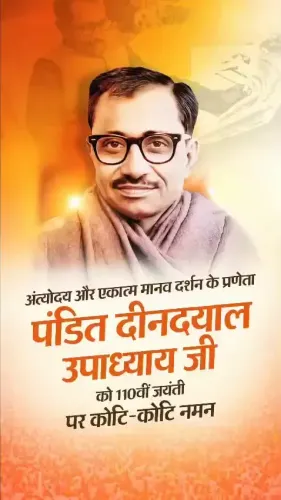
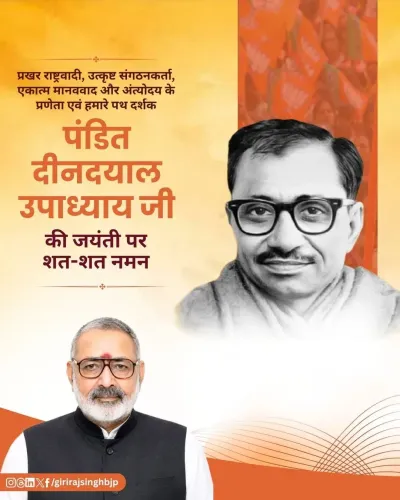
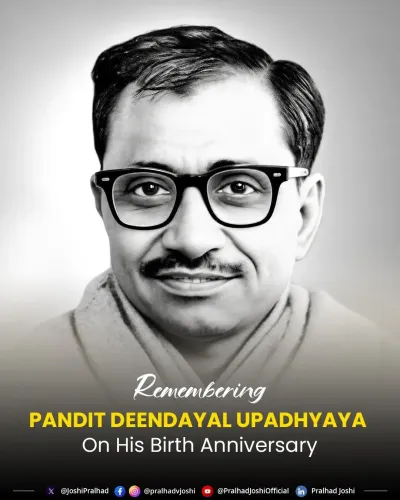
On the anniversary of Pandit Deendayal Upadhyay's birth, Union Textiles Minister Giriraj Singh drew a direct line between a 1960s ideological vision and what he called the sweeping transformation of millions of poor Indian families today — framing contemporary welfare outcomes as the living proof of a decades-old promise.
Writing in Hindi on Friday, 25 September 2026, Singh posted: 'Pandit Deendayal Upadhyay ji ka sapna tha ki samaj ki antim pankti mein khade vyakti ka jeevan badle' — 'Pandit Deendayal Upadhyay's dream was that the life of the person standing in the last row of society should change, and that they should be connected to the mainstream of development. Today, crores of poor families coming out of poverty is proof of the great transformation that has taken place in the direction of realising his Antyodaya resolve. Under the leadership of honourable Prime Minister Shri Narendra Modi, the work of bringing Deendayal ji's idea of Antyodaya to the ground through public welfare policies is continuously moving forward.'
The Antyodaya idea: from Jan Sangh manifesto to national policy
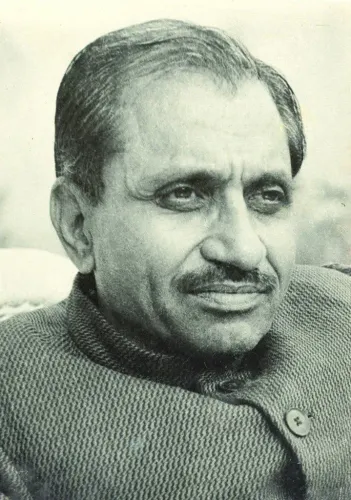
Pandit Deendayal Upadhyay, the ideologue of the Bharatiya Jana Sangh — the political forerunner of the BJP — articulated the concept of Antyodaya in the 1960s as part of his broader 'Integral Humanism' framework. The idea was simple and radical at once: no development agenda is complete unless it reaches the very last person in the social hierarchy. The concept predates independent India's welfare architecture yet has shaped it repeatedly.
Its formal policy footprint is significant. The Antyodaya Anna Yojana was launched in 2000 to deliver heavily subsidised foodgrains specifically to the poorest-of-the-poor households identified by state governments. Fifteen years later, in 2015, the Deendayal Antyodaya Yojana–National Rural Livelihoods Mission was restructured to push self-employment and skill development among rural poor — explicitly naming the ideologue to signal continuity of intent across NDA tenures.
BJP's governing strategy: ideology as a welfare compass
Singh's post is part of a consistent BJP pattern of framing its poverty-reduction measures — from direct benefit transfers to targeted food, housing, and health entitlements — as operationalisation of Upadhyay's Antyodaya philosophy rather than as discrete administrative acts. The rhetorical move does two things simultaneously: it roots present-day governance in a longer ideological lineage, and it distinguishes NDA welfare architecture from what the party presents as earlier governments' more fragmented approaches.
Prime Minister Narendra Modi's name appears explicitly in Singh's post as the force driving this translation 'from thought to ground.' That framing — crediting leadership while evoking founding ideology — is a recurring structure in senior BJP ministerial communication, particularly on occasions that mark Upadhyay's birth or death anniversaries.
What the numbers debate will hinge on
Singh's claim that 'crores of poor families' have exited poverty points toward data that remains contested in public discourse. NITI Aayog's Multidimensional Poverty Index reports have shown measurable declines in poverty headcounts across multiple dimensions — health, education, living standards — in recent years. However, the specific figure and its precise attribution to any single suite of policies are subjects of ongoing methodological debate among economists and policymakers. Any parliamentary budget discussion in the coming session is likely to revisit these numbers directly.
For now, what Singh has done is stake a clear ideological marker: seventy-plus years after Upadhyay first sketched 'the last man,' the BJP insists it holds the clearest map to reach him.
Point of View
The party simultaneously claims a founding moral purpose and measures its own governance against a high standard. The reference to 'crores' exiting poverty points directly at NITI Aayog's Multidimensional Poverty Index methodology, which will face fresh scrutiny in the coming budget session. Over twelve years of NDA government, the Antyodaya idiom has evolved from a philosophical touchstone into the BJP's preferred lens for assessing whether the state has truly reached its most marginalised citizens — making it both a powerful communication tool and an accountability benchmark opponents will press hard.
NationPress
25 Sept 2026
Frequently Asked Questions
Who was Pandit Deendayal Upadhyay and what is Antyodaya?
Pandit Deendayal Upadhyay was the chief ideologue of the Bharatiya Jana Sangh, the predecessor of the BJP, who in the 1960s developed the concept of Antyodaya — meaning the upliftment of the last person in the social hierarchy — as part of his Integral Humanism philosophy.
What is the Antyodaya Anna Yojana?
The Antyodaya Anna Yojana, launched in 2000 , is a central government scheme that provides heavily subsidised foodgrains to households identified as the poorest of the poor, drawing its name directly from Deendayal Upadhyay's Antyodaya concept.
What is the Deendayal Antyodaya Yojana–National Rural Livelihoods Mission?
The Deendayal Antyodaya Yojana–National Rural Livelihoods Mission was restructured in 2015 under the NDA government to promote self-employment, skill development, and livelihood support for rural poor households, explicitly named after the BJP's founding ideologue.
Why does the BJP frequently mention Deendayal Upadhyay in welfare policy statements?
The BJP uses Deendayal Upadhyay's Antyodaya framework as a consistent ideological anchor for its welfare policies, arguing that its governance translates his 1960s vision into practice and distinguishes its approach from earlier governments.
What is NITI Aayog's Multidimensional Poverty Index?
NITI Aayog's Multidimensional Poverty Index measures poverty across multiple dimensions — health, education, and living standards — and has been cited by the government as evidence of significant poverty reduction in recent years, though its methodology and scope remain subjects of expert debate.