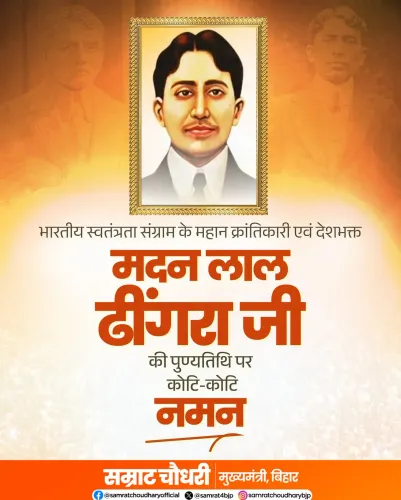
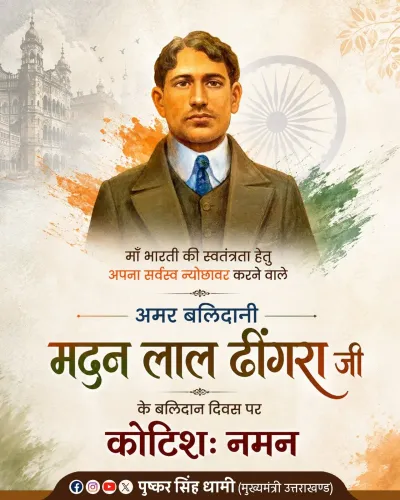
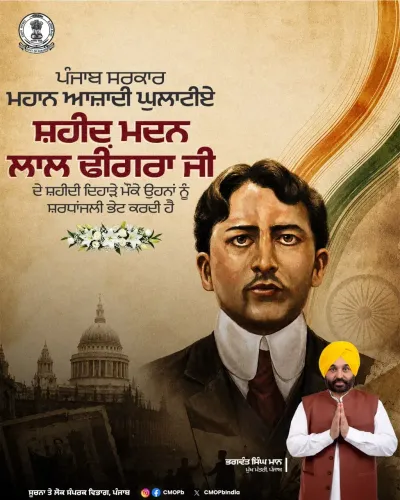
Khattar pays tribute to martyr Madan Lal Dhingra on death anniversary
Synopsis
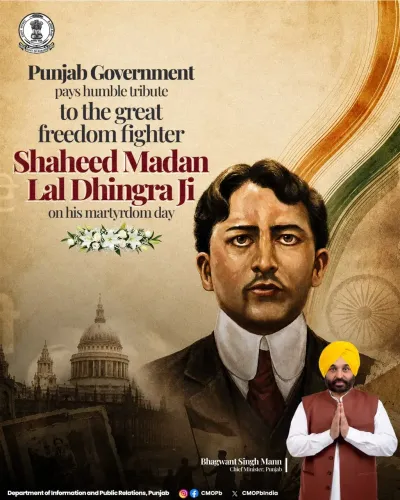
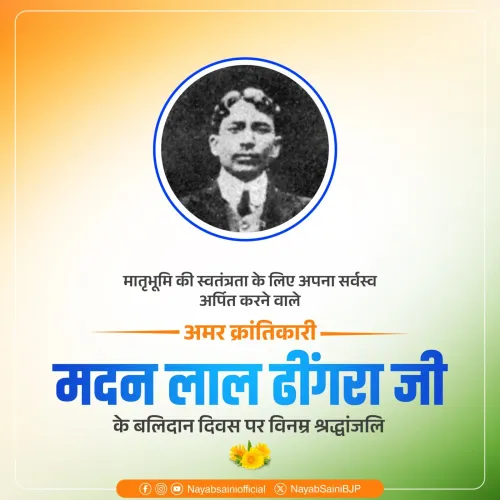
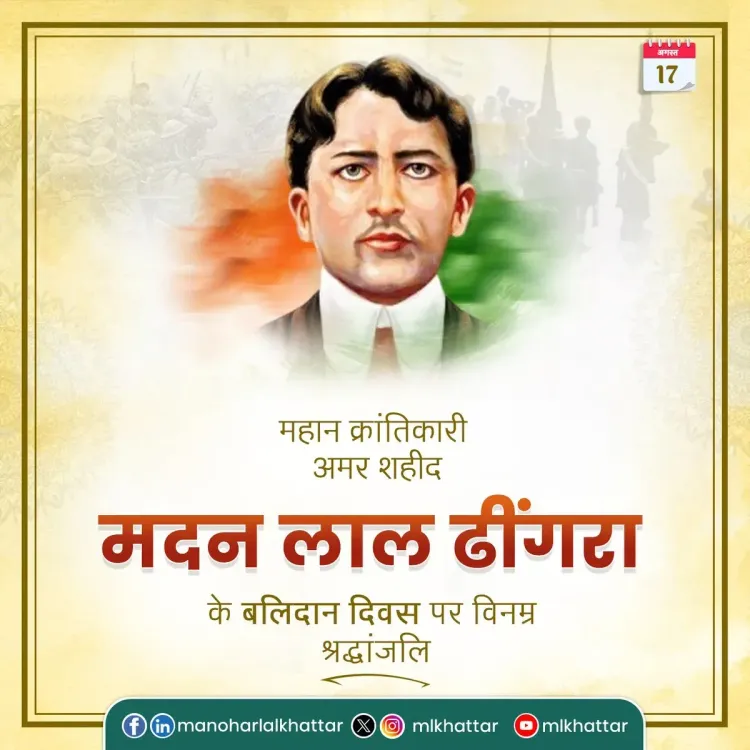
Union Power Minister Manohar Lal Khattar on 17 August 2026 paid tribute to revolutionary martyr Madan Lal Dhingra, executed on this date in 1909 at age 24 for assassinating British official Sir Curzon Wyllie in London, calling his fearlessness an eternal source of national awakening.
Key Takeaways
Madan Lal Dhingra was executed on 17 August 1909 in London at the age of 24 .
Dhingra assassinated Sir Curzon Wyllie on 1 July 1909 at the Imperial Institute, London, in protest against British colonial rule.
Union Power Minister Manohar Lal Khattar paid tribute on the 117th martyrdom anniversary , describing Dhingra's fearlessness as an enduring force for national awakening.
Dhingra was born in 1883 in Amritsar and had travelled to London to study engineering before becoming a revolutionary.
Indian leaders across the political spectrum regularly mark the death anniversaries of pre-independence revolutionaries, keeping the armed-resistance strand of the freedom struggle in public memory.
A young man of 24 who walked to the gallows in London on 17 August 1909 rather than beg for mercy — Union Power Minister Manohar Lal Khattar remembered that defiance on Monday, marking the 117th martyrdom anniversary of revolutionary Madan Lal Dhingra.
Posting in Hindi on 17 August 2026, Khattar wrote: 'अमर शहीद मदन लाल ढींगरा जी के बलिदान दिवस पर उन्हें विनम्र श्रद्धांजलि अर्पित करता हूँ' — 'I humbly pay tribute to immortal martyr Madan Lal Dhingra on his martyrdom day.' He added that Dhingra's fearlessness and revolutionary thought 'will forever serve the cause of national awakening.'
The act that shook the British Empire
Born in 1883 into a prosperous family in Amritsar, Dhingra travelled to London to study engineering — and found himself radicalised by the brutal repression of Indian political voices abroad. On 1 July 1909, at the Imperial Institute in London, he shot and killed Sir Curzon Wyllie, aide-de-camp to the Secretary of State for India, in a calculated act of political protest. He was arrested at the scene, refused to show remorse, and delivered a courtroom statement declaring that every Indian had a duty to drive out the coloniser. He was hanged on 17 August 1909 — at just 24 years old.Why revolutionaries still anchor India's national memory
Dhingra's act sits at the sharper, more contested edge of India's freedom-struggle narrative — one defined by armed resistance rather than constitutional agitation. Indian leaders across the political spectrum periodically invoke such figures on their death anniversaries, reinforcing the idea that the independence movement drew from multiple streams of sacrifice. Khattar's tribute fits that established pattern, framing Dhingra not as a historical curiosity but as an enduring source of 'national awakening' — a phrase with deliberate resonance in contemporary political discourse. The courage of a young man who refused to flinch in a London courtroom more than a century ago still commands the attention of India's highest offices. That, in itself, is a measure of how deep the roots go.Point of View
Bhagat Singh, and Subhas Chandra Bose receive heightened official attention in this political moment. The language of 'national awakening' carries deliberate contemporary weight, linking pre-independence sacrifice to present-day nationalist discourse. Such tributes also serve a cultural-consolidation function: they position the ruling party as custodians of the full spectrum of anti-colonial struggle. The gesture is ceremonial in form but politically purposeful in framing.
NationPress
17 Aug 2026
Frequently Asked Questions
Who was Madan Lal Dhingra?
Madan Lal Dhingra was an Indian revolutionary born in 1883 in Amritsar who assassinated British official Sir Curzon Wyllie in London on 1 July 1909. He was executed on 17 August 1909 at the age of 24 and is remembered as one of India's earliest martyrs of the armed independence movement.
Why did Madan Lal Dhingra kill Curzon Wyllie?
Dhingra carried out the assassination as a deliberate act of political protest against British colonial rule over India. In his courtroom statement he declared it the duty of every Indian to resist the coloniser, refusing to express remorse.
When is Madan Lal Dhingra's martyrdom day?
Madan Lal Dhingra's martyrdom day is observed on 17 August , the date he was hanged in London in 1909 .
What did Manohar Lal Khattar say about Madan Lal Dhingra?
Khattar paid humble tribute to Dhingra on his martyrdom anniversary and said his fearlessness and revolutionary ideas 'will forever serve the cause of national awakening.'
Where was Madan Lal Dhingra executed?
Madan Lal Dhingra was executed in London on 17 August 1909, following his trial for the assassination of Sir Curzon Wyllie at the Imperial Institute.