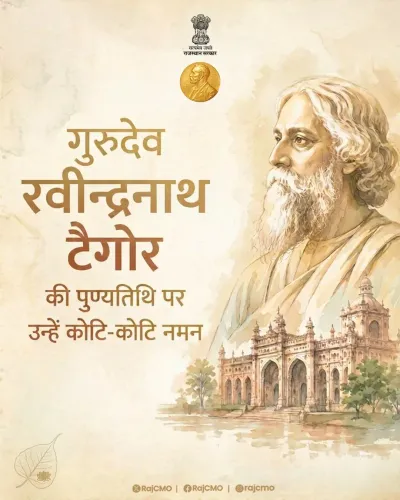
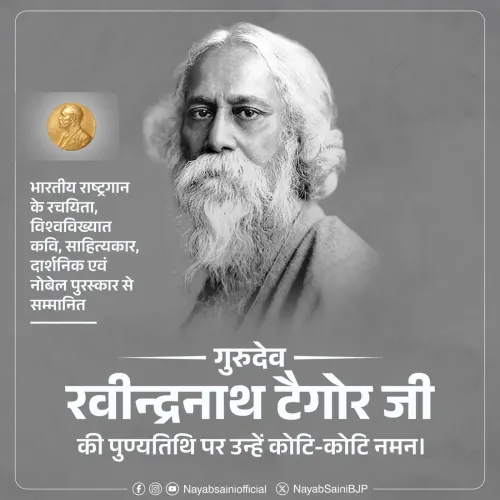
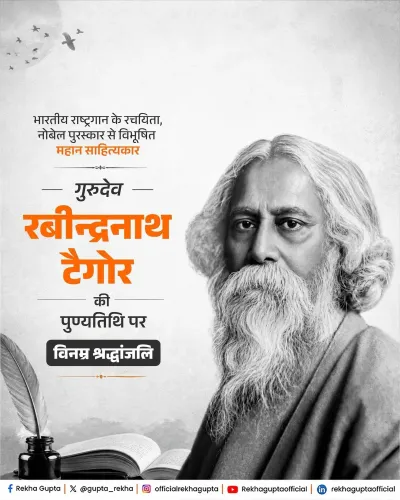
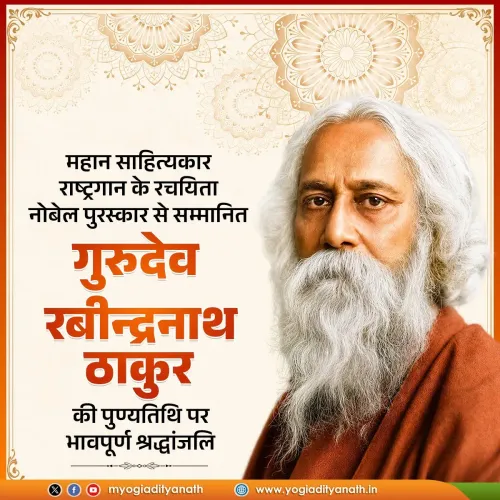
Khattar pays tribute to Tagore on death anniversary

Synopsis
Union Power Minister Manohar Lal Khattar honoured Rabindranath Tagore on his 85th death anniversary, saluting the Nobel laureate's contributions to India's national anthem, education, art, and the idea of Swaraj.
Key Takeaways
Manohar Lal Khattar posted a Hindi tribute to Rabindranath Tagore on 7 August 2026 , the poet's death anniversary.
Tagore composed 'Jana Gana Mana' in 1911 ; it was adopted as India's national anthem on 24 January 1950 .
Tagore was awarded the Nobel Prize in Literature in 1913 , the first non-European to receive the honour.
He founded Visva-Bharati University in Santiniketan, embodying his philosophy of nature-rooted, humanist education.
Khattar described Tagore as the 'pioneer of India's cultural renaissance' and credited him with shaping ideas of education, art, and Swaraj.
On the 85th death anniversary of Rabindranath Tagore, Union Power Minister Manohar Lal Khattar offered a solemn tribute on 7 August 2026 to the Nobel laureate whose pen gave India its national anthem and whose vision reshaped the nation's conscience.
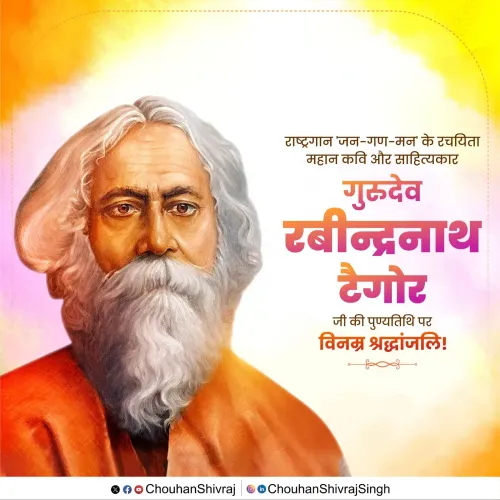
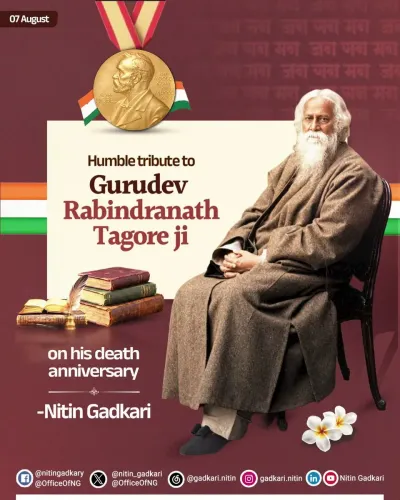
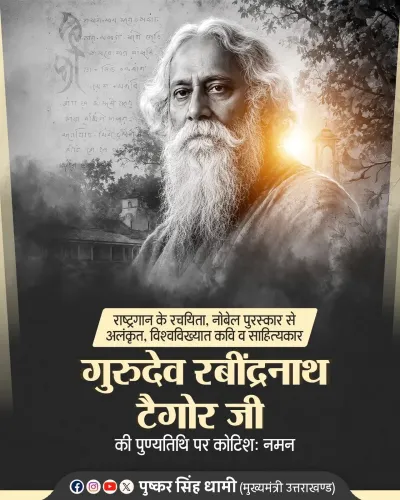
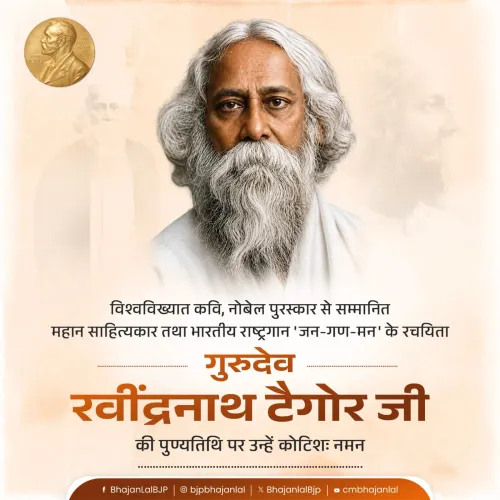
Khattar's tribute, posted in Hindi, described Tagore as 'bharat ke sanskritik punarjagaran ke agradoot' — 'the pioneer of India's cultural renaissance' — and saluted him as a great philosopher, litterateur, and Nobel Prize winner. He noted that Tagore not only composed the sacred national anthem 'Jana Gana Mana' but also gave new direction to the ideas of education, art, and Swaraj (self-rule).
The man who wrote India's anthem
Tagore composed 'Jana Gana Mana' in 1911, and the Constituent Assembly formally adopted it as India's national anthem on 24 January 1950 — weeks before the Republic was proclaimed. That a single poet's words became the ceremonial heartbeat of a newly independent nation speaks to the extraordinary reach of his imagination.
Beyond the anthem, Tagore's founding of Visva-Bharati University in Santiniketan embodied his conviction that education must be rooted in nature, culture, and humanism — a philosophy that still animates debates about pedagogy in India today. His Nobel Prize in Literature, awarded in 1913, made him the first non-European to receive the honour, placing India's literary tradition on the world map.
A ritual of remembrance across the political spectrum
Leaders across party lines mark 7 August — the date Tagore died in 1941 — with public tributes, reflecting a broad political consensus on his place in the national imagination. Khattar's post fits within that tradition, invoking Tagore's timeless writings and 'nation-awakening thoughts' as a continuing source of atmabodh (self-awareness), rashtrabodh (national consciousness), and human values.
Cultural institutions, particularly Visva-Bharati University in West Bengal, typically hold commemorations on this anniversary — keeping alive the connection between Tagore's living legacy and the institutions he built.
Point of View
Blending cultural nationalism with constitutional pride. For the BJP, invoking Tagore — composer of the national anthem and champion of Swaraj — serves a dual purpose: affirming patriotic continuity and broadening the party's cultural canvas beyond its core ideological touchstones. The reference to 'Jana Gana Mana' is particularly pointed, anchoring a literary tribute in the most visible symbol of national unity. Such commemorations also signal the state's ongoing investment in pre-independence intellectual figures as sources of soft-power legitimacy.
NationPress
7 Aug 2026
Frequently Asked Questions
When did Rabindranath Tagore die?
Rabindranath Tagore died on 7 August 1941 . His death anniversary is observed annually across India with cultural programmes and official tributes.
Who composed India's national anthem Jana Gana Mana?
Rabindranath Tagore composed 'Jana Gana Mana' in 1911 . The Constituent Assembly formally adopted it as India's national anthem on 24 January 1950 .
When did Rabindranath Tagore win the Nobel Prize?
Tagore was awarded the Nobel Prize in Literature in 1913 , making him the first non-European to receive the honour, primarily for his collection 'Gitanjali'.
What is Visva-Bharati University and who founded it?
Visva-Bharati University in Santiniketan, West Bengal, was founded by Rabindranath Tagore . It embodies his philosophy of humanist, nature-rooted education and remains a central institution in his legacy.
What did Manohar Lal Khattar say about Tagore?
Khattar described Tagore as the 'pioneer of India's cultural renaissance' and said his timeless writings continue to inspire self-awareness, national consciousness, and human values.