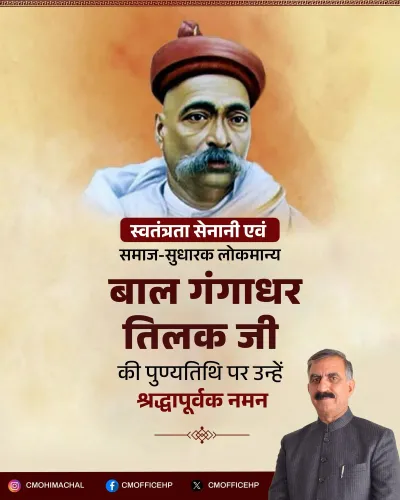
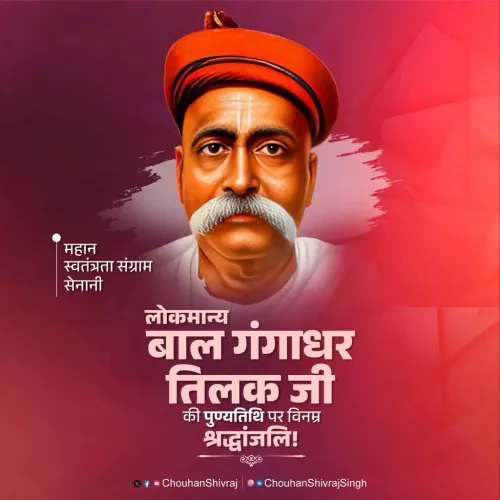
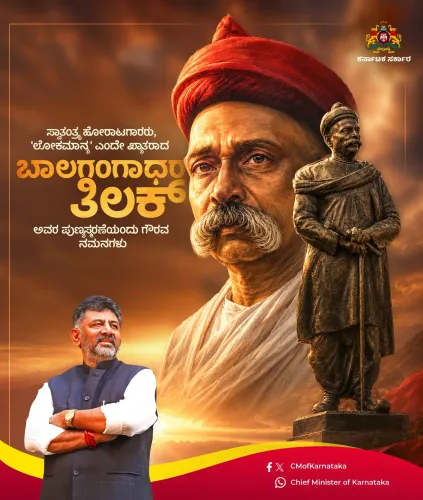
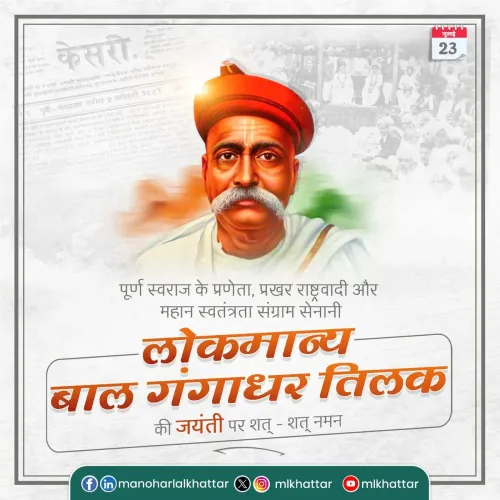
Khattar pays tribute to Bal Gangadhar Tilak on punyatithi
Synopsis
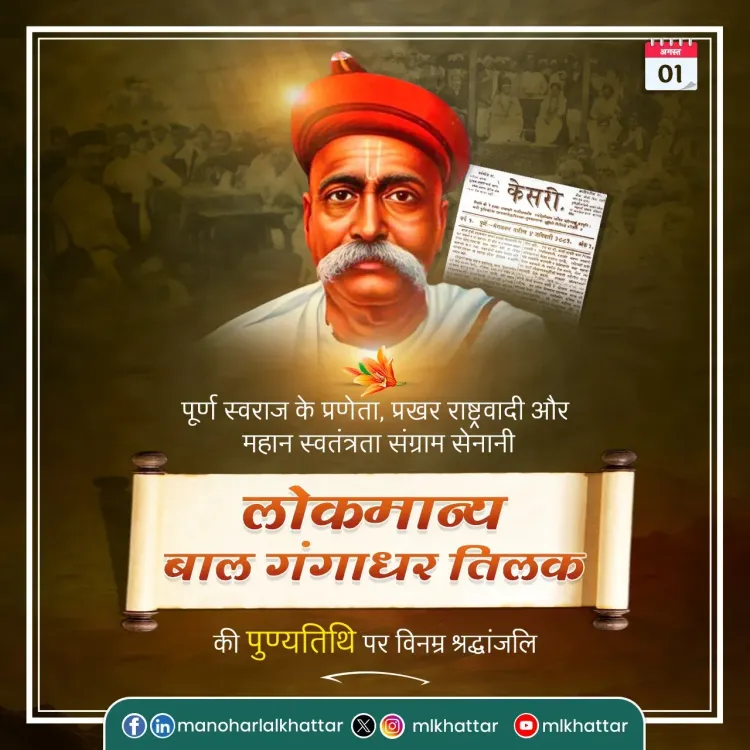
Union Power Minister Manohar Lal Khattar on 1 August 2026 paid tribute to Lokmanya Bal Gangadhar Tilak on his death anniversary, honouring the nationalist leader's legacy of Swaraj, swabhasha, and swasanskriti.
Key Takeaways
Union Power Minister Manohar Lal Khattar paid tribute to Bal Gangadhar Tilak on his punyatithi , 1 August 2026 .
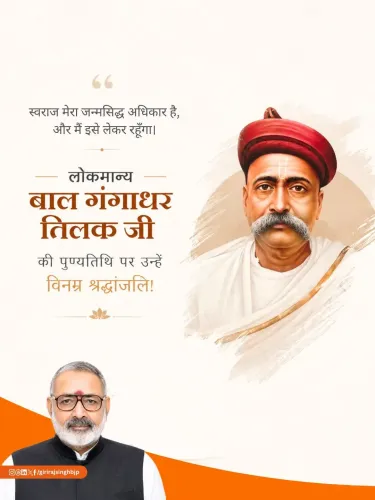
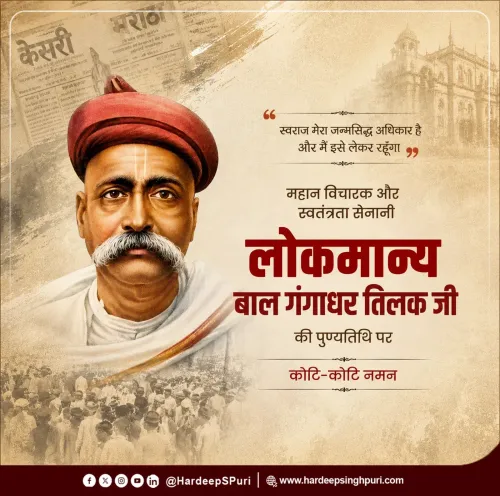
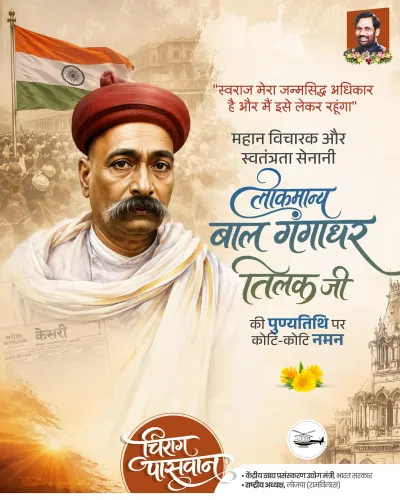
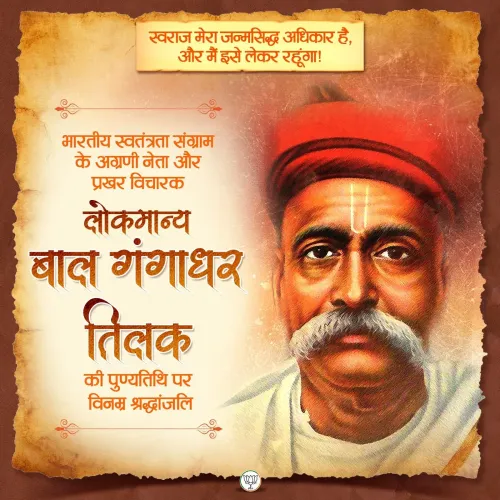
Khattar quoted Tilak's iconic declaration: 'Swaraj is my birthright and I shall have it.' He described Tilak as a 'fervent nationalist thinker, eloquent orator, and great freedom fighter.' Tilak, known as Lokmanya , died on 1 August 1920 and is credited with mass-mobilising India's early independence movement.
Khattar highlighted Tilak's commitment to swadesh , swabhasha , and swasanskriti as an enduring inspiration.
A declaration that shook an empire still echoes — 'Swaraj mera janmasiddh adhikar hai aur main ise lekar rahunga' ('Swaraj is my birthright and I shall have it'). On the death anniversary of Bal Gangadhar Tilak, Union Power Minister Manohar Lal Khattar on Saturday, 1 August 2026 paid homage to the firebrand nationalist who turned a slogan into a movement.
Khattar described Tilak as a 'fervent nationalist thinker, eloquent orator, and great freedom fighter' whose immortal proclamation of Purna Swaraj (complete self-rule) wove the entire nation into a single thread of purpose. He offered his tribute on Tilak's punyatithi, noting that Tilak devoted every moment of his life to the honour of swadesh (one's own nation), swabhasha (one's own language), and swasanskriti (one's own culture).
The man behind the battle cry
Bal Gangadhar Tilak, born on 23 July 1856 in Ratnagiri, Maharashtra, was among the earliest and most uncompromising voices for Indian self-rule. Known by the honorific Lokmanya — 'accepted by the people' — he built mass political consciousness at a time when the independence movement was still finding its footing. His insistence on swadeshi, cultural pride, and the Ganesh Utsav as a vehicle for public mobilisation made him a pioneer of grassroots nationalism long before such methods became standard. His death on 1 August 1920 marked the close of an era — but his slogan outlived him by a century and counting.A tribute in a recurring national ritual
Every 1 August, political leaders across the spectrum pause to remember Tilak, making the anniversary a quiet but consistent fixture on India's commemorative calendar. Khattar's tribute fits within that tradition while underscoring themes — cultural assertion, linguistic pride, the pre-Gandhian roots of the freedom struggle — that resonate strongly within the BJP's broader ideological framing of Indian nationalism. Tilak's philosophy, Khattar wrote, 'will continue to inspire us always.'Point of View
Culturally assertive nationalists — figures whose emphasis on swadeshi, language, and civilisational pride aligns with the party's ideological grammar. Tilak's anniversary is one of the few dates that draws cross-party homage, giving such tributes a veneer of consensus while allowing each party to inflect the legacy differently. For the BJP, Tilak's stress on swasanskriti and swabhasha is particularly resonant with current cultural-policy priorities. The ritual consistency of these tributes also signals how India's political class uses historical memory as a living resource, not merely an archival one.
NationPress
15 Sept 2026
Frequently Asked Questions
Why is 1 August observed as Bal Gangadhar Tilak's punyatithi?
Bal Gangadhar Tilak died on 1 August 1920, and the day is observed annually as his punyatithi (death anniversary) across India.
What is the meaning of 'Swaraj is my birthright and I shall have it'?
The slogan, coined by Tilak, asserted that self-rule (Swaraj) was not a privilege to be granted by colonial rulers but an inherent right of every Indian — it became a rallying cry of the independence movement.
Who is Lokmanya Bal Gangadhar Tilak?
Lokmanya Bal Gangadhar Tilak was a Maharashtra-born nationalist leader, orator, and freedom fighter born in 1856, widely regarded as one of the fathers of Indian unrest against British rule.
What did Manohar Lal Khattar say about Bal Gangadhar Tilak?
Khattar called Tilak a fervent nationalist thinker, eloquent orator, and great freedom fighter who devoted his life to swadesh, swabhasha, and swasanskriti, and said Tilak's life philosophy would continue to inspire the nation.
What does 'Lokmanya' mean?
'Lokmanya' is an honorific in Marathi and Sanskrit meaning 'accepted by the people' or 'respected by the masses,' a title conferred on Tilak in recognition of his popular standing.