Kishan Reddy Attacks Rahul Gandhi Over UPA's LWE Record
Synopsis
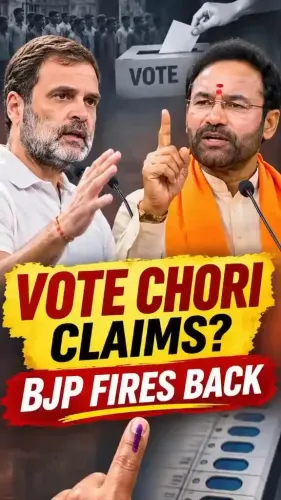
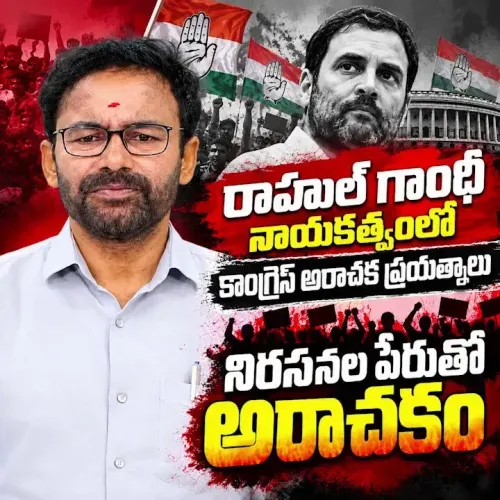
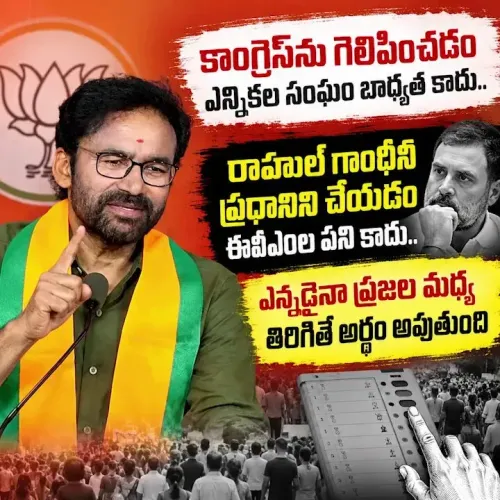
Union Minister G. Kishan Reddy publicly attacked Rahul Gandhi on November 9, accusing the Congress-led UPA government of endorsing Left Wing Extremism violence during 2004–2014 and describing Rahul as a 'two-rupee troll' in a pointed political exchange.
Key Takeaways
Union Coal and Mines Minister G.
Kishan Reddy posted a sharp attack on Rahul Gandhi on 9 November 2026 .
Reddy alleged that Congress and its Ministers (2004–2014) 'supported and endorsed' Left Wing Extremism rather than combating it.
He invoked Sonia Gandhi's role, calling her the 'Super PM' during the UPA decade, as the locus of accountability.
The UPA did launch Operation Green Hunt in 2009 , a coordinated anti-Naxal offensive — a fact the BJP framing does not typically foreground.
Reddy tagged PM Narendra Modi and senior BJP leaders, signalling the post is part of a coordinated political messaging effort.
The Congress had not publicly responded to the post at the time of publication.
A sharp political exchange over India's decades-long battle against Left Wing Extremism landed on Monday evening when Union Coal and Mines Minister G. Kishan Reddy turned his fire directly on Congress leader Rahul Gandhi, accusing the opposition of enabling Maoist violence during the UPA era (2004–2014) rather than confronting it.
The Charge: 'Supported and Endorsed' LWE Violence
Reddy's post pulled no punches. 'Congress and its Ministers in that era supported and endorsed the violence unleashed by Left Wing Extremism instead of finding a way to put an end to this menace,' he wrote, tagging Prime Minister Narendra Modi and senior BJP functionaries. The language — 'two-rupee troll', 'gross negligence' — signals that this is a retaliation post, though the specific remark by Rahul Gandhi that triggered the response is not on public record from the available information.
The core accusation is a familiar BJP line: that the Sonia Gandhi-led UPA government, which critics and opponents frequently characterise as operating under a 'Super PM' arrangement, failed to mount a credible security response in Naxal-affected states for a full decade. It is a charge the Congress has consistently denied.
What the UPA Record Actually Shows
The historical picture is more layered than either side typically acknowledges. The UPA government did launch Operation Green Hunt in 2009 — a coordinated, multi-state anti-Naxal offensive involving central paramilitary forces — representing one of the most aggressive security pushes against Maoist insurgents in India's post-independence history. Critics, however, argued the operation was too slow in coming and was undercut by simultaneous political conversations that some read as softening the state's posture.
Left Wing Extremism has been one of India's most persistent internal security challenges, with violence concentrated in central and eastern districts sometimes called the 'Red Corridor.' Both major parties have alternated in power and both have faced questions about the balance between security operations and development-driven solutions in LWE-affected regions.
BJP's Post-2014 Security Narrative
Kishan Reddy, as Telangana BJP president as well as a Union Minister, occupies a strategically significant position — Telangana borders LWE-sensitive districts in neighbouring states. For the BJP, contrasting its post-2014 approach — which the party credits with sharply reducing LWE incidents and surrenders — against the UPA's decade is a well-worn but electorally effective argument, particularly in states where security concerns remain salient.
The Congress has not yet responded publicly to this specific post, as of the time of publication.
India's LWE policy debate is not settling anytime soon — with parliamentary committees and state governments still parsing incident data and surrender figures, the argument over who kept the Red Corridor burning and who began to douse it will continue to shape internal-security politics for years to come.
Point of View
' Reddy shifts accountability upward within the Congress hierarchy, making Rahul Gandhi's criticism of the current government appear hypocritical by inheritance. The invocation of LWE is tactically sharp in Telangana, where the BJP is working to consolidate its base ahead of future electoral cycles. What is notably absent from the post — and from most such exchanges — is any engagement with the operational record of either era, suggesting this is political positioning rather than a genuine policy debate.
NationPress
9 Nov 2026
Frequently Asked Questions
What did Kishan Reddy say about Rahul Gandhi on November 9 2026?
Kishan Reddy accused Rahul Gandhi of behaving like a 'two-rupee troll' and alleged that Congress and its Ministers during the UPA era (2004–2014) supported and endorsed Left Wing Extremism violence instead of combating it.
What is Left Wing Extremism in India?
Left Wing Extremism refers to the Maoist or Naxalite insurgency active in central and eastern India. It has caused significant violence over decades and affected populations in what is often called the 'Red Corridor' of states.
What did the UPA government do about Naxalism?
The UPA government launched Operation Green Hunt in 2009, a major coordinated security offensive involving central paramilitary forces across multiple LWE-affected states, though critics argued the response was delayed and inconsistent.
Why does the BJP blame Congress for Left Wing Extremism?
The BJP routinely argues that the Congress-led UPA (2004–2014) was slow to mount a decisive security response and that some ministers were seen as politically accommodating toward Maoist groups, in contrast to the BJP's post-2014 approach which it credits with reducing LWE incidents.
Who is Kishan Reddy?
G. Kishan Reddy is India's Union Minister of Coal and Mines and the BJP's Telangana state president. He is a senior BJP leader and has been vocal on security and development issues affecting southern and central India.