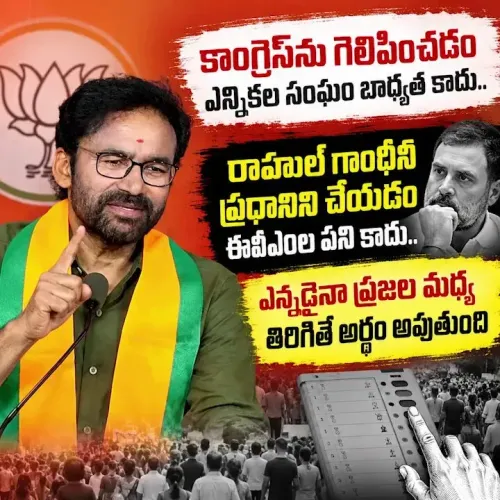
Kishan Reddy Backs Election Commission, Slams Opposition Double Standards
Synopsis
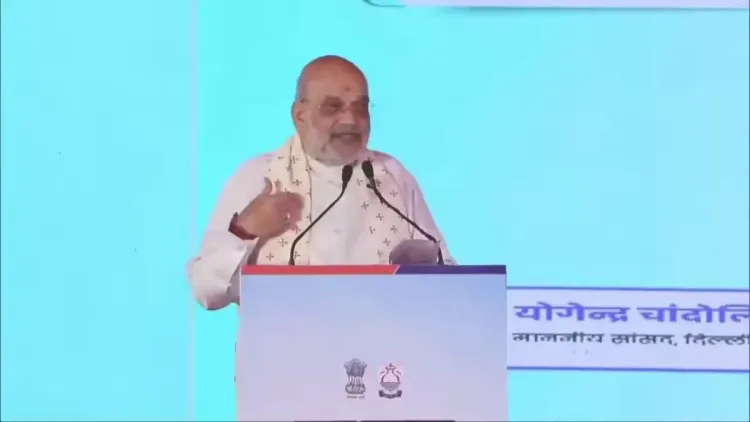
Union Minister G. Kishan Reddy amplified a statement by Home Minister Amit Shah accusing the opposition of applying double standards to the Election Commission — praising it on winning and blaming it on losing — while asserting BJP's 'Nation First' commitment will sustain public mandates for decades.
Key Takeaways
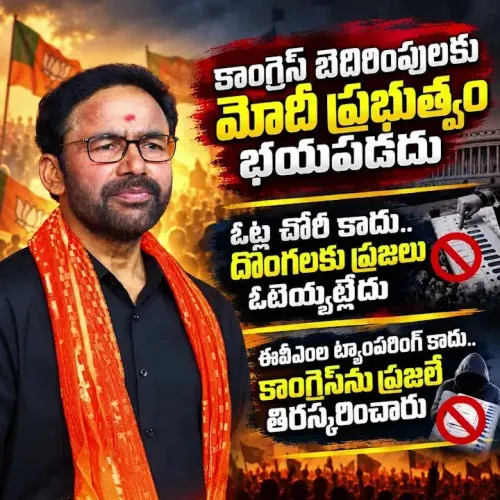
Kishan Reddy shared a statement from Union Home Minister Amit Shah on October 22, 2026 defending the Election Commission of India .
Shah accused the opposition of 'negative politics' and raising questions about institutions only when convenient — praising the EC on winning and condemning it on losing.
The Election Commission of India is a constitutional body established under Article 324 , overseeing elections since 1951-52 .
Shah invoked the BJP's Rashtra Pratham ('Nation First') principle as the reason popular mandates will continue 'for the coming decades.' Kishan Reddy serves as both Union Minister of Coal and Mines and BJP Telangana state president , giving the amplification both national and regional political weight.
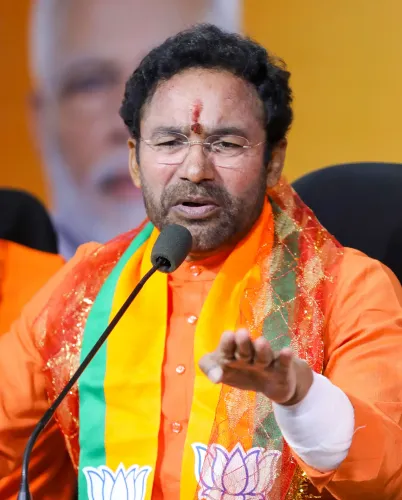
The credibility of India's constitutional election machinery is once again at the centre of political debate — and Union Coal and Mines Minister G. Kishan Reddy has drawn a sharp line in the sand. Sharing a statement from Union Home Minister Amit Shah on Thursday, October 22, 2026, Reddy amplified a pointed broadside against what the BJP frames as selective institutional criticism by the opposition.
The quoted statement from Amit Shah pulls no punches: 'नकारात्मक राजनीति और सुविधा अनुसार संस्थाओं पर सवाल उठाने से जनता का विश्वास नहीं जीता जा सकता' — 'Negative politics and raising questions on institutions at one's own convenience cannot win the trust of the people.' The message is directed squarely at parties that, in the BJP's telling, praise the Election Commission of India when they win and vilify it when they lose.
The Double-Standard Charge Against Opposition Parties
Shah's statement captures a charge the BJP has levelled repeatedly: that the opposition applies a blatant double standard to constitutional bodies. 'Calling the Election Commission correct on winning and wrong on losing — the people of this country understand this double standard very well,' the statement reads. It is a combative framing, but one rooted in a recurring pattern visible across multiple election cycles.
The Election Commission of India, established under Article 324 of the Constitution and backed by the Representation of the People Act, has superintended India's elections since the first general election in 1951-52. Its independence is a bedrock constitutional guarantee — yet it has periodically found itself caught in the crossfire of post-election political contestation, with losing sides questioning everything from Electronic Voting Machine integrity to the timing of model code enforcement.
Shah's 'Nation First' Declaration and the Decades-Long Mandate Claim
The statement closes with an unmistakable assertion of long-term political dominance: Shah argues that the BJP's 'unbreakable dedication' to 'Rashtra Pratham' — 'Nation First' — and public service will sustain the current wave of popular mandates for 'the coming decades.' It is both a victory lap and a forward-looking political manifesto compressed into a single sentence.
By sharing this statement, Kishan Reddy — who leads the BJP's Telangana state unit in addition to his Union ministerial role — signals alignment between the party's national leadership and its state-level messaging. In a state where the BJP remains in a competitive battle for political space, amplifying a 'Nation First' narrative serves a dual purpose: national solidarity and local electoral positioning.
The people, Shah's statement concludes, already see through the convenience-driven critique. Whether the opposition responds in kind or lets the charge stand unanswered will tell us much about where the next political battleground forms.
Point of View
The party ensures the narrative penetrates both national and regional media cycles. The 'decades-long mandate' claim is the more consequential line: it is an assertion of political hegemony dressed in the language of public service, and it will be tested by whichever electoral contest arrives next.
NationPress
22 Oct 2026
Frequently Asked Questions
What did Amit Shah say about the Election Commission?
Amit Shah stated that the opposition cannot win public trust through 'negative politics' and selective criticism of institutions. He specifically called out the double standard of praising the Election Commission when winning elections and blaming it when losing.
Why did G. Kishan Reddy share Amit Shah's statement?
G. Kishan Reddy, who is both Union Minister of Coal and Mines and BJP's Telangana state president, shared the statement to amplify BJP's national messaging on institutional credibility and the 'Nation First' political narrative.
What is the Election Commission of India and why is it being discussed?
The Election Commission of India is a constitutional body established under Article 324, responsible for overseeing free and fair elections since 1951-52. It periodically becomes a flashpoint when losing parties allege electoral irregularities or institutional bias.
What does 'Rashtra Pratham' or 'Nation First' mean in BJP's political context?
'Rashtra Pratham' means 'Nation First' in Hindi and is a core ideological slogan of the BJP, used to contrast the party's claimed public-service orientation with what it characterises as opposition self-interest.
What is G. Kishan Reddy's political role?
G. Kishan Reddy serves as Union Minister of Coal and Mines in the central government and also heads the BJP as its Telangana state president, making him a key figure bridging national policy and state-level party politics.