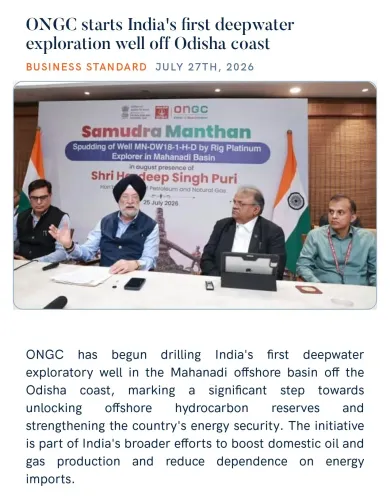
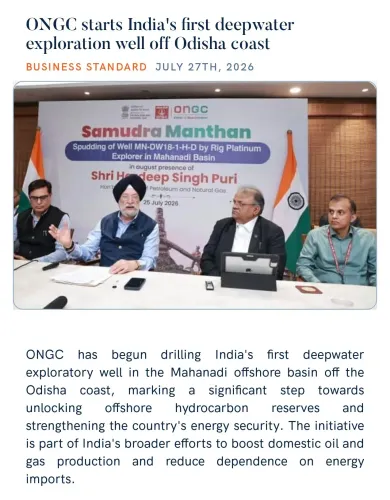
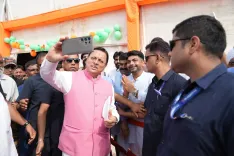
Kishan Reddy: Cabinet Clears ₹84,084 Cr Samudra Manthan Scheme

Synopsis
The Union Cabinet has approved 'Samudra Manthan', a ₹84,084 crore National Offshore Exploration Scheme aimed at unlocking over 600 MMTOE of hydrocarbon reserves, boosting domestic energy production, and building an indigenous offshore industry ecosystem under Aatmanirbhar Bharat.
Key Takeaways
The Union Cabinet , chaired by PM Narendra Modi , approved the Samudra Manthan scheme on July 31, 2026 .
The scheme carries an outlay of ₹84,084 crore , making it one of the largest dedicated offshore energy investments.
It targets unlocking over 600 Million Metric Tons of Oil Equivalent (MMTOE) of hydrocarbon reserves.
The scheme is explicitly linked to Make in India and Aatmanirbhar Bharat goals for indigenous manufacturing and technology.
It builds on the Hydrocarbon Exploration and Licensing Policy (HELP) framework introduced in 2016 .
Kishan Reddy announced the Cabinet decision, positioning it as a step toward Viksit Bharat .
India's offshore energy ambitions just got a ₹84,084 crore engine. Union Coal and Mines Minister G. Kishan Reddy announced on Friday, July 31, 2026 that the Union Cabinet, chaired by Prime Minister Narendra Modi, has approved 'Samudra Manthan' — the National Offshore Exploration Scheme — a landmark push to unlock hydrocarbon reserves buried beneath Indian waters.
What 'Samudra Manthan' Sets Out to Do
Named after the mythological churning of the ocean, the scheme is designed to do exactly that — churn the seabed for energy wealth. The government targets unlocking over 600 Million Metric Tons of Oil Equivalent (MMTOE) of hydrocarbon reserves, a figure that would represent a substantial accretion to India's domestic resource base. The scheme is built around accelerating offshore oil and gas exploration, strengthening domestic production, and building a globally competitive offshore ecosystem.
The ₹84,084 crore outlay is not just for drilling. It is explicitly tied to promoting advanced exploration technologies and generating large-scale investment and employment opportunities — with a direct linkage to Make in India and Aatmanirbhar Bharat goals for indigenous manufacturing.
A Policy Lineage Built on Decades of Reform
India's offshore energy push has a long runway. The Hydrocarbon Exploration and Licensing Policy (HELP), launched in 2016, replaced the older New Exploration Licensing Policy (NELP) and introduced a uniform licensing regime for oil and gas blocks — a structural shift designed to attract private and foreign capital into a sector long dominated by state players. Samudra Manthan extends that arc with a dedicated, high-outlay scheme focused specifically on the offshore frontier.
India's import dependence on crude oil remains a persistent pressure on the current account. Every barrel produced domestically is a rupee saved. A scheme of this scale signals that the government views offshore exploration not as a niche technical exercise, but as a core pillar of energy security strategy.
Investment, Jobs, and the Offshore Ecosystem Play
Beyond reserves, the scheme targets the creation of an entire offshore industry ecosystem — from advanced seismic survey capabilities to deep-water drilling infrastructure and supply-chain manufacturing. Offshore energy firms and domestic manufacturers are the immediate stakeholders, but the ripple effects — skilled employment, port-linked industrial activity, technology transfer — are the longer game the government is signalling.
The next concrete milestone to watch: the launch of new offshore bidding rounds under the scheme, and whether reserve accretion toward the 600 MMTOE target begins to show in annual upstream production data. The name 'Samudra Manthan' promises treasure from the deep. The drilling will determine whether the metaphor holds.
Point of View
Signalling a deliberate escalation beyond the licensing-reform approach of HELP 2016. Framing the scheme under Aatmanirbhar Bharat is politically significant — it positions energy self-reliance not merely as an economic goal but as a sovereignty argument, insulating the policy from opposition critique. The 600 MMTOE target is ambitious; its credibility will rest entirely on how quickly offshore bidding rounds are launched and whether private and foreign capital actually flows in. For Minister Kishan Reddy, championing a scheme of this scale strengthens his portfolio's national visibility ahead of what promises to be a contested political cycle in Telangana.
NationPress
31 Jul 2026
Frequently Asked Questions
What is the Samudra Manthan scheme approved by the Cabinet?
'Samudra Manthan' is the National Offshore Exploration Scheme approved by the Union Cabinet with an outlay of ₹84,084 crore. It aims to accelerate offshore oil and gas exploration, unlock over 600 MMTOE of hydrocarbon reserves, and build a globally competitive offshore energy ecosystem linked to Make in India goals.
How much money has the government allocated for Samudra Manthan?
The Union Cabinet has approved an outlay of ₹84,084 crore for the Samudra Manthan — National Offshore Exploration Scheme.
What is the 600 MMTOE target in the Samudra Manthan scheme?
The scheme is expected to unlock over 600 Million Metric Tons of Oil Equivalent (MMTOE) of hydrocarbon reserves from India's offshore basins, significantly boosting domestic energy production and reducing import dependence.
Who announced the Samudra Manthan Cabinet approval?
Union Coal and Mines Minister G. Kishan Reddy announced the Cabinet approval of Samudra Manthan. The Cabinet meeting was chaired by Prime Minister Narendra Modi.
How does Samudra Manthan relate to India's earlier oil and gas policies?
Samudra Manthan builds on the Hydrocarbon Exploration and Licensing Policy (HELP) introduced in 2016, which replaced the older NELP framework. The new scheme extends the reform arc with a dedicated, large-scale outlay focused specifically on offshore exploration and indigenous manufacturing.