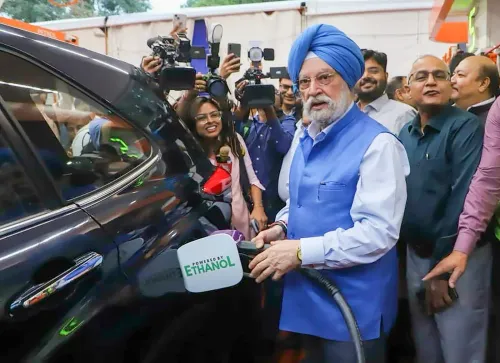
Kishan Reddy defends E-20 rollout, cites ahead-of-schedule 20% ethanol blend

Synopsis
Union Minister G. Kishan Reddy defended India's E-20 ethanol-blending programme on 30 July 2026, detailing its three-phase rollout from 2023 to 2026 and asserting the 20% blending target was achieved ahead of schedule, delivering forex savings, farmer income gains, and lower carbon emissions.
Key Takeaways
Union Coal and Mines Minister G.
Kishan Reddy posted on 30 July 2026 defending the E-20 ethanol-blending programme against critics.
The rollout followed three phases: E-20 material compatibility from April 2023, engine compatibility from April 2025, and a minimum RON 95 quality standard from 2026.
Reddy claims India achieved the 20% ethanol blending target ahead of the 2025 deadline , itself brought forward from the original 2030 goal set in the National Policy on Biofuels 2018 .
Stated benefits include foreign exchange savings , additional income for sugarcane farmers and ethanol producers , and reduced carbon emissions .
The programme is part of the broader Atmanirbhar Bharat energy-security strategy to reduce crude oil import dependence.
Next policy milestones to watch: Petroleum Ministry blending reports for 2026-27 and potential extension of norms to E-25 or flex-fuel vehicles .
India hit a fuel milestone it once pencilled in for 2025 — and did so on its own terms. Union Coal and Mines Minister G. Kishan Reddy took to X on Thursday, 30 July 2026, to defend the phased rollout of the E-20 ethanol-blending programme, arguing that the facts behind the initiative speak louder than the questions raised against it.
The three-step roadmap Reddy laid out
In his post, Reddy sketched the programme's architecture in precise sequence. From April 2023, all new petrol vehicles were required to be E-20 material compatible — meaning their fuel-system components could withstand a 20% ethanol blend without degradation. From April 2025, the bar rose: new vehicles had to be E-20 engine compatible, capable of running efficiently on the blend. And from 2026, a minimum RON 95 quality standard was mandated for E-20 fuel itself, ensuring the higher-octane blend performs consistently across the fleet.
'सुनियोजित तैयारी के परिणामस्वरूप' ('as a result of systematic preparation'), he wrote, India achieved the 20% ethanol blending target ahead of schedule. The original national deadline, set under the National Policy on Biofuels 2018, was 2030. A 2021 government decision pulled that forward to 2025 — and the minister's post claims the country has already crossed the finish line.
Farmers, forex, and falling emissions
Reddy listed three concrete dividends from the programme: a notable saving in foreign exchange by displacing crude oil imports, fresh economic power for sugarcane farmers and ethanol producers, and a measurable reduction in carbon emissions from the transport sector. Each of these sits squarely within the logic of the programme as designed — ethanol sourced domestically from sugarcane and grain replaces imported petroleum, putting money into rural supply chains while trimming the fuel-import bill and the tailpipe carbon count.
The E-20 drive is part of a wider energy-security push under the Atmanirbhar Bharat framework, which has sought to reduce India's dependence on global crude markets — a vulnerability that bites hardest whenever oil prices spike. Oil marketing companies, vehicle manufacturers, and ethanol producers all had to align their timelines with the government's phased mandates, making the coordination behind the rollout as significant as the blending number itself.
A minister on the defensive — and what comes next
Reddy's framing is telling. He opens by acknowledging that 'बड़े बदलावों पर सवाल उठना स्वाभाविक है' — 'it is natural to raise questions about big changes' — before pivoting to say the answers always lie in the facts. That is the language of a politician responding to criticism, not announcing fresh news. The post functions as a rebuttal, likely aimed at voices questioning whether the vehicle-compatibility mandates were rolled out smoothly or whether the blending claims are accurate.
The next test will be the Petroleum Ministry's blending percentage reports for 2026-27, which will either validate or complicate the ahead-of-schedule claim. Policymakers are also watching whether compatibility norms extend to E-25 or flex-fuel vehicles — the logical next step if the government wants to push the blending frontier further.
For now, Reddy's message is unambiguous: the E-20 programme was built on a plan, executed in stages, and delivered results. The data, he insists, is the only argument that matters.
Point of View
Deploying a structured policy timeline to neutralise criticism of the E-20 rollout — a move that signals the programme has become a BJP governance talking point ahead of any electoral cycle. The ahead-of-schedule framing is significant: it positions the ethanol target alongside other advance-delivery claims the government has made on infrastructure and clean energy, reinforcing a broader 'delivery state' narrative. However, the absence of independently verified blending figures leaves the central claim open to scrutiny, and the Petroleum Ministry's upcoming reports will determine whether the political credit holds. If the numbers stack up, E-20 becomes a template argument for how India can marry energy security, rural income, and climate goals — a trifecta with real policy and electoral weight.
NationPress
30 Jul 2026
Frequently Asked Questions
What is India's E-20 ethanol blending programme?
E-20 is India's programme to blend 20% ethanol with petrol across the country, reducing crude oil imports, cutting carbon emissions, and generating additional income for sugarcane farmers and ethanol producers. It is governed by the National Policy on Biofuels 2018 and a 2021 decision that advanced the target to 2025 from 2030.
Has India achieved 20% ethanol blending?
Union Minister G. Kishan Reddy claimed on 30 July 2026 that India achieved the 20% ethanol blending target ahead of schedule . The claim is yet to be independently confirmed by official Petroleum Ministry blending reports for 2026-27.
What does E-20 material compatible and engine compatible mean for vehicles?
Material compatible (mandated from April 2023 ) means a vehicle's fuel-system parts — seals, hoses, tanks — can withstand a 20% ethanol blend without damage. Engine compatible (mandated from April 2025 ) means the engine is tuned to run efficiently on the blend. From 2026 , E-20 fuel must also meet a minimum RON 95 octane standard .
How does ethanol blending save foreign exchange for India?
Every litre of domestic ethanol blended into petrol displaces an equivalent volume of imported crude oil, reducing India's fuel-import bill. With 20% ethanol in the mix, the country saves significant foreign currency that would otherwise be spent on global crude markets.
What is the next step after E-20 for India's ethanol blending policy?
Policy watchers are tracking whether India will extend compatibility norms to E-25 blends or flex-fuel vehicles , which can run on varying ethanol-petrol ratios. Official Petroleum Ministry reports for 2026-27 will also be closely watched to validate the 20% blending achievement.