Kishan Reddy writes to Telangana CM over SCCL coal missing
Synopsis
Union Coal Minister G. Kishan Reddy has written to Telangana CM Revanth Reddy demanding an urgent probe into media reports alleging 40 lakh tonnes of coal worth ₹1,600 crore have gone missing from SCCL, citing ₹51,500 crore in outstanding dues and the welfare of over 40,000 employees.
Key Takeaways
Kishan Reddy , Union Coal and Mines Minister, wrote to Telangana CM Revanth Reddy on June 13, 2026 seeking an urgent inquiry into alleged coal irregularities at SCCL .
Media reports cited in the letter allege the disappearance of 40 lakh tonnes of coal worth nearly ₹1,600 crore from SCCL .
SCCL is already under financial stress, with over ₹51,500 crore in outstanding dues owed by the Telangana government .
The company employs over 40,000 workers whose welfare the minister cited as a central concern.
SCCL is a joint undertaking of the Government of India and the Government of Telangana , incorporated in 1920 .
The episode follows a broader pattern of Union ministers writing to opposition-governed states on public-sector governance issues.
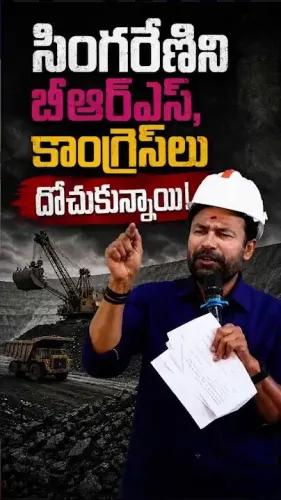
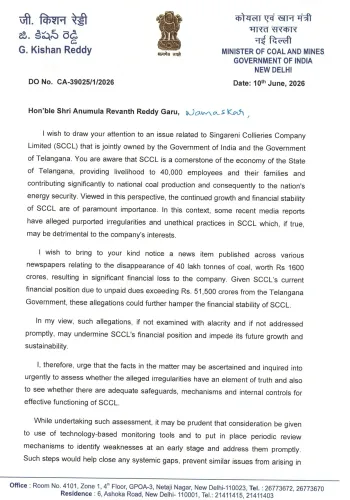
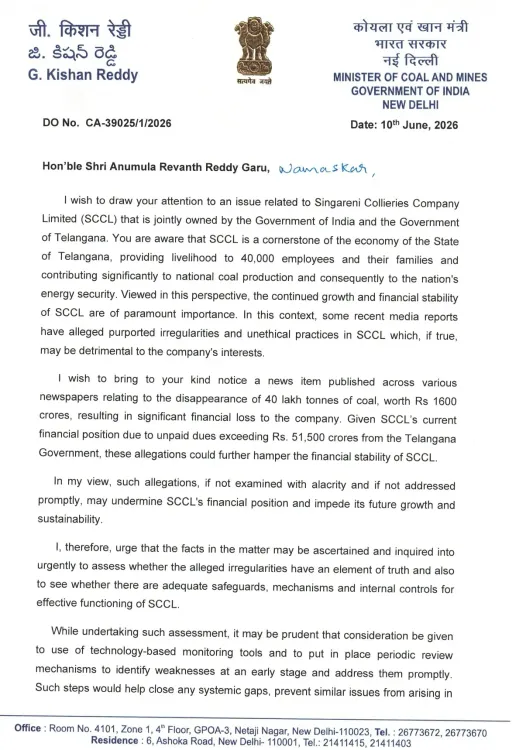
Union Coal and Mines Minister G. Kishan Reddy wrote to Telangana Chief Minister Revanth Reddy on Saturday, June 13, 2026, demanding an urgent inquiry into media reports alleging the disappearance of 40 lakh tonnes of coal worth nearly ₹1,600 crore from the Singareni Collieries Company Limited (SCCL). The minister shared the letter publicly on X, citing the company's existing financial stress and the welfare of its over 40,000 employees.
Context
Kishan Reddy, who also serves as the BJP's Telangana state president, stated in his letter that the reported irregularities warranted a thorough investigation given SCCL's precarious financial position. He pointed to over ₹51,500 crore in outstanding dues owed to the company by the Telangana government as the backdrop against which any stock discrepancy would be especially damaging. The minister called upon Chief Minister Revanth Reddy to ensure a prompt inquiry, strengthen safeguards where necessary, and secure the smooth operation of SCCL and the welfare of its workforce.
In his post, Kishan Reddy wrote: 'The welfare of over 40,000 SCCL employees and their families, as well as the future of this prestigious institution, must remain our collective priority.' The letter frames the issue as one of institutional accountability rather than political confrontation, though it arrives amid a charged Centre-state dynamic in Telangana.
Policy Backdrop
SCCL, incorporated in 1920 under the Nizam's government, is a joint undertaking of the Government of India and the Government of Telangana. Following the 2014 bifurcation of Andhra Pradesh, the company's ownership and coal linkages were allocated to Telangana under the Andhra Pradesh Reorganisation Act, making the state the primary operational and financial stakeholder.
Central government audits and parliamentary questions have periodically flagged outstanding payments owed by state utilities to coal companies, including SCCL. The coal ministry, which Kishan Reddy heads at the Union level, retains oversight responsibilities for the sector even where state governments hold majority equity in specific enterprises. Stock-verification controversies of this nature have also surfaced in coalfields managed by Coal India subsidiaries in other states.
Stakeholders and Impact
The most immediate concern flagged by the minister is the livelihood of SCCL's workforce. The company employs over 40,000 workers directly, and their families' welfare is closely tied to the financial health of the enterprise. Any prolonged irregularity in coal inventory — if confirmed — could affect the company's revenue, its ability to service operational costs, and its long-term viability as a public-sector employer in Telangana.
Beyond the workforce, SCCL is a critical supplier of coal to Telangana's power generation utilities. Disruptions in supply or revenue flows could have downstream effects on the state's electricity sector. The episode also fits a recurring pattern in which Union ministers from the ruling party at the Centre write formally to opposition-governed states on public-sector governance matters, elevating administrative disputes into the political arena.
What's Next
The Telangana government's formal response to Kishan Reddy's letter will be closely watched. A state-ordered inquiry, if announced, would need to address both the alleged stock discrepancy and the broader question of the outstanding ₹51,500 crore in dues. Any findings could also become the subject of scrutiny by the Comptroller and Auditor General of India, which periodically reviews SCCL's accounts.
With Parliament's monsoon session expected in the coming weeks, the matter could be raised on the floor of the House, giving the Union ministry a formal platform to press for accountability. The outcome of this exchange between the Centre and Telangana will signal how disputes over jointly held public-sector coal assets are managed under the current political configuration — and whether institutional safeguards at SCCL are strengthened in time to protect its long-term operations.
Point of View
The minister occupies defensible moral ground while simultaneously keeping the BJP's Telangana opposition narrative alive. The invocation of ₹51,500 crore in outstanding dues alongside the alleged stock discrepancy compounds the reputational burden on the state government. How Revanth Reddy responds — and how quickly — will determine whether this becomes a sustained governance controversy or a one-cycle political flare-up.
NationPress
18 Sept 2026
Frequently Asked Questions
What is the SCCL coal missing controversy about?
Media reports have alleged that 40 lakh tonnes of coal worth nearly ₹1,600 crore have gone missing from the Singareni Collieries Company Limited (SCCL) in Telangana . Union Coal Minister G. Kishan Reddy has written to Telangana CM Revanth Reddy demanding an urgent inquiry into these reports.
What is SCCL and who owns it?
Singareni Collieries Company Limited (SCCL) is a major public-sector coal mining company incorporated in 1920 . It is a joint undertaking of the Government of India and the Government of Telangana , and is the primary coal supplier for Telangana 's power generation utilities.
How much does Telangana owe SCCL?
According to the letter written by Kishan Reddy , the Telangana government has outstanding dues of over ₹51,500 crore owed to SCCL , which the minister cited as a reason why any additional irregularities would be especially damaging to the company.
How many employees does SCCL have?
SCCL employs over 40,000 workers directly. Union Minister G. Kishan Reddy specifically cited the welfare of these employees and their families as a central concern in his letter to the Telangana Chief Minister .
What action has Kishan Reddy asked Revanth Reddy to take?
Kishan Reddy has called upon Chief Minister Revanth Reddy to ensure a prompt inquiry into the alleged coal stock discrepancy, strengthen safeguards at SCCL where necessary, and secure the smooth operation of the company and the welfare of its workforce.