Kishan Reddy Hails Agni-4 Missile Test at Chandipur

Synopsis
India successfully test-fired the Agni-4 medium-range ballistic missile from Chandipur, Odisha on August 7, 2026. Union Minister G. Kishan Reddy hailed the launch as a milestone for indigenous defence capability, congratulating DRDO and the Strategic Forces Command.
Key Takeaways
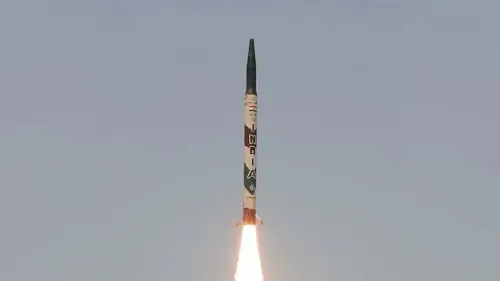
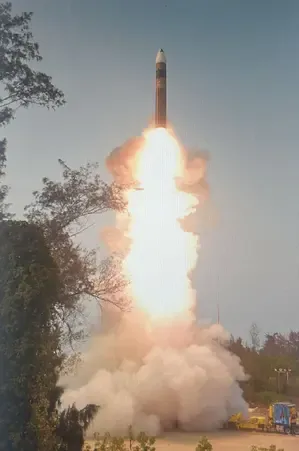
The Agni-4 medium-range ballistic missile was successfully test-fired from the Integrated Test Range, Chandipur, Odisha on August 7, 2026 .
The launch validated all operational and technical parameters , according to Union Minister G.
Agni-4 has a range of approximately 3,500 km and is part of India's land-based strategic deterrence architecture.
DRDO first tested Agni-4 in 2011 , with subsequent trials in 2014 and 2016 before this latest test.
The test aligns with the Aatmanirbhar Bharat initiative's goal of reducing India's dependence on imported defence platforms.
The Strategic Forces Command , custodian of India's nuclear arsenal, is associated with the missile's operational development.
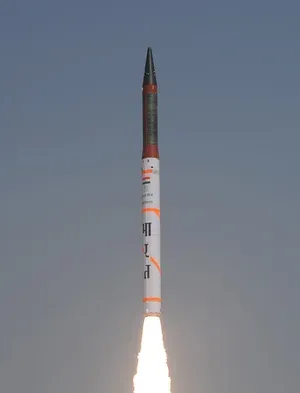
India's strategic deterrence just got a sharper edge. Union Coal and Mines Minister G. Kishan Reddy on Friday, August 7, 2026, congratulated DRDO and the Strategic Forces Command after the successful test-firing of the Agni-4 medium-range ballistic missile from the Integrated Test Range, Chandipur, Odisha — calling it a milestone in India's growing indigenous defence capabilities.
Posting on X, Reddy wrote that the launch 'validated all operational and technical parameters,' and credited the achievement to the leadership of Prime Minister Narendra Modi and the Aatmanirbhar Bharat framework that has anchored India's defence indigenisation push since 2020.
What Agni-4 Brings to India's Strategic Shelf
Agni-4 is no newcomer. With a range of approximately 3,500 km, it sits in the upper tier of India's land-based ballistic missile family — capable of reaching targets deep into adversarial territory without crossing into intercontinental range. DRDO conducted its first successful developmental trial of the missile in 2011, with follow-on tests in 2014 and 2016 steadily maturing the system toward operational readiness. The Strategic Forces Command, the tri-service custodian of India's nuclear arsenal, oversees its deployment posture. The Integrated Test Range at Chandipur on Odisha's coastline has been the workhorse facility for these trials — a controlled, instrumented corridor that lets scientists validate guidance, propulsion, and re-entry performance before a system is cleared for induction.Agni Series and the Indigenisation Arc
The broader Agni programme traces its roots to India's Integrated Guided Missile Development Programme, launched in 1983 under a mandate to build a self-reliant family of strategic and tactical missiles. Four decades on, the family spans Agni-1 through Agni-5 — with Agni-5 already tested at intercontinental range. Each successful trial is a data point in a longer argument: that India can design, build, and field credible deterrence without foreign platforms. That argument has gained political weight under the Aatmanirbhar Bharat initiative, which set explicit targets for cutting defence import dependence and expanding domestic production. Reddy's post frames the Agni-4 test squarely within that narrative — a strategic test and a political statement in one.Minimum Deterrence, Maximum Credibility
India's declared doctrine of minimum credible deterrence and no-first-use means every successful test carries a specific signal: the arsenal is reliable, survivable, and ready. The Strategic Forces Command's involvement in this trial — rather than a purely developmental DRDO exercise — suggests the system is being validated for operational use, not just laboratory benchmarks. Whether this test precedes a formal induction announcement will be the next thing to watch, alongside any parallel activity in the Agni-5 programme. For India's defence establishment, a clean test at Chandipur is a message sent without a word to anyone who needs to hear it.Point of View
Decade-long pattern of India inducting and validating each tier of its land-based ballistic missile ladder — not as isolated events but as cumulative proof of a credible deterrent. The involvement of the Strategic Forces Command, rather than DRDO alone, signals this is closer to operational validation than pure research. Politically, the framing by a senior BJP minister under the Aatmanirbhar Bharat banner reinforces the government's consistent effort to link strategic achievements to its indigenisation narrative. The test also arrives at a moment when India's defence export ambitions and domestic production targets are under close international scrutiny.
NationPress
7 Aug 2026
Frequently Asked Questions
What is the Agni-4 missile and what is its range?
Agni-4 is an indigenously developed Indian medium-range ballistic missile with a range of approximately 3,500 km , designed as part of India's land-based strategic deterrence posture under the Agni series.
Where was the Agni-4 missile tested on August 7, 2026?
The Agni-4 was test-fired from the Integrated Test Range at Chandipur in Odisha , India's primary coastal missile testing facility.
Who develops the Agni missile series in India?
The Defence Research and Development Organisation (DRDO) develops the Agni missile series, while the Strategic Forces Command oversees its operational deployment.
What is the Aatmanirbhar Bharat initiative in defence?
Launched in 2020 , Aatmanirbhar Bharat sets explicit targets for reducing India's defence import dependence by boosting domestic design, development, and production of military systems.
When was Agni-4 first tested?
Agni-4 underwent its first successful developmental trial in 2011 , followed by additional tests in 2014 and 2016 , with the latest test conducted in August 2026 .