Kishan Reddy marks World Olympic Day, backs India's sports push
Synopsis
Union Coal and Mines Minister G. Kishan Reddy marked World Olympic Day on 23 June 2026 by highlighting India's efforts to strengthen its sporting ecosystem. His message invoked the Olympic values of excellence, friendship, and respect, and pointed to ongoing government schemes nurturing the country's next generation of champions.
Key Takeaways
Kishan Reddy , Union Coal and Mines Minister, posted a World Olympic Day message on 23 June 2026 .
World Olympic Day is observed annually on 23 June to promote Olympic values of excellence, friendship, and respect.
The Khelo India scheme, launched in 2017 , funds grassroots sports infrastructure and talent identification across India.
The Target Olympic Podium Scheme (TOPS) , introduced in 2014 , provides elite athletes with financial and coaching support for Olympic preparation.
Reddy's message underlines the government's broader strategy of linking sports development to youth empowerment and national prestige.
The next phase will focus on new Khelo India centre rollouts and fresh TOPS selection lists ahead of the next Olympic cycle.
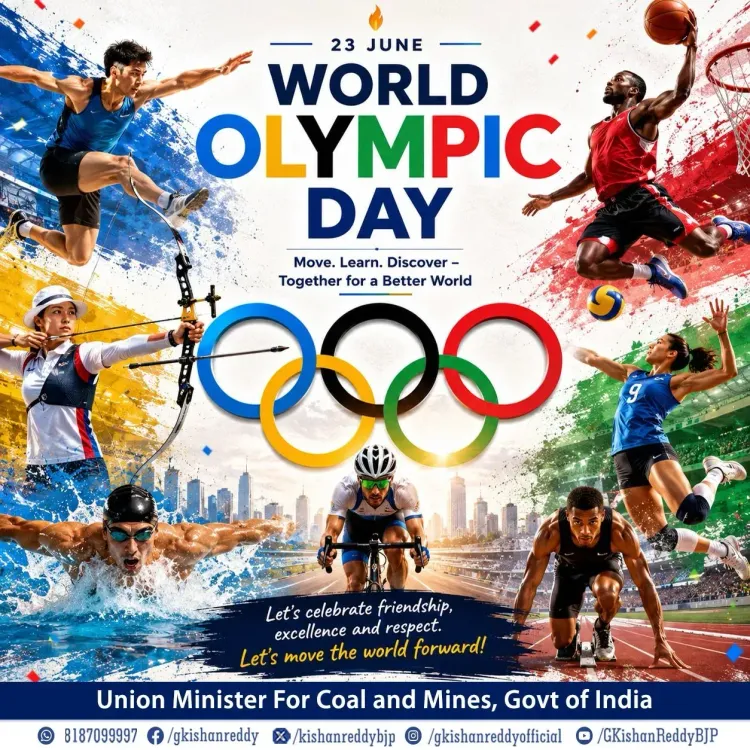
Union Coal and Mines Minister G. Kishan Reddy on Tuesday, 23 June 2026 marked World Olympic Day by calling on citizens to embrace the transformative power of sport, highlighting India's ongoing efforts to strengthen its sporting ecosystem and develop future champions.
In his post on X, the minister wrote: 'On World Olympic Day, we celebrate the spirit of excellence, friendship, and respect that unites athletes across the world. Sports inspire discipline, perseverance, and teamwork, empowering individuals to push beyond limits and strive for greatness. As India strengthens its sporting ecosystem and nurtures future champions, let us continue to embrace the transformative power of sport.'
Context
World Olympic Day is observed every year on 23 June to mark the founding of the modern Olympic movement in 1894 and to promote the core values of excellence, friendship, and respect. The observance draws participation from governments, sporting bodies, and public figures worldwide who use the occasion to reaffirm commitment to sport as a vehicle for social development.
Kishan Reddy's message aligns with a pattern of ministerial outreach on international sporting occasions, linking the Olympic ethos to India's broader national development narrative. As BJP Telangana state president, Reddy also carries a regional political voice that amplifies such messaging across the southern state.
Policy Backdrop
India's central government has built a layered institutional framework to improve the country's Olympic performance over successive years. The Khelo India scheme, launched in 2017, targets grassroots infrastructure and talent identification across states, funding academies, coaching centres, and annual multi-sport games for school and college athletes.
Complementing this is the Target Olympic Podium Scheme (TOPS), introduced in 2014, which provides elite athletes with financial assistance, specialised coaching, and access to international competition to prepare them for Olympic medal contention. Together, these two programmes represent the government's twin-track approach — building the base while fast-tracking the best.
Stakeholders and Impact
The primary beneficiaries of India's expanding sports infrastructure are young athletes from across the country, particularly those from smaller towns and rural areas who gain access to quality coaching and competitive exposure through Khelo India centres. State sports departments are key implementation partners, receiving central funds and coordinating local talent pipelines.
For the broader public, ministerial messaging on Olympic values serves a dual purpose: reinforcing civic pride around Indian sporting achievements and building political goodwill among a youth demographic that increasingly follows sport. India's growing medal tally at international events has made sports policy a more visible part of the national conversation.
What's Next
Attention now turns to the rollout of new Khelo India centres and the next round of athlete selection lists under TOPS as India prepares for the upcoming Olympic cycle. The government's ability to translate scheme outlays into podium finishes will be the measure by which this sustained policy push is ultimately judged.
Point of View
Friendship, and respect' alongside India's 'sporting ecosystem,' the message subtly credits central government policy for the country's improving athletic profile. Such messaging has become a standard feature of the BJP's outreach to younger voters, for whom sporting success carries real cultural weight. The post also signals continuity — reinforcing that sports investment is a cross-ministerial priority, not confined to the sports ministry alone.
NationPress
23 Jun 2026
Frequently Asked Questions
What is World Olympic Day and when is it celebrated?
World Olympic Day is an international observance held every year on 23 June to mark the founding of the modern Olympic movement in 1894 and to promote the values of excellence, friendship, and respect through sport.
What did G. Kishan Reddy say on World Olympic Day 2026?
G. Kishan Reddy posted a message celebrating the Olympic spirit and called on Indians to embrace the transformative power of sport, noting that India is strengthening its sporting ecosystem and nurturing future champions.
What is the Khelo India scheme?
Khelo India is a central government programme launched in 2017 to develop grassroots sports infrastructure, identify talent at the school and college level, and promote a culture of sport across India.
What is the Target Olympic Podium Scheme (TOPS)?
The Target Olympic Podium Scheme (TOPS) , introduced in 2014 , provides India's top elite athletes with financial assistance, world-class coaching, and international competition exposure to help them win Olympic medals.
Who is G. Kishan Reddy?
G. Kishan Reddy is India's Union Minister of Coal and Mines and also serves as the BJP state president for Telangana . He is a senior BJP leader from Hyderabad.