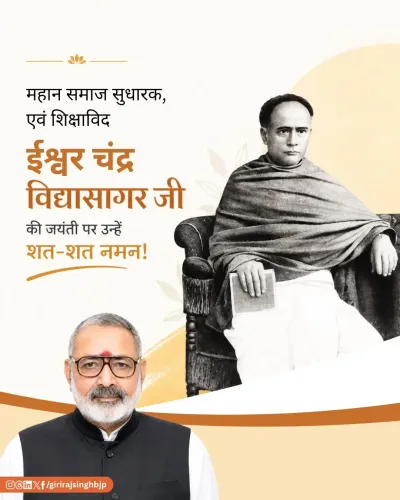
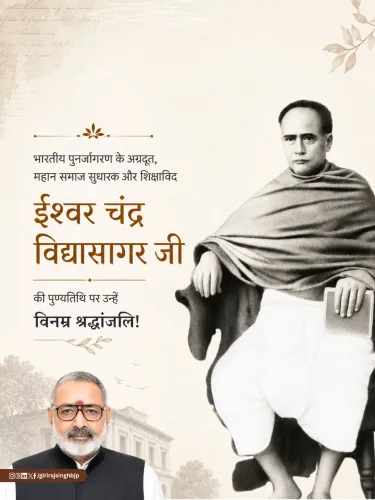
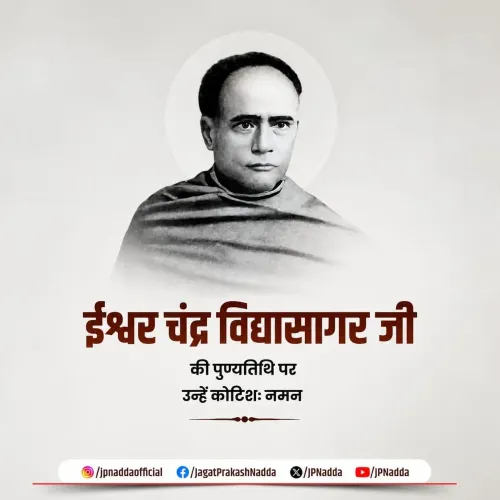
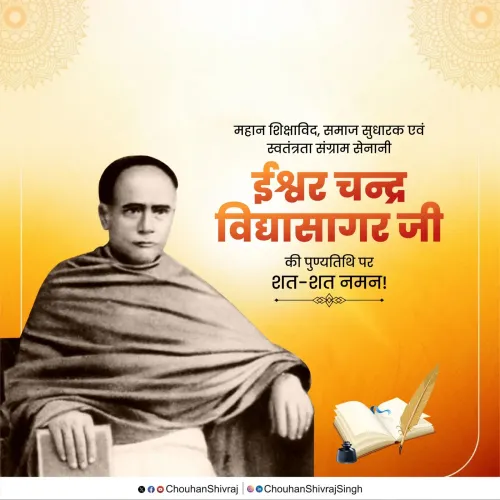
Kishan Reddy pays tribute to Ishwar Chandra Vidyasagar on Janma Jayanti
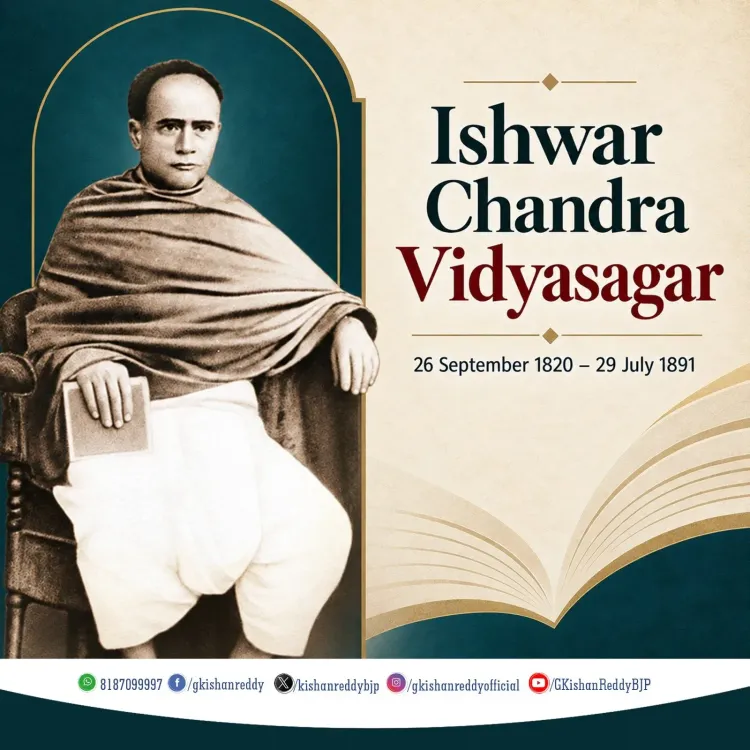
Synopsis
Union Coal and Mines Minister G. Kishan Reddy paid tribute to Ishwar Chandra Vidyasagar on his birth anniversary, honouring the 19th-century Bengali polymath's pivotal role in legalising Hindu widow remarriage and expanding girls' education across colonial India.
Key Takeaways
Kishan Reddy posted a tribute to Ishwar Chandra Vidyasagar on his Janma Jayanti on 26 September 2026 .
Vidyasagar, born in 1820 in Midnapore, Bengal , championed the Hindu Widows' Remarriage Act of 1856 through sustained petitioning of colonial authorities.
He founded dozens of girls' schools across Bengal and simplified the Bengali script, leaving a dual legacy in social reform and education.
The honorific 'Vidyasagar' — meaning 'ocean of knowledge' — was conferred on him by the Sanskrit College, Calcutta .
Indian political leaders across parties routinely commemorate 19th-century reformers' anniversaries to link contemporary policy goals with a longer arc of social progress.
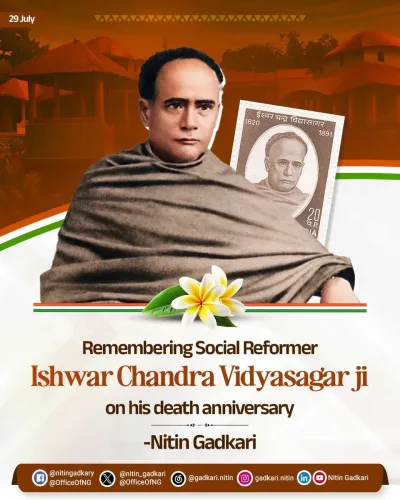
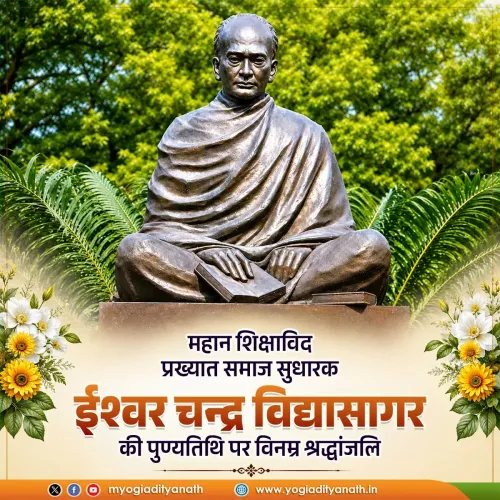
Two centuries after he rewrote the rules of 19th-century Bengal, Ishwar Chandra Vidyasagar continues to command reverence from across India's political spectrum — and on Saturday, 26 September 2026, Union Coal and Mines Minister G. Kishan Reddy added his voice to that chorus, honouring the reformer on his birth anniversary.
The man who moved mountains for widows and girls
Born in 1820 in the Midnapore district of Bengal, Vidyasagar was at once a Sanskrit scholar, a prolific writer in Bengali, and a relentless social agitator. His most consequential battle was fought in the courtrooms and drawing rooms of colonial India: the campaign to legalise Hindu widow remarriage, which culminated in the landmark Hindu Widows' Remarriage Act of 1856 — a direct result of his petitioning of the British colonial administration.
He did not stop there. Vidyasagar established dozens of schools for girls across Bengal at a time when female education was considered transgressive. He simplified the Bengali script, authored foundational primers still echoed in the language's pedagogy, and used his own earnings — and debts — to fund institutions he believed in. The 'Vidyasagar' honorific, meaning 'ocean of knowledge,' was earned, not inherited.
Why politicians mark this day — and what they are signalling
In his post, Kishan Reddy described Vidyasagar as 'an eminent social reformer, educationist and champion of women's rights' whose 'lifelong commitment to education, social reform and human dignity played a transformative role in 19th-century India.' The tribute is brief, but the figure it invokes is anything but.
Indian political leaders across parties routinely mark the birth anniversaries of 19th-century reformers — figures like Vidyasagar, Raja Ram Mohan Roy, and Jyotiba Phule — as a way of anchoring contemporary governance rhetoric in a longer arc of social progress. For a minister whose portfolio spans coal and mines and who also leads the BJP in Telangana, invoking Vidyasagar on education and women's rights connects to national-level conversations around female literacy and social equity that cut across regions.
Vidyasagar's legacy also carries live political charge: his statue in Kolkata became a flashpoint during the 2019 general election campaign, making him a symbol whose memory neither the ruling establishment nor the opposition can afford to ignore.
Point of View
But Vidyasagar is a particularly loaded choice: his statue's desecration during the 2019 election cycle in Kolkata turned him into a live political symbol well beyond his historical home in Bengal. For a BJP leader like Kishan Reddy, who operates primarily in Telangana, invoking Vidyasagar on themes of women's rights and education also gestures at the party's ongoing effort to broaden its cultural vocabulary beyond its traditional strongholds. The tribute is ceremonial in form, but the figure it references carries enough historical and contemporary charge to make it more than a routine calendar post.
NationPress
26 Sept 2026
Frequently Asked Questions
Who was Ishwar Chandra Vidyasagar and why is he celebrated?
Ishwar Chandra Vidyasagar (1820–1891) was a Bengali polymath, social reformer, and educationist celebrated for securing the legal right for Hindu widows to remarry through the Hindu Widows' Remarriage Act of 1856 and for establishing girls' schools across Bengal.
When is Ishwar Chandra Vidyasagar's Janma Jayanti celebrated?
Vidyasagar's birth anniversary, known as Janma Jayanti, is observed on 26 September each year to mark his birth in 1820.
What did Vidyasagar do for women's rights in India?
Vidyasagar campaigned tirelessly for the right of Hindu widows to remarry, directly contributing to the passage of the Hindu Widows' Remarriage Act of 1856. He also founded numerous schools for girls at a time when female education was widely discouraged.
Who is G. Kishan Reddy?
G. Kishan Reddy is India's Union Minister of Coal and Mines and the BJP's Telangana state president, a senior leader in Prime Minister Narendra Modi's cabinet.
Why did Vidyasagar's statue become politically significant in recent years?
Vidyasagar's bust at Vidyasagar College in Kolkata was vandalised during a political confrontation in 2019, turning the reformer into a symbol of political contestation in West Bengal and drawing national attention to his enduring cultural significance.