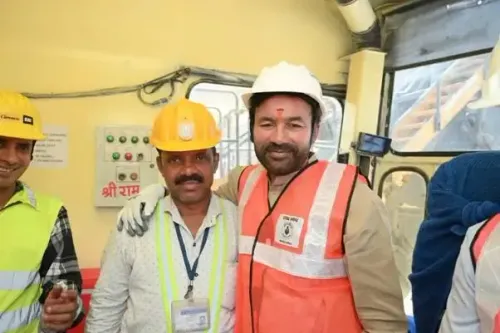
Kishan Reddy Highlights SECL Korea Mine Green Zone in Chhattisgarh
Synopsis
Union Coal Minister G. Kishan Reddy on 18 July 2026 showcased SECL's Korea Underground Project in Chhattisgarh as a green-zone success, stating mine entries have been sealed, the landscape stabilised, and all environmental parameters brought within prescribed limits under PM Modi's sustainability roadmap.
Key Takeaways
Union Coal and Mines Minister G.
Kishan Reddy highlighted the SECL Korea Underground Project in MCB district, Chhattisgarh on 18 July 2026 .
South Eastern Coalfields Limited (SECL) is a subsidiary of Coal India Limited operating primarily in Chhattisgarh and Madhya Pradesh .
The project has reportedly sealed mine entries, stabilised the landscape, and brought environmental parameters within prescribed limits.
The initiative is framed as part of PM Narendra Modi's roadmap for environmental sustainability in the mining sector.
India's mine closure guidelines, issued in 2009 , require progressive eco-restoration of exhausted mines by Coal India subsidiaries.
Annual environmental compliance reports by CIL subsidiaries will be the formal benchmark for verifying the project's green-zone status.
Union Coal and Mines Minister G. Kishan Reddy on Saturday, 18 July 2026, highlighted the transformation of South Eastern Coalfields Limited's (SECL) Korea Underground Project in the Manendragarh-Chirmiri-Bharatpur (MCB) district of Chhattisgarh into a safe, green zone, citing it as a model for sustainable mine closure under Prime Minister Narendra Modi's environmental roadmap.
Context
Kishan Reddy's post, shared on his official X account, stated that the Korea Underground Project has 'effectively sealed mine entries, stabilised the landscape, and brought all environmental parameters perfectly within limits.' He attributed the initiative to PM Modi's roadmap for environmental sustainability, framing it as evidence that mining sites can transition into ecologically sound zones once extraction activity ends.
The Ministry of Coal and SECL — a subsidiary of Coal India Limited (CIL) — were tagged in the post, signalling an official endorsement of the project's outcomes as part of the ministry's broader communication on green mining practices.
Policy Backdrop
India's framework for mine closure and land reclamation dates to 2009, when the Ministry of Coal issued guidelines mandating progressive environmental restoration of exhausted mines. These norms require Coal India subsidiaries to undertake eco-restoration alongside active production targets, covering soil stabilisation, revegetation, and pollution-parameter monitoring.
SECL operates across Chhattisgarh and Madhya Pradesh, two of India's most coal-rich states. Underground mine sealing — the process of physically closing off worked-out galleries to prevent subsidence, gas leaks, and groundwater contamination — is a key step in the mine closure protocol and forms the core of what the Korea Underground Project has reportedly achieved.
India's dual obligation to sustain domestic coal output for energy security while meeting its international climate commitments has made the rehabilitation of mined-out land a recurring policy priority. Green-zone conversion of closed mines is increasingly cited by the government as a tangible deliverable on both fronts.
Stakeholders and Impact
Communities in the MCB district that live in proximity to legacy underground workings stand to benefit most directly. Sealed and stabilised mine sites reduce risks of land subsidence, dust pollution, and contamination of local water sources — hazards that have historically affected mining townships in Chhattisgarh.
Environmental regulators, including state and central pollution control bodies, are the institutional stakeholders who certify that parameters are within prescribed limits. The minister's claim that 'all environmental parameters' are now within limits implies compliance with norms set by these bodies, though independent verification of the specific outcomes at the Korea Underground Project remains subject to official reporting.
What's Next
Coal India Limited and its subsidiaries are required to publish annual environmental compliance reports, which will be the formal record against which the Korea project's green-zone status can be assessed. The Ministry of Coal is expected to continue spotlighting similar closure and rehabilitation projects as part of its communication strategy ahead of domestic and international climate forums.
Further mine closure or green-zone announcements from SECL and other CIL subsidiaries operating in Chhattisgarh and neighbouring states are likely, as the government seeks to demonstrate that large-scale coal extraction and environmental stewardship can coexist.
Point of View
Using a specific sub-district project to illustrate a national narrative: that India's coal sector is not merely extractive but also restorative. By anchoring the claim to PM Modi's sustainability roadmap, the communication serves a dual purpose — defending the government's coal expansion record while simultaneously projecting climate responsibility. The Korea Underground Project, as a completed underground closure rather than an open-cast site, is a relatively low-visibility but technically credible example, lending the claim more substance than a generic announcement. The broader pattern suggests the Ministry of Coal is building a portfolio of closure-and-rehabilitation cases to deploy in domestic policy debates and international climate negotiations.
NationPress
16 Oct 2026
Frequently Asked Questions
What is the SECL Korea Underground Project in Chhattisgarh?
The SECL Korea Underground Project is a coal mine closure and rehabilitation initiative by South Eastern Coalfields Limited in the Manendragarh-Chirmiri-Bharatpur district of Chhattisgarh. According to Union Coal Minister G. Kishan Reddy, the project has sealed mine entries, stabilised the surrounding landscape, and brought environmental parameters within prescribed limits, converting the site into a green zone.
What does sealing a coal mine entry mean?
Sealing a coal mine entry means physically closing off the underground galleries and access points of a worked-out mine to prevent hazards such as land subsidence, gas leaks, and groundwater contamination. It is a mandatory step under India's mine closure guidelines issued by the Ministry of Coal in 2009.
What is South Eastern Coalfields Limited (SECL)?
South Eastern Coalfields Limited is a subsidiary of Coal India Limited, the state-owned coal mining conglomerate. SECL operates coal mines primarily in Chhattisgarh and Madhya Pradesh and is among the major producing subsidiaries of CIL.
What are India's rules on mine closure and environmental restoration?
The Ministry of Coal issued mine closure guidelines in 2009 requiring Coal India subsidiaries to undertake progressive reclamation and environmental restoration of exhausted mines. These rules cover soil stabilisation, revegetation, pollution-parameter monitoring, and physical sealing of underground workings.
Why is G. Kishan Reddy highlighting green mining projects?
As Union Minister of Coal and Mines, G. Kishan Reddy has been communicating the government's efforts to balance large-scale coal production with environmental stewardship. Highlighting projects like the Korea Underground Project supports the government's narrative that mining and ecological restoration can coexist, which is relevant to both domestic policy debates and India's international climate commitments.