CM Sukhu wins Supreme Court battle for Wild Flower Hall
Synopsis
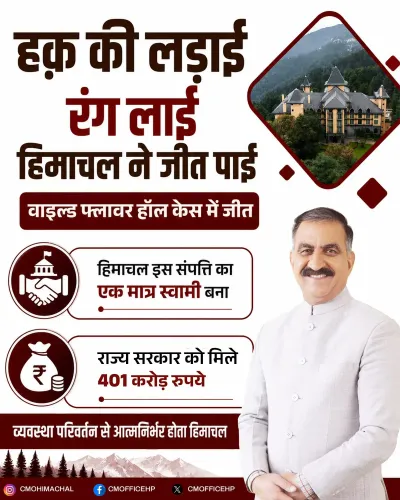
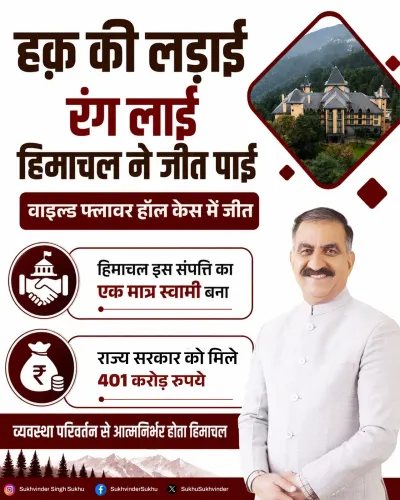
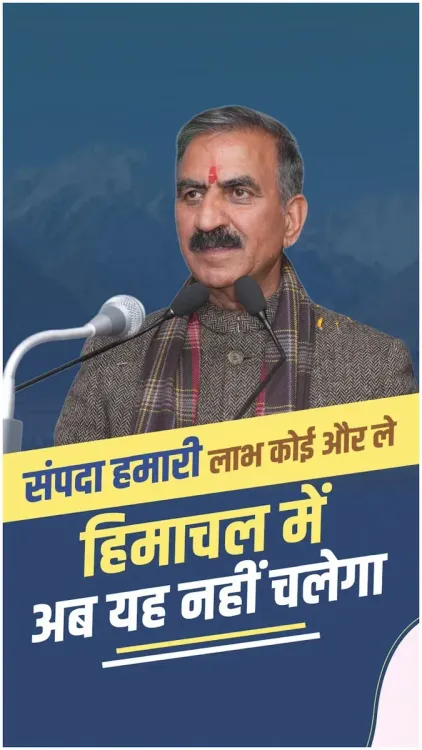
Chief Minister Sukhvinder Singh Sukhu announced that Himachal Pradesh won the Wild Flower Hall property dispute at the Supreme Court after an earlier High Court loss caused by counsel non-appearance. The state recovered land title, received ₹401 crore, and has issued a lease tender for the heritage Shimla-area property.
Key Takeaways
The Himachal Pradesh High Court had ruled against the state in the Wild Flower Hall case because the government's lawyer did not appear in court.
CM Sukhu took the matter to the Supreme Court of India and secured a victory, restoring state ownership of the property.
Following the apex court ruling, the land mutation ( intkal ) was formally recorded in the state government's name.
The state received ₹401 crore as a result of the restored ownership and settlement of related claims.
A fresh tender has been issued to lease out Wild Flower Hall , enabling the state to generate recurring revenue from the asset.
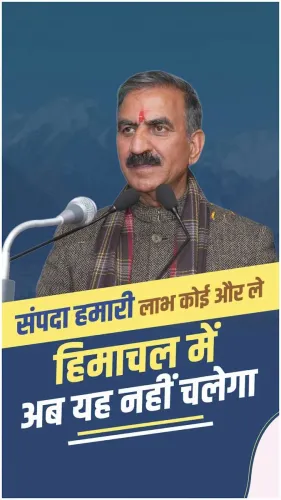
CM Sukhu rejected a negotiated compromise, framing the legal fight as a defence of the rights of 75 lakh Himachalis.
Himachal Pradesh Chief Minister Sukhvinder Singh Sukhu announced on Saturday, 18 July 2026 that the state government has secured a landmark Supreme Court victory in the Wild Flower Hall property dispute, recovering full ownership of the heritage estate and receiving ₹401 crore in the process — with a fresh lease tender now issued for the property.
Context
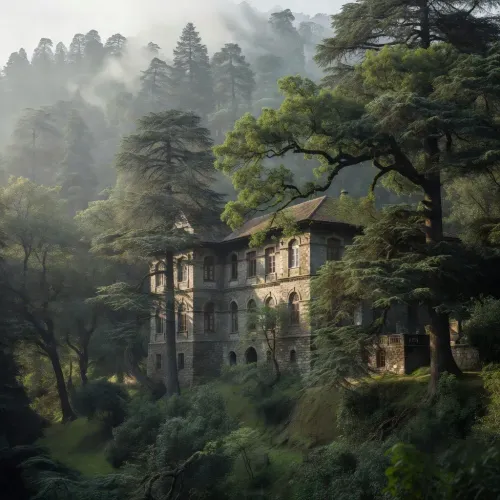
The dispute centred on Wild Flower Hall, a heritage property and hotel located in Mashobra, near Shimla, long regarded as a state government asset. In his post, CM Sukhu revealed that the Himachal Pradesh High Court had earlier ruled against the state — not on merits, but because the government's own counsel failed to appear in court. 'यह केवल कानूनी चूक नहीं थी' ['This was not merely a legal lapse'], he wrote, calling it 'an injustice to the interests of 75 lakh brothers and sisters of Himachal Pradesh.'
The Chief Minister made clear the government refused to treat the adverse ruling as final. 'The land of Wild Flower Hall is ours, everything is ours,' he stated, signalling the administration's decision to escalate the matter to the apex court.
Policy Backdrop
Indian states have periodically pursued appellate litigation to recover or confirm title over high-value public properties after adverse lower-court orders. Such legal battles carry significant fiscal weight: a successful outcome can unlock one-time revenue receipts that are then recycled into leasing or development arrangements, directly benefiting the state exchequer.
The Sukhu government, which took office in December 2022, has positioned itself as a guardian of state resources. In this case, the administration took the matter to the Supreme Court of India, won the appeal, and subsequently had the land records — intkal [mutation of title] — transferred formally to the state government's name. The state then received ₹401 crore as a result of the settlement of claims arising from the restored ownership.
Stakeholders and Impact
The primary beneficiary is the Himachal Pradesh state exchequer, which gains both the asset and the liquidity from the ₹401 crore receipt. CM Sukhu explicitly framed the victory as belonging to the state's 75 lakh residents, arguing that a negotiated compromise would have amounted to a betrayal of public interest.
A fresh tender has already been issued to lease out Wild Flower Hall, meaning the property is set to generate recurring revenue for the state rather than remaining locked in litigation. The outcome also sends a signal to other parties in disputes over state-held heritage and hospitality assets across Himachal Pradesh.
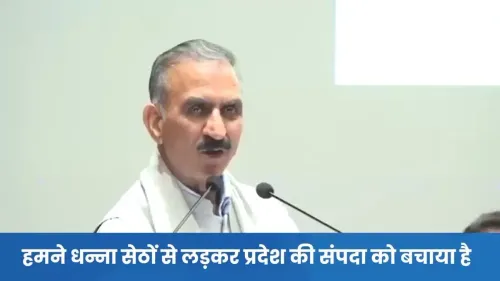
'We could have chosen the path of compromise,' Sukhu wrote, 'but doing so would have been a compromise on the interests of the people of Himachal Pradesh. Therefore, we kept the state's interests paramount at every step and secured the people's rights by winning the rightful battle.'
What's Next
The immediate focus shifts to the lease tender for Wild Flower Hall. The award of the tender, the identity of the successful bidder, and the annual lease premium will determine how much long-term value the state extracts from the recovered property. Observers will also watch whether the ₹401 crore receipt is reflected in a supplementary budget or earmarked for specific development programmes in Himachal Pradesh. A transparent tender process will be critical to insulating the government from political scrutiny over the eventual deal.
Point of View
CM Sukhu converts a bureaucratic failure into a political asset, positioning the Congress government as a vigilant steward of state resources ahead of what remains a competitive political environment in Himachal Pradesh. The ₹401 crore receipt and the pending lease tender will be the real test: how transparently the funds are accounted for and how competitively the tender is awarded will determine whether the victory holds up to scrutiny beyond the announcement cycle.
NationPress
17 Oct 2026
Frequently Asked Questions
What is Wild Flower Hall and why was it disputed?
Wild Flower Hall is a heritage property and hotel in Mashobra near Shimla, long treated as a Himachal Pradesh government asset. Its ownership became disputed, and the state government had to fight a legal battle to formally confirm its title.
Why did the Himachal Pradesh High Court rule against the state?
According to CM Sukhu, the High Court ruled against Himachal Pradesh because the government's own lawyer did not appear before the court — an administrative lapse rather than a defeat on merits.
How did Himachal Pradesh win the Wild Flower Hall case?
The Sukhu government appealed to the Supreme Court of India, which ruled in the state's favour, allowing the government to get the land mutation formally recorded in the state's name.
What is the ₹401 crore that Himachal Pradesh received?
Following the Supreme Court victory and restoration of ownership, the Himachal Pradesh state government received ₹401 crore arising from the settlement of claims connected to the Wild Flower Hall property.
What happens to Wild Flower Hall now?
The Himachal Pradesh government has issued a tender to lease out Wild Flower Hall, which will allow the state to earn recurring revenue from the property going forward.