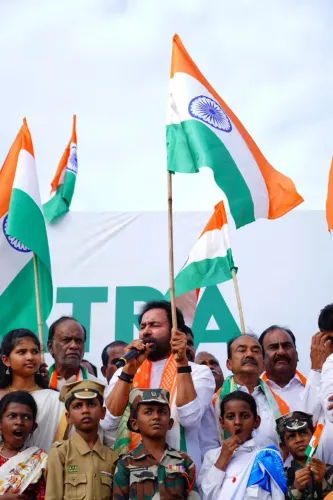
Kishan Reddy slams Congress over 'regime change' video
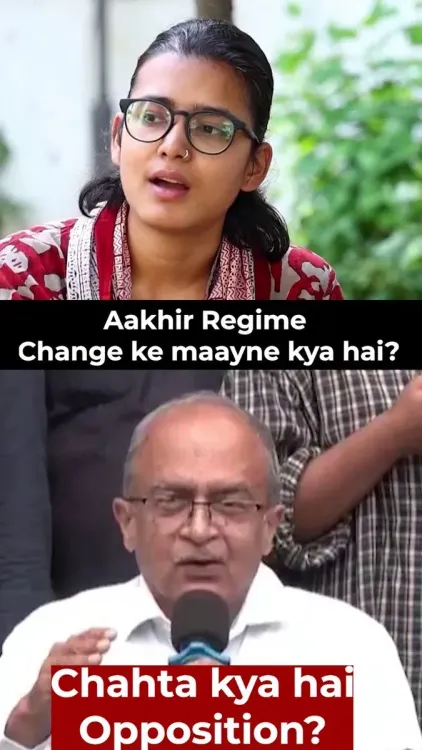
Synopsis
Union Minister G. Kishan Reddy has accused the Congress and left-wing ecosystem of using a video to advocate unconstitutional 'regime change' and foreign-style anarchy, directly targeting Rahul Gandhi and warning that India's democratic stability will not be compromised.
Key Takeaways
Kishan Reddy posted a sharp Hindi-language statement on October 16, 2026 condemning a circulating video.
The video allegedly advocates Bangladesh and Nepal-style anarchy , threats to 'uproot Parliament,' and unconstitutional regime change.
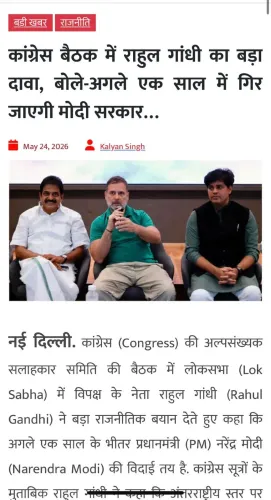
Reddy directly names Rahul Gandhi , accusing him of spreading instability and discrediting constitutional bodies after electoral failures.
He defends the Election Commission, judiciary, and other institutions as pillars of India's democratic order.
The post is addressed to PM Narendra Modi and BJP handles, signalling a coordinated party counter-offensive.
India's democracy, Reddy asserts, is anchored in the 'invincible strength of 140 crore citizens ' and constitutional supremacy.
A viral video circulating on Indian social media has triggered a sharp political counter-offensive — and on Friday, October 16, 2026, Union Coal and Mines Minister G. Kishan Reddy fired back with one of the most pointed broadsides yet, accusing the Congress and what he termed the 'left-wing ecosystem' of crossing every line of political decency in a bid to destabilise India's constitutional order.
What the video allegedly shows — and why Reddy calls it dangerous
Reddy's post, written in Hindi, describes a video in which speakers openly advocate 'Bangladesh and Nepal-style anarchy,' issue threats to 'uproot Parliament,' and push for 'unconstitutional regime change.' He calls this a 'dangerous conspiracy to push the country into deep uncertainty.' The research background cannot independently verify the video's contents or the specific occasion on which the statements were made, but Reddy's framing is unambiguous: he sees the material as an explicit invitation to extra-constitutional upheaval.
The invocation of Bangladesh and Nepal is deliberate. Both countries have seen street-driven political transitions in recent years — and their example has become a recurring motif in BJP messaging, held up as a cautionary contrast to India's constitutional framework. By naming them, Reddy is not merely criticising a video; he is situating the clip inside a broader argument about where unchecked political aggression leads.
Reddy's direct charge against Rahul Gandhi
'When leaders like Rahul Gandhi fail to face the public in elections, their only remaining agenda is to spread instability in the country, create distrust in our judiciary, Election Commission, and other constitutional institutions, and foment anarchy' — that is how Reddy frames the opposition's motivation. It is a combative formulation, one that ties electoral failure directly to what he characterises as institutional sabotage.
Rahul Gandhi has been the BJP's most consistent rhetorical target on this front. The ruling party has repeatedly argued that Congress, having lost successive general elections, has shifted strategy toward delegitimising the very institutions that conduct and certify those elections — a charge Congress categorically rejects. Reddy's post is the latest, and among the sharpest, iterations of that argument.
The constitutional floor Reddy draws
'India's democracy rests on the invincible strength of 140 crore citizens and the supremacy of our Constitution,' Reddy declares. 'We will not allow the country's stability and security to be toyed with for any selfish political interest.' The closing line, directed at Prime Minister Narendra Modi and BJP handles, signals that this is not an isolated statement but a coordinated party position.
The broader pattern here is well-established: ruling-party figures routinely invoke constitutional sanctity when opposition actors question institutions such as the Election Commission or the judiciary. What gives this particular post its edge is the specificity — a named video, named foreign analogies, a named political opponent — rather than the generic charge alone. That specificity will either force a direct rebuttal or become the next flashpoint in what is already a volatile political season.
If the video gains wider circulation and the opposition responds, the coming days in Parliament — or on the campaign trail — could turn this exchange into a defining moment of the current political session. The constitutional stakes, as Reddy frames them, could hardly be higher.
Point of View
Frame it not as political criticism but as an existential threat to the constitutional order itself — forcing the opposition to defend the video rather than prosecute its contents. The Bangladesh and Nepal references are especially pointed given those countries' recent political turbulence, and their invocation is designed to make the analogy feel visceral rather than abstract. This post also continues a long-running BJP effort to pre-emptively delegitimise any post-election institutional grievances by labelling them as anti-democratic before they gain traction. Whether Congress can rebut the specific charge — rather than the general accusation — will determine who wins this particular news cycle.
NationPress
17 Oct 2026
Frequently Asked Questions
What did G. Kishan Reddy say about the Congress 'regime change' video?
Reddy accused Congress and the 'left-wing ecosystem' of using a video to openly advocate Bangladesh-style anarchy, threats to 'uproot Parliament,' and unconstitutional regime change, calling it a 'dangerous conspiracy' to push India into instability.
Why did Kishan Reddy target Rahul Gandhi specifically?
Reddy argued that leaders like Rahul Gandhi, having failed to win public support at elections, resort to spreading distrust in constitutional institutions such as the Election Commission and judiciary as their primary political strategy.
What is the BJP's position on India's constitutional institutions?
The BJP, through statements like Reddy's, consistently asserts that institutions like the Election Commission and the judiciary are independent constitutional pillars and that attempts to undermine them amount to an anti-national agenda.
Why does BJP reference Bangladesh and Nepal in its political messaging?
Both countries have experienced street-driven political transitions, and BJP messaging uses them as cautionary examples to argue that extra-constitutional agitation leads to dangerous instability — contrasting that with India's constitutional framework.
What has Kishan Reddy's role been in BJP's political communications?
As Union Minister of Coal and Mines and BJP's Telangana state president, Reddy is a senior party voice on both national governance and regional politics, frequently issuing statements on political and constitutional matters.