Kishan Reddy Marks 12 Years of Modi Govt's Healthcare Push
Synopsis
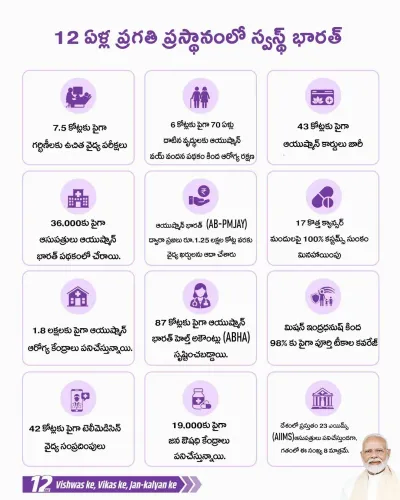
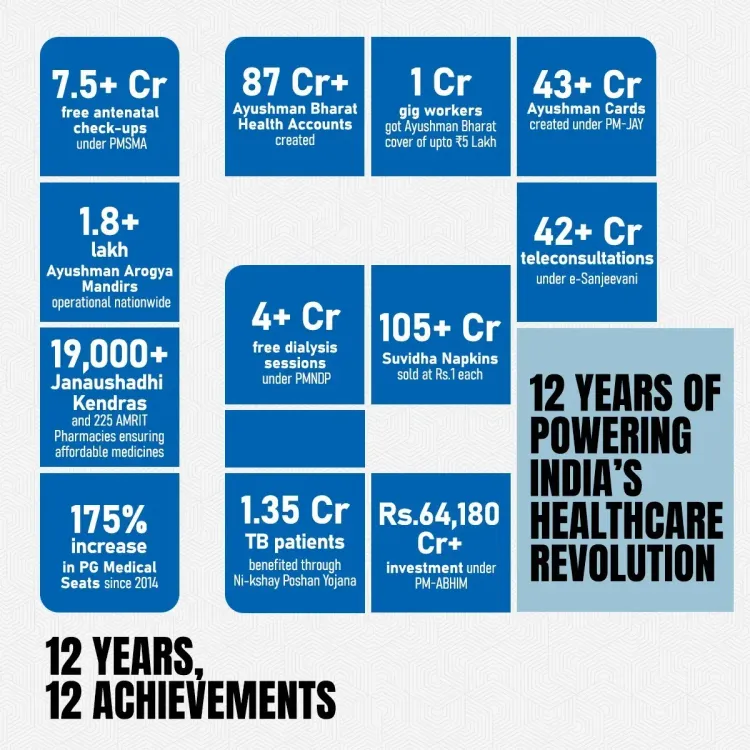
Union Minister G. Kishan Reddy has highlighted twelve years of the Modi government's healthcare expansion, citing over 43 crore Ayushman Bharat cards, 87 crore health accounts, 19,000-plus Jan Aushadhi Kendras, and Rs 64,180 crore invested under PM-ABHIM as evidence of unprecedented scale in India's public health push.
Key Takeaways
43 crore-plus Ayushman Bharat cards have been issued under the Modi government's flagship health insurance scheme since its 2018 launch.
42 crore-plus teleconsultations have been conducted, enabled by the Ayushman Bharat Digital Mission's health ID and telemedicine infrastructure.
87 crore-plus Ayushman Bharat Health Accounts (ABHAs) have been created, forming the digital backbone of the national health ecosystem.
19,000-plus Jan Aushadhi Kendras are operational, providing generic medicines at low prices to reduce out-of-pocket expenditure.
1.8 lakh Ayushman Arogya Mandirs have been established to deliver primary and preventive care at the grassroots level.
Rs 64,180 crore-plus has been invested under PM-ABHIM to upgrade health infrastructure at district and block levels nationwide.
Union Coal and Mines Minister and BJP Telangana president G. Kishan Reddy on Sunday, 14 June 2026, highlighted the central government's healthcare achievements over twelve years, citing the expansion of the Ayushman Bharat ecosystem, Jan Aushadhi Kendras, and infrastructure investment under Prime Minister Narendra Modi.
Context
Reddy's post, tagged #12YearsOfSwasthBharat, marks twelve years since the Modi government took office in May 2014. The minister cited figures including 43 crore-plus Ayushman Bharat cards issued, 42 crore-plus teleconsultations conducted, and 87 crore-plus Ayushman Bharat Health Accounts (ABHAs) created, describing the scale as 'unprecedented.' He also pointed to 19,000-plus Jan Aushadhi Kendras and 1.8 lakh Ayushman Arogya Mandirs as physical pillars of the expanded network.
The post further highlighted an investment of Rs 64,180 crore-plus under the Pradhan Mantri Ayushman Bharat Health Infrastructure Mission (PM-ABHIM), framing it as evidence of the government's commitment to affordable and technology-driven healthcare for every citizen.
Policy Backdrop
Ayushman Bharat was launched in 2018 as a two-pronged national programme: the Pradhan Mantri Jan Arogya Yojana (PM-JAY), which provides up to Rs 5 lakh annual hospitalisation cover to eligible families, and a network of Health and Wellness Centres — now rebranded as Ayushman Arogya Mandirs — to strengthen primary care. The scheme was anchored in the National Health Policy 2017, which set targets for increasing public health expenditure and expanding primary care access.
The Pradhan Mantri Bharatiya Janaushadhi Pariyojana, which governs Jan Aushadhi Kendras, was scaled up significantly after 2014 to make quality generic medicines available at low prices. The Ayushman Bharat Digital Mission, rolled out in 2021, introduced unique digital health IDs and enabled the telemedicine infrastructure that underpins the teleconsultation figures cited by the minister. PM-ABHIM was announced in the Union Budget 2021-22 to address gaps in health infrastructure at district and block levels.
Stakeholders and Impact
The primary beneficiaries of these schemes are low-income families and rural patients who face high out-of-pocket health expenditure. By combining demand-side insurance coverage, supply-side infrastructure upgrades, and digital tools, the government has pursued a multi-pronged strategy aligned with the broader objective of universal health coverage. State health departments are central to implementation, as most scheme delivery occurs at the state level.
Jan Aushadhi Kendras specifically target medicine affordability, offering generic alternatives to branded drugs at significantly lower prices. The Ayushman Arogya Mandirs, spread across 1.8 lakh locations, are designed to reduce the load on district and tertiary hospitals by handling primary and preventive care closer to patients' homes.
What's Next
State-wise utilisation and physical progress reports under PM-ABHIM are expected to be reviewed in subsequent health ministry assessments. A key area to watch is the deeper integration of the Ayushman Bharat Digital Mission with state health record systems, which could be addressed in the next Union Budget cycle. The government's emphasis on scale, technology, and generic medicines signals that health infrastructure will remain a central plank of national policy alongside roads and energy.
Point of View
Timed to the twelfth anniversary of the Modi government and designed to consolidate the BJP's narrative of governance-through-scale in social sectors. The aggregation of figures across Ayushman Bharat, digital health, generic medicines, and infrastructure into a single post reflects the party's strategy of presenting health as a cross-cutting delivery story ahead of electoral cycles. The framing of technology-driven and affordable healthcare as a unified achievement also signals an attempt to own the universal health coverage agenda, which opposition parties have contested on implementation grounds. Whether the on-ground utilisation rates and quality outcomes match the scale of enrolment and investment figures will be the central question in any independent assessment of this record.
NationPress
21 Sept 2026
Frequently Asked Questions
What is Ayushman Bharat and how many people have benefited?
Ayushman Bharat is a national health programme launched in 2018 comprising PM-JAY health insurance and a network of primary care centres. The government has cited over 43 crore cards issued and 87 crore-plus digital health accounts created, though independent verification of the latest figures is ongoing.
What is PM-ABHIM and how much has been invested?
The Pradhan Mantri Ayushman Bharat Health Infrastructure Mission (PM-ABHIM) is a central scheme announced in the 2021-22 Union Budget to build and upgrade health facilities at district and block levels. The government has cited an investment of over Rs 64,180 crore under the mission.
What are Jan Aushadhi Kendras and how many are there?
Jan Aushadhi Kendras are government-backed outlets that sell quality generic medicines at prices significantly lower than branded drugs. The government has stated that over 19,000 such kendras are now operational across India.
What is an Ayushman Bharat Health Account (ABHA)?
An Ayushman Bharat Health Account (ABHA) is a unique digital health ID issued under the Ayushman Bharat Digital Mission, launched in 2021, that allows citizens to link and access their health records digitally and enables telemedicine services. Over 87 crore such accounts have been cited by the government.
What are Ayushman Arogya Mandirs?
Ayushman Arogya Mandirs are the rebranded Health and Wellness Centres under the Ayushman Bharat programme, designed to deliver primary and preventive care at the community level. The government has cited 1.8 lakh such centres as operational.