Kishan Reddy pays tribute to Telangana rebel Chakali Ilamma
Synopsis
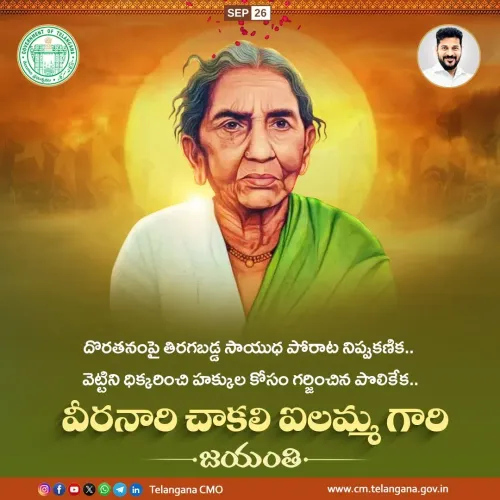
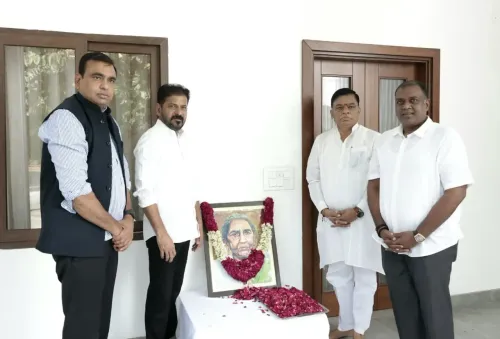
Union Coal and Mines Minister G. Kishan Reddy marked Chakali Ilamma's Jayanti on 26 September 2026, honouring the Telangana peasant warrior who resisted Nizam autocracy, Razakar violence, and feudal landlord exploitation in the 1940s.
Key Takeaways
Kishan Reddy , Union Coal and Mines Minister and BJP Telangana president, paid tribute to Chakali Ilamma on her birth anniversary on 26 September 2026 .
Chakali Ilamma was a washerwoman who became a key figure in the 1940s Telangana peasant armed struggle against the Nizam, Razakars, and feudal landlords.
Kishan Reddy described her as a 'veeravanita' (heroic woman) whose 'uncompromising struggle for land and self-respect' is a perpetual inspiration.
The Razakars were a Nizam-aligned paramilitary militia that carried out reprisals against villages resisting feudal rule during the uprising.
Telangana became a separate Indian state in 2014 , but the region's political identity remains deeply rooted in the memory of the 1940s agrarian rebellion.
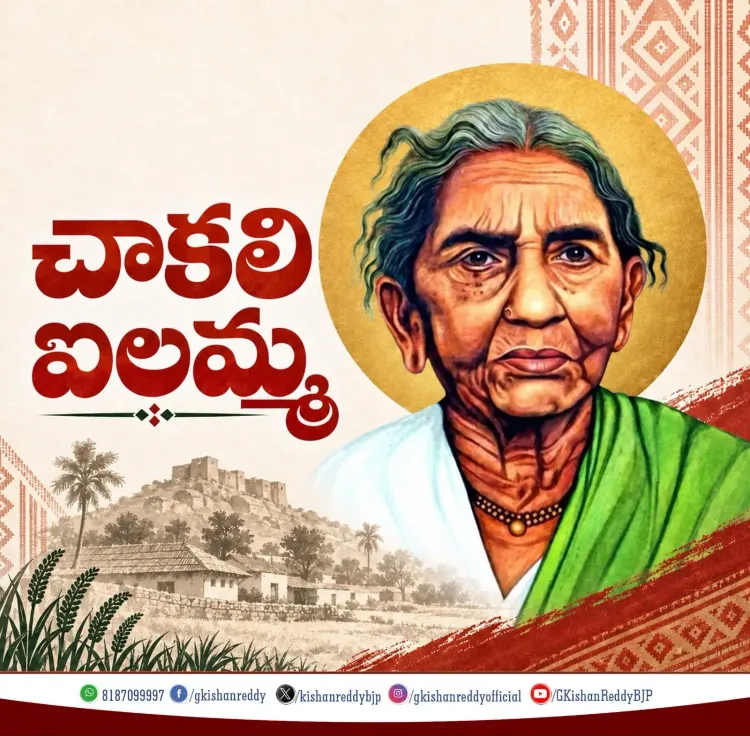
A washerwoman who refused to surrender her land to a feudal landlord and took up arms against the Nizam's reign — Chakali Ilamma remains one of the most defiant symbols of the Telangana peasant armed struggle. On her birth anniversary, Union Coal and Mines Minister G. Kishan Reddy offered a solemn tribute on Saturday, 26 September 2026, honouring the fighter he called a 'veeravanita' — a heroic woman.
In a post in Telugu, Kishan Reddy wrote: 'Nijaamu nirankuSatvaaniki, Razaakaarla araachakaalaku, bhoosvamuala dopiDiki vErEchitangaa pOraaDidina... veeravanita Chaakali Ailamma gaari Jayanti sandarbhangaa ghana nivaLulu arpistunnanu.' — ('I offer solemn tributes on the Jayanti of Chakali Ilamma, the heroic warrior-woman who fought valiantly against the autocracy of the Nizam, the anarchy of the Razakars, and the exploitation of landlords.')
He added that Ilamma's 'uncompromising struggle for her land and self-respect will be a perpetual inspiration for future generations.'
Who was Chakali Ilamma — and why her story still resonates
Chakali Ilamma was a washerwoman from the Telangana region who became one of the most celebrated figures of the 1940s Telangana peasant armed struggle. When a local landlord attempted to seize her small plot of land, she refused to yield — and her resistance became a rallying point for a broader uprising against feudal oppression.
That uprising was waged on two fronts: against the autocratic rule of the Nizam of Hyderabad, whose regime controlled a vast princely state, and against the Razakars — a paramilitary militia aligned with the Nizam that carried out reprisals against villages that resisted. Ilamma's courage in the face of both made her a folk hero of agrarian defiance.
Telangana's armed struggle — the deep root of a modern state
The 1940s Telangana peasant rebellion is etched into the political identity of the region. The struggle was one of the most significant armed peasant uprisings in post-colonial South Asia, fought over land rights, dignity, and freedom from feudal bondage. Telangana eventually became a separate Indian state only in 2014, but its politicians — across party lines — regularly invoke the memory of the armed struggle to connect with the region's historical consciousness.
Kishan Reddy, who serves as BJP's Telangana state president in addition to his Union cabinet role, has consistently engaged with markers of Telangana cultural and political identity. Tributes to icons of the peasant rebellion are a recurring feature in the political calendar of the state, from ruling-party functionaries to opposition leaders alike.
Ilamma's legacy is not merely symbolic. It speaks to a lineage of resistance — from the soil of Telangana's villages to the halls of Indian parliament — that politicians from the region continue to claim as their own moral inheritance. Her fight for 'her land and self-respect,' as Kishan Reddy put it, was the micro-story that lit a macro-movement.
Point of View
Which governs at the Centre but remains a challenger in state politics, associating with icons like Ilamma is a calibrated move to contest the historical ownership of Telangana's liberation narrative. The tribute also underlines how the memory of feudal resistance and Nizam-era repression continues to function as live political currency — not merely archival footnote — in a state formed as recently as 2014. As Telangana's party landscape remains contested, expect these commemorative moments to intensify ahead of key electoral and cultural milestones.
NationPress
26 Sept 2026
Frequently Asked Questions
Who was Chakali Ilamma?
Chakali Ilamma was a washerwoman from Telangana who became a celebrated figure in the 1940s Telangana peasant armed struggle. She resisted a landlord's attempt to seize her land and fought against the autocracy of the Nizam of Hyderabad and the violence of the Razakar paramilitary militia.
What were the Razakars in Telangana?
The Razakars were a paramilitary militia aligned with the Nizam of Hyderabad that carried out attacks on villages during the Telangana peasant rebellion of the 1940s. They are widely remembered in Telangana for their role in repressing the agrarian uprising.
Why did G. Kishan Reddy pay tribute to Chakali Ilamma?
Union Minister G. Kishan Reddy paid tribute to Chakali Ilamma on her Jayanti (birth anniversary) on 26 September 2026, honouring her as a 'heroic woman' who fought for land rights and self-respect against feudal and autocratic oppression in 1940s Telangana.
What was the Telangana peasant armed struggle?
The Telangana peasant armed struggle was a major agrarian uprising in the 1940s in what was then Hyderabad state. Peasants rose against feudal landlords, the autocratic Nizam, and the Razakar militia, demanding land rights and dignity. It is one of the most significant armed peasant revolts in post-colonial South Asian history.
When did Telangana become a separate state?
Telangana became a separate Indian state in 2014, carved out of the erstwhile Andhra Pradesh. The region's political identity is deeply shaped by the memory of the 1940s peasant armed struggle.