KSFC hands CM Shivakumar ₹28.84 cr dividend cheque

Synopsis
Karnataka State Financial Corporation posted a ₹100.01 crore profit after tax in FY 2025–26, sanctioned ₹1,086.67 crore in term loans, and handed CM D. K. Shivakumar a ₹28.84 crore dividend cheque — a landmark year for the 67-year-old development lender.
Key Takeaways
KSFC recorded a profit before tax of ₹155.23 crore and profit after tax of ₹100.01 crore in FY 2025–26.
The corporation sanctioned term loans worth ₹1,086.67 crore and disbursed ₹722.15 crore during the year.
Loan recoveries of ₹790.32 crore exceeded disbursals, reflecting stronger credit discipline.
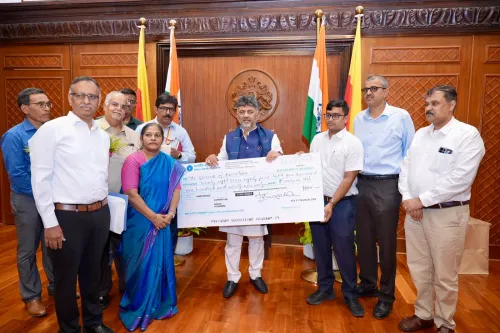
Shivakumar received a dividend cheque of ₹28.84 crore for the Government of Karnataka.
KSFC was established in 1959 to provide long-term credit to MSMEs underserved by commercial banks.
A ₹28.84 crore dividend cheque changed hands in Bengaluru on Friday, 30 October 2026 — and the number behind it tells a larger story about Karnataka's oldest industrial lender quietly turning a corner. The Chief Minister's Office of Karnataka announced that Karnataka State Financial Corporation (KSFC) delivered a profit before tax of ₹155.23 crore and a profit after tax of ₹100.01 crore for FY 2025–26, handing Chief Minister D. K. Shivakumar the dividend on behalf of the state government.
The numbers behind the cheque
KSFC sanctioned term loans worth ₹1,086.67 crore during the year, disbursed ₹722.15 crore, and recovered ₹790.32 crore — a recovery figure that actually exceeds the year's disbursals, a signal of tightening credit discipline. The dividend cheque was presented by Ritesh Kumar Singh, IAS, Chairman, KSFC, and S. S. Nakul, IAS, Managing Director, KSFC, both of whom have overseen the corporation's push to clean up its balance sheet.
Six decades of industrial lending — and why this year stands out
Established in 1959 under the State Financial Corporations Act, 1951, KSFC was built to do what commercial banks historically would not — extend long-term credit to small and medium industries that lacked the collateral or scale to attract mainstream finance. For much of its history the corporation wrestled with high non-performing assets and thin margins, a pattern common to state development finance institutions across India. A profit after tax crossing ₹100 crore in a single year is, against that backdrop, a genuine milestone. State financial corporations that return healthy surpluses to treasuries reduce the government's dependence on central transfers and free up fiscal space for capital expenditure.
What Karnataka's treasury does with the windfall
The ₹28.84 crore dividend flows directly into the state's non-tax revenue. In a fiscal environment where Karnataka has been managing a wide revenue-expenditure gap, every crore from profitable public enterprises matters. Stronger loan recoveries also suggest KSFC is better positioned to rotate capital into fresh lending — potentially expanding credit access for the MSME sector that depends on it most. The next budget presentation will be the real test: whether the government uses KSFC's improved balance sheet to set more ambitious lending targets for FY 2026–27 or simply books the dividend as a one-year win.
For a 67-year-old development lender, a ₹155 crore pre-tax profit year is not just an accounting entry — it is a case study in what public-sector financial discipline, when it actually works, can deliver to a state's bottom line.
Point of View
The dividend and the recovery surplus matter beyond optics — they reduce pressure on a state budget that has faced recurring revenue-deficit concerns. The recovery-exceeding-disbursals ratio is the sharpest signal here: it suggests a deliberate pivot toward portfolio quality over loan-book volume. Whether KSFC can sustain this balance while meaningfully expanding credit to Karnataka's MSME base — its original mandate — will define the next chapter.
NationPress
30 Oct 2026
Frequently Asked Questions
What is KSFC and what does it do?
Karnataka State Financial Corporation (KSFC) is a state-level development finance institution established in 1959 to provide long-term term loans to small and medium industries, particularly MSMEs that do not easily access credit from commercial banks.
How much dividend did KSFC pay to the Karnataka government in 2026?
KSFC presented a dividend cheque of ₹28.84 crore to Chief Minister D. K. Shivakumar on behalf of the Government of Karnataka for FY 2025–26.
What was KSFC's profit in FY 2025–26?
KSFC recorded a profit before tax of ₹155.23 crore and a profit after tax of ₹100.01 crore in FY 2025–26.
How much did KSFC sanction and disburse in loans in FY 2025–26?
KSFC sanctioned term loans worth ₹1,086.67 crore and disbursed ₹722.15 crore, while recovering ₹790.32 crore during FY 2025–26.
Who are the current Chairman and Managing Director of KSFC?
As of FY 2025–26, Ritesh Kumar Singh (IAS) serves as Chairman of KSFC and S. S. Nakul (IAS) serves as Managing Director.