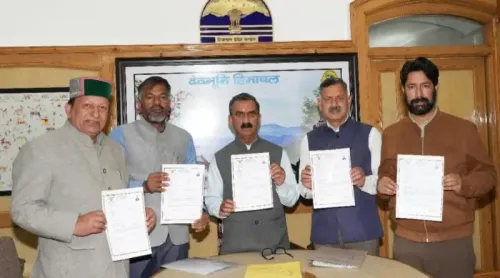
CM Sukhu Announces Above-Market Prices for Turmeric, Ginger, Wheat in Nohradhar

Synopsis
Himachal Pradesh CM Sukhvinder Singh Sukhu announces state procurement of naturally grown turmeric at Rs 150/kg (market: Rs 50–60), ginger at Rs 40/kg (market: Rs 30), wheat at Rs 80/kg and maize at Rs 50/kg in the rural Nohradhar region, with ginger collection centres modelled on the state's apple procurement system.
Key Takeaways
Turmeric will be procured at Rs 150 per kg — nearly three times the market rate of Rs 50–60 per kg — for naturally grown produce in Nohradhar.
Ginger procurement price set at Rs 40 per kg against a current market rate of Rs 30 per kg; a formal notification will be issued soon.
Wheat is already being purchased at Rs 80 per kg and naturally farmed maize at Rs 50 per kg .
Multiple ginger collection centres will be established on the model of Himachal Pradesh's apple procurement system , with doorstep purchase from farmers' homes.
Premium prices apply specifically to crops grown using natural farming methods, incentivising a shift away from synthetic inputs.
The initiative targets Nohradhar in Sirmaur district, a rural area where limited market access constrains farm incomes.
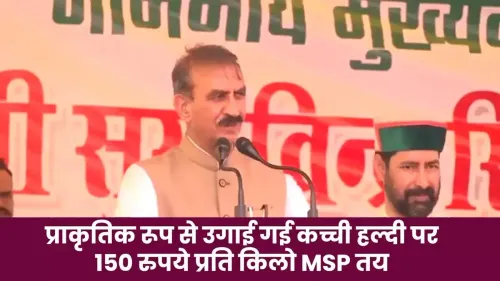
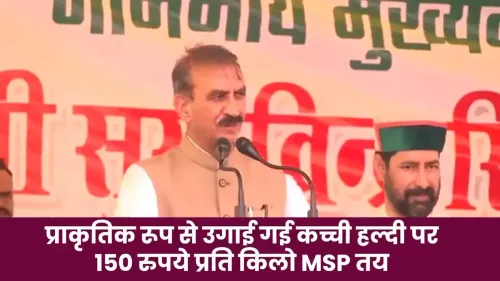
A farmer in Nohradhar growing turmeric would ordinarily pocket Rs 50–60 per kg at the local mandi. Under a new state procurement drive announced by Himachal Pradesh Chief Minister Sukhvinder Singh Sukhu on Friday, 30 October 2026, that same kilogram earns Rs 150 — nearly three times the market rate.
Speaking about the Nohradhar region in Sirmaur district, CM Sukhu laid out a multi-crop procurement package aimed squarely at rural income generation. 'हमारा उद्देश्य किसानों को उनकी उपज का उचित मूल्य दिलाना और गाँव में ही आमदनी के अवसर बढ़ाना है' — 'Our goal is to ensure farmers get a fair price for their produce and that income opportunities grow within the village itself,' he said.
What the state is paying — and what the market pays
The numbers tell the starkest story. Naturally grown turmeric will be procured at Rs 150 per kg against a prevailing market price of Rs 50–60 per kg. Wheat is already being bought at Rs 80 per kg. Naturally farmed maize is being procured at Rs 50 per kg.
Ginger gets its own announcement: the current market rate stands at Rs 30 per kg; the state government will procure it at Rs 40 per kg. Sukhu said a formal notification for the ginger procurement price will be issued shortly.
Ginger gets the apple treatment
Himachal Pradesh has for decades run a structured procurement system for apple orchardists — complete with collection centres spread across hill zones so growers do not have to haul produce to distant mandis. CM Sukhu confirmed that ginger procurement will be modelled on exactly that system.
Multiple collection centres will be set up for ginger, and — critically — the state will purchase ginger directly from farmers' homes. That last detail matters in a terrain where road access is seasonal and transport costs can wipe out any price advantage a hill farmer earns at a distant market.
Natural farming as the qualifying condition
Not every crop in every field qualifies. The premium prices for turmeric and maize are explicitly tied to natural farming — produce grown without synthetic inputs. This aligns with a broader push by several Indian state governments to encourage chemical-free agriculture by making it financially rewarding rather than just aspirational.
For Nohradhar's farming households, the calculus is now straightforward: switch to natural methods, and the state becomes your guaranteed buyer at rates that dwarf what a middleman would offer. Whether the notification and collection infrastructure arrive before the next planting cycle will determine how many farmers actually make that switch.
A procurement promise is only as good as the logistics behind it. The apple system took years to mature — ginger growers in Nohradhar will be watching to see how fast the state can replicate it.
Point of View
The government layers an agrarian-transition incentive onto a straightforward income-support measure — a dual-objective design increasingly common among Congress-governed states. The apple-system template for ginger is politically astute: it leverages existing institutional memory and public trust. The critical test, however, is execution speed — if the ginger notification and collection centres do not materialise before the next sowing season, the announcement risks being remembered as aspiration rather than action.
NationPress
30 Oct 2026
Frequently Asked Questions
What is the new turmeric procurement price in Himachal Pradesh?
The Himachal Pradesh government will procure naturally grown turmeric at Rs 150 per kg in the Nohradhar region, compared to a market price of Rs 50–60 per kg.
What price will the HP government pay for ginger?
The state government has announced a procurement price of Rs 40 per kg for ginger, above the current market rate of Rs 30 per kg. A formal notification will be issued shortly.
What is the wheat procurement price announced by CM Sukhu?
CM Sukhvinder Singh Sukhu stated that wheat is being purchased at Rs 80 per kg under the state government's rural income initiative in Nohradhar.
How will ginger be collected from farmers in Nohradhar?
Multiple collection centres modelled on Himachal Pradesh's apple procurement system will be set up, and the government will also purchase ginger directly from farmers' homes.
Does the higher procurement price apply to all farming methods?
No. The premium procurement prices for turmeric and maize specifically apply to naturally farmed produce — crops grown without synthetic inputs — as part of the state's push to promote natural farming.