BJP Critiques Karnataka's Decision to Abolish Hindi in Class 10 Curriculum
Synopsis
In a critical assessment, Opposition Leader R. Ashoka challenges the Congress government's decision to eliminate Hindi as a third language for Class 10 students, arguing it jeopardizes their future and is politically motivated.
Key Takeaways
Opposition Leader R.
Ashoka criticizes the removal of Hindi as a third language.
Decision seen as politically motivated and harmful to students' futures.
Ashoka references Mahatma Gandhi's historical promotion of Hindi.
Concerns raised about communication challenges for Kannada students BJP plans to support language options through National Education Policy.
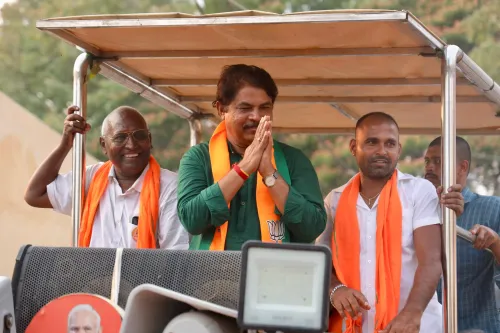
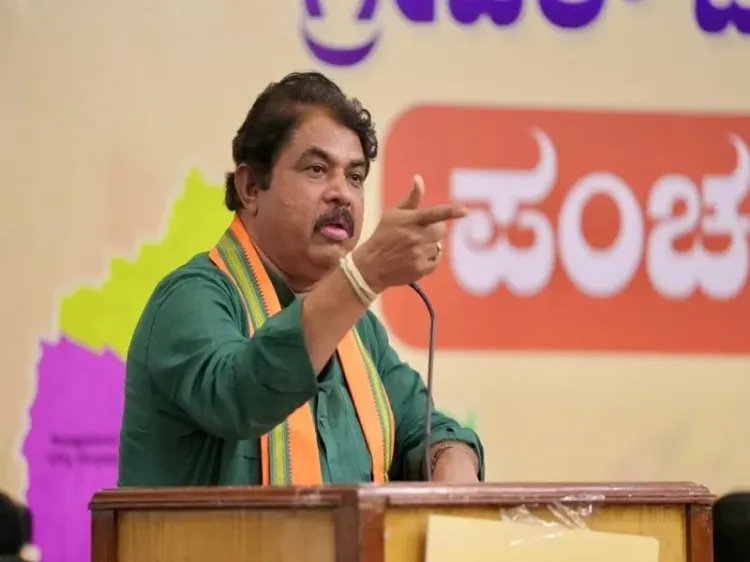
Bengaluru, March 30 (NationPress) The Opposition Leader R. Ashoka has expressed strong disapproval of the Congress government’s recent decision to eliminate Hindi as a third language for Class 10 students, asserting that this change jeopardizes students’ futures. He claimed that the rationale behind this action was not a genuine affection for Kannada, but rather politically motivated.
During a press briefing in Bengaluru, Ashoka pointed out that the Education Department’s abrupt removal of Hindi comes at a critical time, when students are in the midst of their examinations. “Millions of students have dedicated time and effort to studying Hindi; this unexpected alteration has caused significant disruption,” he stated.
He further remarked on Mahatma Gandhi’s historical role as the president of the Hindi Prachar Samiti in 1918, which played a pivotal part in promoting Hindi in South India. “Congress leaders, lacking awareness of this vital history, have hastily discarded Hindi. We must prioritize sensitivity towards children,” he emphasized.
Ashoka noted that English serves as a global lingua franca, and even languages like Urdu—despite not being indigenous—are widely learned in India. “Students who anticipated high marks in Hindi are now left disheartened due to the government’s choice. This not only reflects a weakness in governance but is also a dishonor to Mahatma Gandhi,” he asserted.
He highlighted the irony of Congress leaders who previously protested against the removal of Gandhi's name from MGNREGA but remain silent now. “The three-language policy was first introduced by India’s inaugural Prime Minister, Jawaharlal Nehru, and later reinforced by Indira Gandhi. The current government’s attempt to replicate Tamil Nadu's model seems misguided,” he stated.
Ashoka criticized the Congress government for not ensuring proficiency in Kannada among Muslims in Karnataka, unlike their counterparts in Tamil Nadu and Kerala. “There appears to be no genuine effort to promote fluency in Kannada,” he alleged.
Questioning the implications of this policy, he stated, “If Kannada-speaking students pursue IAS or IPS careers in Hindi-speaking regions, what language will they utilize there? This decision stems from political hostility towards Prime Minister Narendra Modi, representing vote-bank politics that endangers students’ prospects.”
He expressed confidence that the BJP would advance the National Education Policy in the future, which supports multiple language options.
Ashoka conveyed optimism about the BJP’s success in the upcoming by-elections in Davanagere and Bagalkot, asserting that voters in these areas are disenchanted with Congress. He noted that Chief Minister Siddaramaiah is actively campaigning due to fears of losing influence, while Minister Zameer Ahmad Khan is less engaged.
He criticized the government’s financial practices, pointing out the annual increase in borrowing, which he claims prevents welfare schemes from reaching the underprivileged.
In the context of a terror-related case, he mentioned that an individual accused of planning bomb attacks at Dharmasthala and Kadri temples had confessed. He condemned Deputy Chief Minister D.K. Shivakumar for previously referring to the accused as “my brother,” demanding accountability from Congress. “For votes, they align with individuals who pose risks to national security,” he charged.
Ashoka claimed that Congress's survival is contingent upon the INDIA coalition and forecasted a decline for the party on a national scale. He also noted that PM Modi has facilitated oil shipments from Iran to India and expressed hope for a gradual resolution of related issues.
Point of View
The potential impact on students' educational opportunities cannot be overlooked. As political tensions rise, the voices of students and their futures should remain at the forefront of this discussion.
NationPress
2 Oct 2026
Frequently Asked Questions
Why did the Karnataka government remove Hindi as a third language?
The government claims the decision was made for political reasons, but critics argue it jeopardizes students' futures.
What are the implications of this decision for students?
Many students who have prepared for exams in Hindi are now facing confusion and disappointment due to the sudden removal.
What did R. Ashoka say about Mahatma Gandhi's role in promoting Hindi?
Ashoka highlighted Gandhi's historical involvement in promoting Hindi in South India, criticizing the Congress for ignoring this legacy.
How does this decision affect students planning to work in Hindi-speaking regions?
Ashoka raised concerns that Kannada-speaking students may struggle to communicate in Hindi-speaking states, impacting their career prospects.
What does the BJP plan to do regarding the National Education Policy?
The BJP aims to implement the National Education Policy in the future, which supports multiple language options for students.