KTR launches 'Game Changers', spotlights Hyderabad Foodman
Synopsis
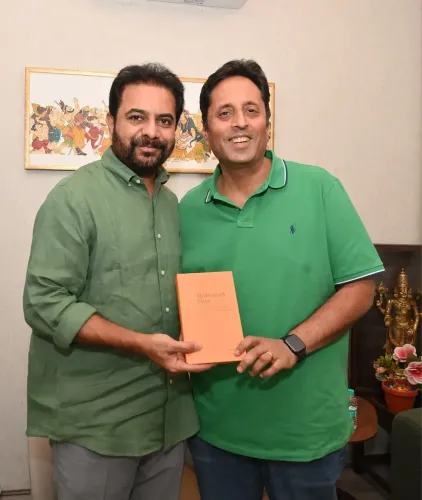
BRS working president K. T. Rama Rao launched 'Game Changers', a book by Uday Shankar profiling 20 Indian heroes including Hyderabad's Azhar Maqsusi, the 'Foodman' who has distributed free meals for over 5,000 consecutive days under the motto 'Hunger has no religion'.
Key Takeaways
Rama Rao launched 'Game Changers' by author Uday Shankar on 18 November 2026 .
The book profiles 20 everyday Indian heroes , blending national figures with regional humanitarians.
Azhar Maqsusi , the 'Hyderabad Foodman' , has distributed free food every single day for more than 5,000 days .
His guiding motto — 'Hunger has no religion' — underpins a service that makes no distinction of identity.
Other featured heroes include E.
Shridharan , Tessy Thomas , Srikanth Bolla , and Dashrath Manjhi .
Rama Rao offered public gratitude to Maqsusi and called for broader recognition of his sustained, grassroots contribution.
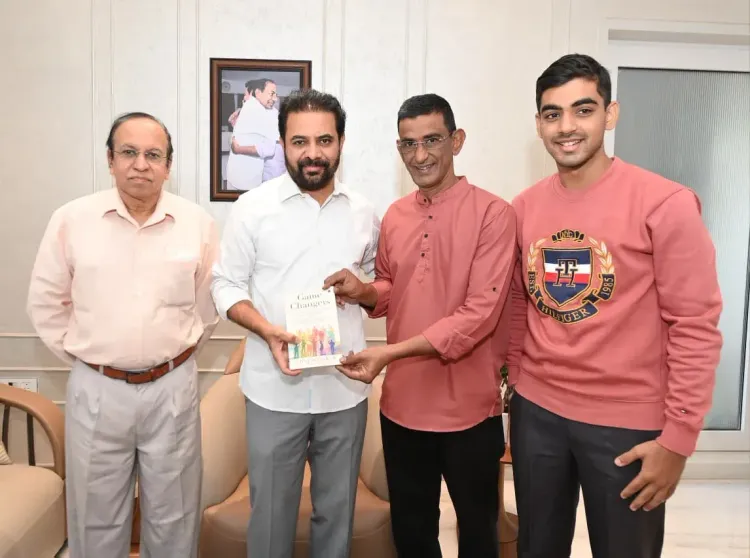
A book celebrating 20 everyday Indian heroes found a vocal champion on Wednesday, 18 November 2026, when BRS working president K. T. Rama Rao launched 'Game Changers' — authored by Uday Shankar — and used the moment to shine an especially warm light on a fellow Hyderabadi quietly fighting hunger one meal at a time.
Fourteen years of free meals, one motto that cuts across every divide
Azhar Maqsusi, widely celebrated as the 'Hyderabad Foodman', has been distributing free food to the hungry every single day for more than 5,000 days — a streak that stretches back well over a decade. His guiding principle is as simple as it is radical: 'Hunger has no religion.' No means test, no identity check, just a meal for anyone who needs one.
Rama Rao, posting on X, called out Maqsusi by name and handle, expressing 'heartfelt gratitude to Azhar bhai for his selfless service to society' and offering a prayer that the Almighty bless him with 'greater strength to continue serving the needy.' In Hyderabad's public life, where communal fault-lines are always close to the surface, the salute carries a particular resonance.
The company Azhar keeps in 'Game Changers'
Maqsusi appears alongside a remarkable cast in Uday Shankar's book. E. Shridharan — 'The Metro Man' — reshaped urban mobility across India through landmark metro rail projects. Tessy Thomas, 'The Missile Woman of India', drove the development of the Agni missile series as a defence scientist. Srikanth Bolla, 'The Sightless Hero', built a thriving enterprise despite total visual impairment. And Dashrath Manjhi, 'The Mountain Man', famously carved a road through a hill in Bihar single-handedly — a feat that has since entered national folklore.
Placing a Hyderabadi street-level humanitarian alongside icons of infrastructure, defence science, and entrepreneurship is itself a statement about what 'changing the game' actually means.
Why a politician's book launch matters beyond the post
Indian political figures regularly amplify books and stories that weave together national icons and local heroes — it is a well-worn genre of public communication. But Rama Rao's choice of emphasis is telling. By foregrounding Maqsusi specifically, he anchors a national narrative back to Hyderabad, and to a kind of quiet, undramatic service that rarely commands prime-time attention.
The 5,000-day milestone — roughly 13-plus years of unbroken daily food distribution — is the kind of number that lands differently once you do the arithmetic. No government scheme, no corporate CSR cycle, just one person showing up every day.
That, as Rama Rao frames it, is what a game changer looks like from the ground up.
Point of View
Amplifying a Hyderabadi Muslim philanthropist with an explicitly secular motto is also a soft-power signal in a state where identity politics runs deep. The book launch format allows a politician to associate with an aspirational national narrative without direct policy stakes. The broader pattern here is of regional political figures using cultural moments to stitch together local pride and pan-India inspiration.
NationPress
18 Nov 2026
Frequently Asked Questions
Who is Azhar Maqsusi and why is he called the Hyderabad Foodman?
Azhar Maqsusi is a Hyderabad-based social activist who has distributed free food to the hungry every day for more than 5,000 days. His motto 'Hunger has no religion' means he feeds anyone in need regardless of identity, earning him the title 'Hyderabad Foodman'.
What is the book 'Game Changers' about?
'Game Changers' is written by Uday Shankar and profiles the inspiring journeys of 20 everyday Indian heroes, including E. Shridharan, Tessy Thomas, Srikanth Bolla, Dashrath Manjhi, and Azhar Maqsusi.
Who launched 'Game Changers' and when?
BRS working president K. T. Rama Rao launched the book on 18 November 2026, announcing it on X and highlighting Azhar Maqsusi's work in particular.
Who are the other heroes featured in 'Game Changers'?
The book features E. Shridharan ('The Metro Man'), Tessy Thomas ('The Missile Woman of India'), Srikanth Bolla ('The Sightless Hero'), and Dashrath Manjhi ('The Mountain Man'), among 15 other everyday heroes.
What is KT Rama Rao's connection to Hyderabad?
K. T. Rama Rao is the working president of BRS and a former Minister for IT, Industries and Municipal Administration in the Telangana government, making Hyderabad his political and professional base.