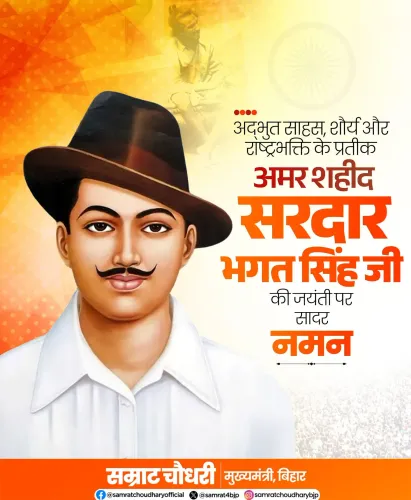
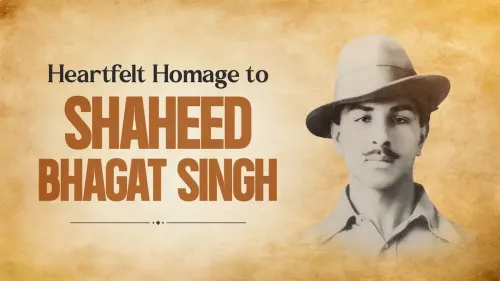
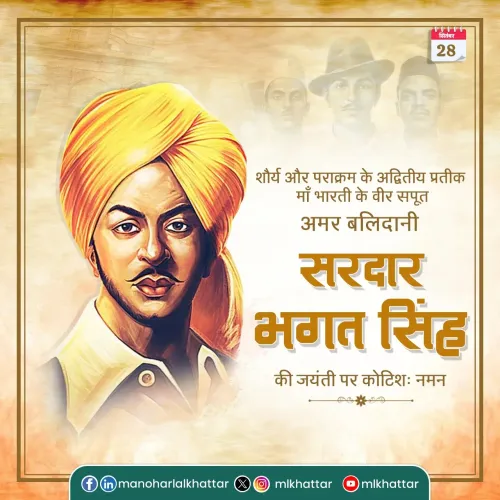
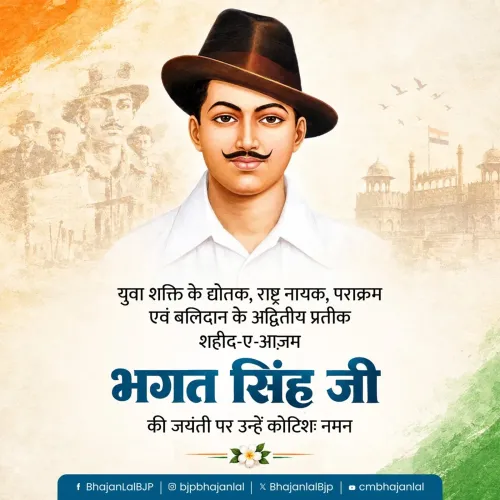
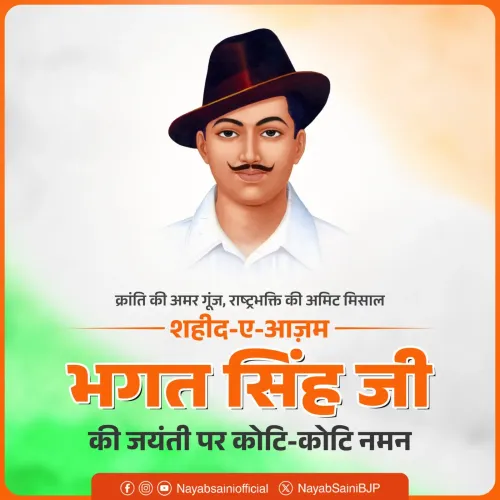
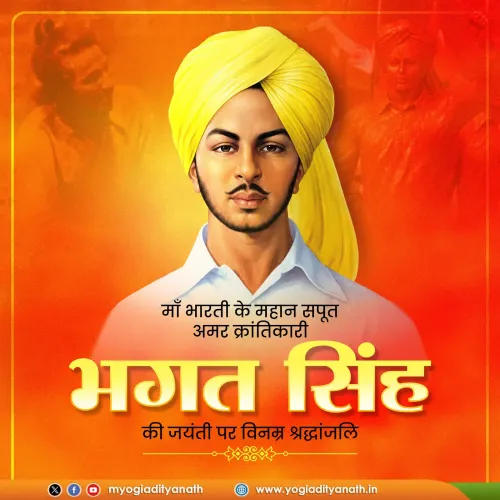
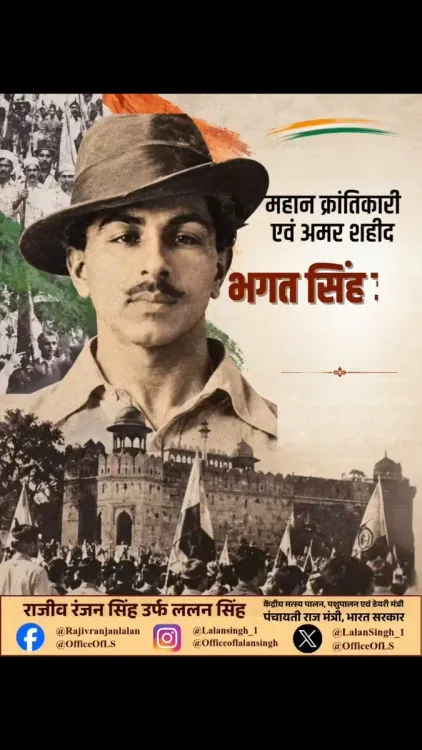
Lalan Singh pays tribute to Bhagat Singh on birth anniversary
Synopsis
Union Panchayati Raj Minister Rajiv Ranjan Singh (Lalan Singh) posted a Hindi tribute on X honouring Sardar Bhagat Singh on his birth anniversary, praising the revolutionary martyr's courage and sacrifice as a perpetual source of national inspiration.
Key Takeaways
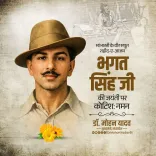
Union Minister Rajiv Ranjan Singh (Lalan Singh) paid tribute to Sardar Bhagat Singh on his birth anniversary, 28 September 2026 .
Bhagat Singh was born on 28 September 1907 and hanged by British authorities on 23 March 1931 at age 23 .
Lalan Singh described Bhagat Singh's courage, sacrifice and patriotism as an eternal source of inspiration for all Indians.
Political leaders across parties observe 28 September annually with tributes to the revolutionary martyr.
Bhagat Singh's legacy transcends party lines, claimed by nationalists, leftists and centrists alike.
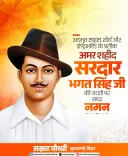
On the birth anniversary of Sardar Bhagat Singh, Union Minister Rajiv Ranjan Singh (Lalan Singh) joined millions of Indians on Monday, 28 September 2026, in honouring the revolutionary martyr who chose the gallows over colonial submission at just 23 years of age.
Posting in Hindi on X, the senior Janata Dal (United) leader wrote: 'महान क्रांतिकारी एवं अमर शहीद सरदार भगत सिंह जी की जयंती पर उन्हें कोटि-कोटि नमन' — ('A million salutes to the great revolutionary and immortal martyr Sardar Bhagat Singh on his birth anniversary'). He added that Bhagat Singh's 'indomitable courage, sacrifice and patriotism for the freedom of the motherland will always inspire the people of this country.'
The martyr whose shadow never left Indian politics
Sardar Bhagat Singh was born on 28 September 1907 in the Lyallpur district of undivided Punjab. Hanged by British authorities on 23 March 1931, he became, in death, something his colonial prosecutors never intended — an enduring symbol of fearless resistance and youthful sacrifice that transcends party and ideology.
His image occupies a unique space in Indian public life: claimed simultaneously by the left for his socialist leanings, by nationalists for his anti-colonial fire, and by every shade of political opinion in between. That universality is precisely why his birth anniversary triggers an annual, cross-party wave of tributes from Parliament to village panchayat.
A ritual of remembrance, year after year
Indian leaders across the political spectrum — from the ruling dispensation to the principal opposition — mark 28 September with statements, wreath-laying ceremonies, and school programmes. The ritual is less about electoral calculation and more about the enduring weight the freedom struggle carries in the country's self-image. For a minister who heads the Panchayati Raj portfolio — the layer of governance closest to India's villages — invoking Bhagat Singh's village-rooted patriotism carries a particular resonance.
Ninety-five years after his execution, the revolutionary from Punjab still anchors the nation's conversation about what it means to love a country enough to die for it. That is not a small inheritance.
Point of View
Notably, is announce any concrete policy or programme in Bhagat Singh's memory — a gap that reformers and historians have repeatedly flagged as the distance between ritual remembrance and substantive legacy.
NationPress
28 Sept 2026
Frequently Asked Questions
When is Sardar Bhagat Singh's birth anniversary?
Sardar Bhagat Singh was born on 28 September 1907 , and his birth anniversary is observed every year on that date across India.
Who is Lalan Singh and what ministry does he head?
Rajiv Ranjan Singh , popularly known as Lalan Singh, is a senior Janata Dal (United) leader and Union Minister for Panchayati Raj, Fisheries, Animal Husbandry and Dairying in the Government of India.
Why was Bhagat Singh hanged by the British?
Bhagat Singh was tried and hanged on 23 March 1931 by British colonial authorities for his role in revolutionary activities against colonial rule, including the Lahore Conspiracy Case. He was 23 years old at the time of his execution.
Why do Indian politicians from different parties all tribute Bhagat Singh?
Bhagat Singh's legacy spans ideological boundaries — his anti-colonial courage appeals to nationalists, his socialist writings attract the left, and his youth and sacrifice resonate universally — making him a rare figure whom every party can honour without political risk.
What did Lalan Singh say about Bhagat Singh on his 2026 birth anniversary?
Lalan Singh posted in Hindi that Bhagat Singh's 'indomitable courage, sacrifice and patriotism for the freedom of the motherland will always inspire the people of this country,' offering what he described as a million salutes to the immortal martyr.