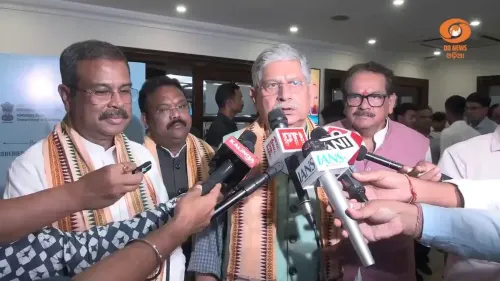
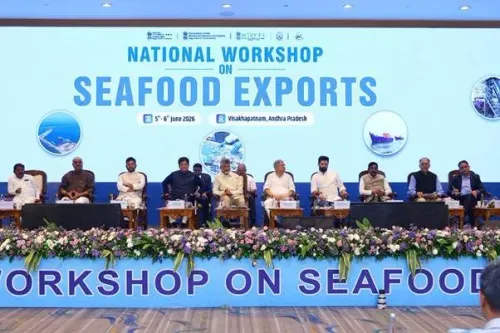
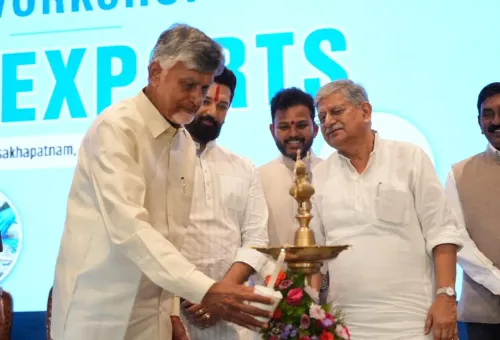
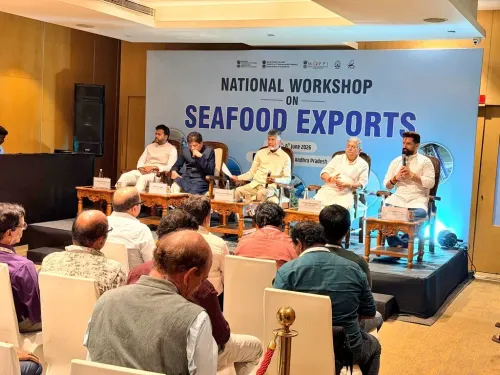
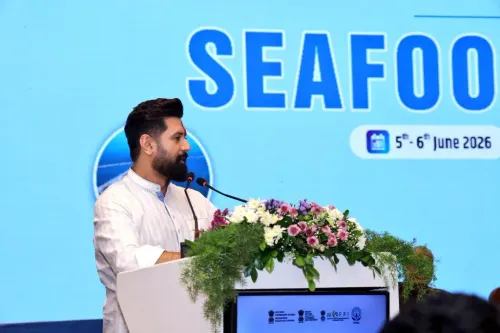
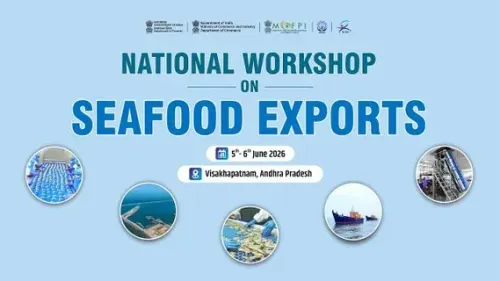
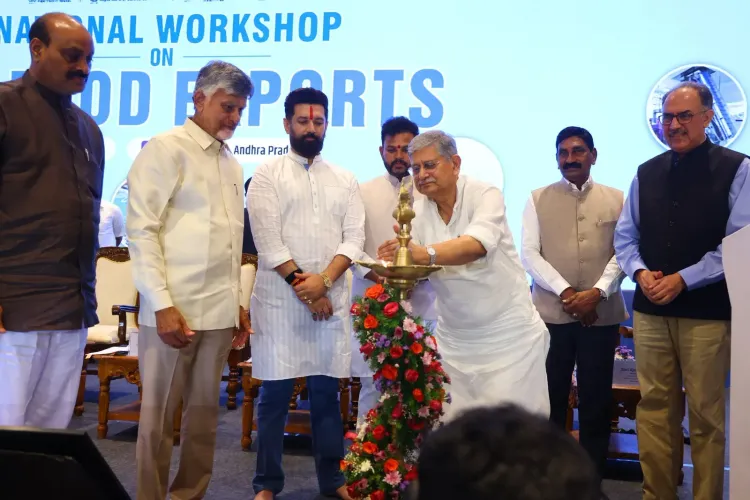
Lalan Singh addresses National Seafood Export Workshop in Visakhapatnam
Synopsis
Union Fisheries Minister Lalan Singh addressed the National Seafood Export Workshop in Visakhapatnam on June 5, 2026, engaging stakeholders on marine product exports and fisheries sector growth under India's blue economy push.
Key Takeaways
Union Minister Rajiv Ranjan Singh (Lalan Singh) addressed the National Seafood Export Workshop in Visakhapatnam, Andhra Pradesh on June 5, 2026 .
The workshop focused on key issues related to seafood exports and development of India's fisheries sector .
Visakhapatnam is one of India's leading port cities and a major hub for seafood processing and marine product exports.
Andhra Pradesh ranks among India's top marine product exporting states, making it a strategic venue for national-level fisheries policy dialogue.
The event aligns with the Pradhan Mantri Matsya Sampada Yojana (PMMSY) , launched in 2020 to modernise fisheries and boost exports.
Outcomes may include state-specific implementation guidelines under central fisheries schemes and inputs into upcoming seafood export data assessments.
Union Panchayati Raj and Fisheries Minister Rajiv Ranjan Singh, popularly known as Lalan Singh, addressed participants at the National Seafood Export Workshop held in Visakhapatnam, Andhra Pradesh, on Friday, June 5, 2026. The workshop brought together stakeholders from the fisheries and marine products sector to deliberate on key issues concerning seafood exports and the broader development of India's fisheries industry.
Context
In his post on X, the Minister stated that he 'समुद्री उत्पादों के निर्यात और मत्स्य क्षेत्र के विकास से जुड़े महत्वपूर्ण विषयों पर चर्चा की' — that is, 'discussed important topics related to the export of marine products and the development of the fisheries sector.' The event was hosted in Visakhapatnam, one of India's foremost port cities and a nerve centre for seafood processing and export logistics along the eastern coast.
Andhra Pradesh has consistently ranked among India's top marine product exporting states, making it a natural venue for a national-level conversation on scaling up seafood trade and strengthening value-addition capacity.
Policy Backdrop
The workshop takes place within the framework of the Pradhan Mantri Matsya Sampada Yojana (PMMSY), the flagship central scheme launched in 2020 to modernise the fisheries sector, enhance production, and boost marine product exports. The scheme has set an ambitious goal of doubling the incomes of fishers and significantly raising India's share in global seafood trade.
Successive central governments have positioned fisheries as a core pillar of India's blue economy strategy. Targeted workshops at the state level — particularly in high-output coastal states — form a key component of the policy outreach and implementation architecture under PMMSY and allied programmes. The emphasis has increasingly shifted toward cold-chain infrastructure, value addition, and compliance with international quality standards to make Indian seafood more competitive in global markets.
Stakeholders and Impact
Seafood exporters, processing unit operators, and coastal fishermen from Andhra Pradesh and neighbouring states are among the primary stakeholders engaged by such workshops. For fishing communities, improved export linkages translate directly into better price realisation and more stable livelihoods.
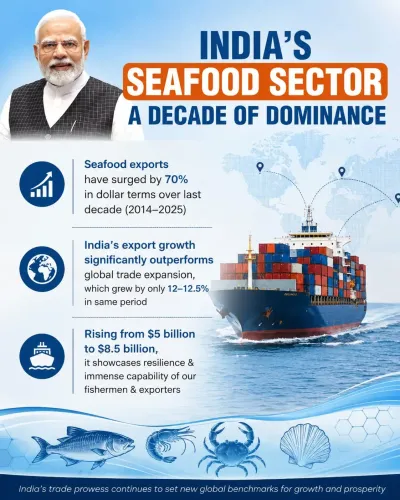
India's marine products export sector supports millions of jobs along the coastline, from harvest and processing to logistics and packaging. Visakhapatnam's port infrastructure and established cold-chain networks make it a strategic focal point for any national initiative aimed at expanding seafood exports. Deliberations at this level typically feed into state-specific implementation guidelines and budgetary allocations under central fisheries schemes.
What's Next
Observers will watch for any state-specific guidelines or directives that emerge from the June 5 workshop, as well as the release of updated annual seafood export data that would benchmark India's progress toward its blue economy targets. The Ministry's continued engagement with coastal states signals that fisheries development will remain a priority area in the government's economic agenda.
With global demand for sustainably sourced seafood rising, India's ability to align domestic production and export infrastructure with international standards will be critical to capturing a larger share of the market in the coming years.
Frequently Asked Questions
What is the National Seafood Export Workshop in Visakhapatnam?
It is a national-level workshop held in Visakhapatnam, Andhra Pradesh, on June 5, 2026, convened to discuss strategies for boosting India's seafood exports and developing the fisheries sector, attended by Union Fisheries Minister Lalan Singh and key industry stakeholders.
Who is Lalan Singh and what is his role in fisheries?
Lalan Singh, formally known as Rajiv Ranjan Singh, is the Union Minister of Panchayati Raj, Fisheries, Animal Husbandry and Dairying. He is a senior Janata Dal (United) leader and the central government's principal minister responsible for fisheries policy and seafood export promotion.
What is Pradhan Mantri Matsya Sampada Yojana?
Pradhan Mantri Matsya Sampada Yojana (PMMSY) is a flagship central scheme launched in 2020 to modernise India's fisheries sector, enhance fish production, improve cold-chain infrastructure, and significantly increase marine product exports with the goal of doubling fishers' incomes.
Why is Visakhapatnam important for seafood exports?
Visakhapatnam is a major port city in Andhra Pradesh with well-established seafood processing facilities, cold-chain networks, and export logistics infrastructure. Andhra Pradesh consistently ranks among India's top marine product exporting states, making Visakhapatnam a key hub for national fisheries trade.
What are the key issues discussed at India's seafood export workshops?
Such workshops typically cover topics including compliance with international quality standards, expansion of cold-chain and processing infrastructure, value addition in marine products, implementation of central schemes like PMMSY, and strategies to raise India's share in global seafood markets.