Life convicts wed inside Jodhpur's Mandore Open Jail after Rajasthan HC nod
Synopsis
Two life convicts serving sentences for separate murder cases got married inside Jodhpur's Mandore Open Jail on Wednesday — a ceremony made possible only by a Rajasthan High Court order. With just 21 witnesses and sweets instead of a banquet, the wedding is less a human-interest oddity and more a rare, visible test of whether India's open-jail rehabilitation model can deliver on its promise of second chances.
Key Takeaways
Mularam and Seema , both life convicts in separate murder cases, were married inside Mandore Open Jail , Jodhpur , on Wednesday .
The Rajasthan High Court granted permission for the marriage after reviewing the couple's rehabilitation progress and legal rights.
The ceremony involved traditional Hindu saat phere rituals, with 21 witnesses — mostly prison and security personnel.
Both convicts had earned transfer to Mandore Open Jail , a rehabilitation-focused institution, due to their good conduct.
The couple will continue serving their respective life sentences but now do so as husband and wife under open-jail rules.
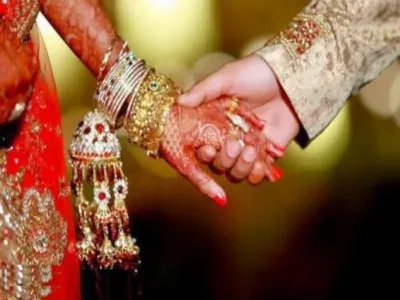
Mularam and Seema, two life convicts serving sentences in separate murder cases, were married inside the premises of Mandore Open Jail in Jodhpur on Wednesday, after securing permission from the Rajasthan High Court. The ceremony, conducted with traditional Hindu wedding rituals including the saat phere, briefly transformed the open jail into a wedding venue — garlands and wedding chants replacing the usual rhythms of incarceration.
The Ceremony
Mularam, dressed as the groom, and Seema, adorned as the bride, exchanged garlands before completing the customary seven rounds in the presence of jail officials, police personnel, and prison staff who served as witnesses. The guest list was limited to 21 people, comprising mostly prison administration and security personnel. Sweets were distributed and the occasion carried, by accounts of those present, the warmth of a family gathering rather than an institutional event.
How the Rajasthan High Court Enabled the Wedding
Both convicts had earned transfer to Mandore Open Jail — a correctional facility designed for rehabilitation rather than strict confinement — on account of their good conduct while serving their respective life sentences. It was within the open jail's environment that the two came to know each other, and their acquaintance gradually developed into a relationship. Since they remained under judicial custody, their marriage required court approval. The Rajasthan High Court granted permission after considering their rehabilitation progress and legal rights, and also directed that the necessary parole and administrative formalities be completed before the ceremony could proceed.
What Mandore Open Jail Represents
Unlike high-security prisons, open jails in Rajasthan are designed for inmates who demonstrate good conduct and pose lower security risks. The philosophy underpinning such institutions is to prepare prisoners for eventual reintegration into society by fostering responsibility, discipline, and social engagement. Prison officials have stated that the institution's broader objective is to ensure inmates are not defined solely by their crimes but are given structured opportunities to reform. The marriage of Mularam and Seema is being viewed within that larger rehabilitative framework.
Significance Beyond the Prison Walls
The wedding has drawn attention not because of its scale but because of what it represents. It highlights the role of rehabilitation within India's criminal justice system and raises broader questions about human dignity, second chances, and the capacity for change — even for those serving life sentences. The couple will continue to serve their respective sentences under the rules governing the open jail, but now do so as partners. As prison officials noted, the day marked not the end of a sentence but the beginning of a shared journey — one that began not in a wedding hall, but within walls built on the premise that rehabilitation, too, has a place in justice.
Point of View
Concrete instance of India's open-jail philosophy producing a visible human outcome — but it also exposes how little public attention the country's rehabilitation infrastructure ordinarily receives. The Rajasthan High Court's willingness to grant marital rights to life convicts is legally significant, yet it will likely be remembered as a curiosity rather than a precedent unless prison reform advocates push it into policy discourse. The deeper question the case surfaces — whether life imprisonment should extinguish civil rights like marriage — remains unresolved in Indian law and largely unasked in mainstream coverage.
NationPress
21 Oct 2026
Frequently Asked Questions
Who are Mularam and Seema, the convicts who married in Jodhpur jail?
Mularam and Seema are two life convicts serving sentences in separate murder cases at Mandore Open Jail in Jodhpur, Rajasthan. Their good conduct while in prison earned them a transfer to the open jail, where they met and eventually sought court permission to marry.
How did the marriage inside Jodhpur jail get legal approval?
The couple approached the Rajasthan High Court, which granted permission for the marriage after considering their rehabilitation progress and legal rights. The court also directed that necessary parole and administrative formalities be completed before the ceremony.
What is Mandore Open Jail and how is it different from a regular prison?
Mandore Open Jail in Jodhpur is a correctional institution designed for inmates with good conduct and lower security risks. Unlike high-security prisons, it focuses on rehabilitation and preparing convicts for eventual reintegration into society through responsibility and social engagement.
Will the couple be released after the marriage?
No. Mularam and Seema will continue to serve their respective life sentences under the rules governing Mandore Open Jail. The marriage does not alter their legal sentences but allows them to live as partners within the open-jail framework.
Why is this prison wedding significant?
The wedding highlights the role of rehabilitation within India's criminal justice system and raises questions about human dignity and second chances for life convicts. It is being viewed as a reflection of the open-jail model's broader goal of allowing inmates to reform and rebuild their lives.