CM Yogi: Lucknow Seed Park named after Chaudhary Charan Singh
Synopsis
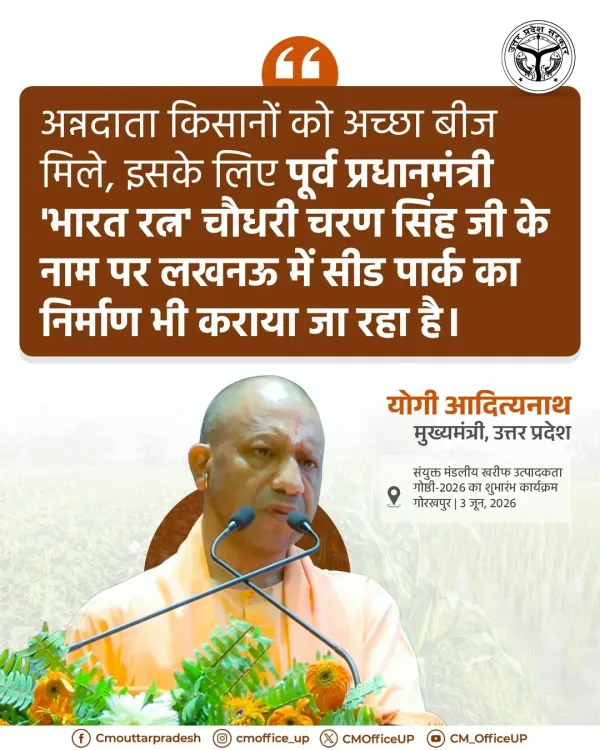
The Chief Minister's Office of Uttar Pradesh announced that a Seed Park is being built in Lucknow, named after former Prime Minister and Bharat Ratna Chaudhary Charan Singh, to ensure that farmers receive quality seeds. CM Yogi Adityanath framed the project as part of the state's wider push to strengthen agricultural inputs and farmer welfare.
Key Takeaways
A new Seed Park is being constructed in Lucknow , the Chief Minister's Office of Uttar Pradesh said on 3 June 2026 .
The park will be named after former Prime Minister and Bharat Ratna awardee Chaudhary Charan Singh .
Chief Minister Yogi Adityanath said the aim is to ensure 'good quality seed' reaches farmers, described as annadata (food-providers).
The initiative slots into Uttar Pradesh's broader agricultural infrastructure push around seed quality and supply.
Construction timelines, costs and commissioning details were not specified in the announcement.
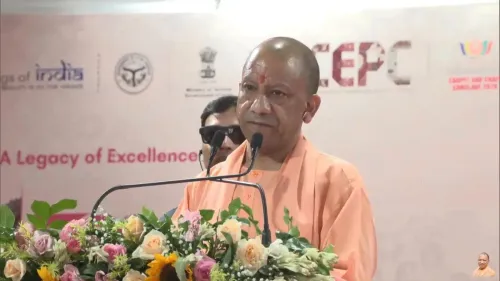
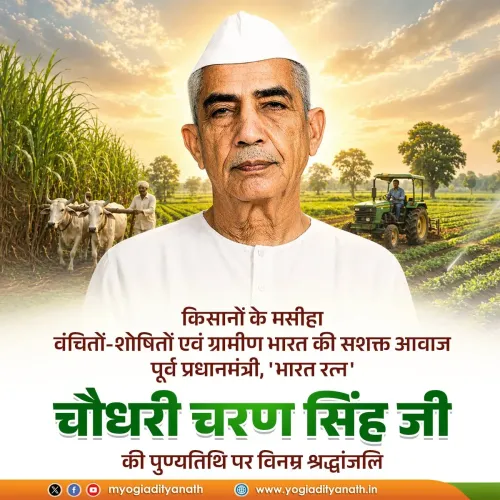
The Chief Minister's Office of Uttar Pradesh on Wednesday, 3 June 2026 announced that a dedicated Seed Park is being built in Lucknow in the name of former Prime Minister and Bharat Ratna awardee Chaudhary Charan Singh, framing the facility as a step toward improving quality seed access for farmers. The announcement, attributed to Chief Minister Yogi Adityanath, casts the project as part of the state's broader push to strengthen agricultural inputs.
In the post, the Chief Minister said in Hindi, 'Annadata kisanon ko achha beej mile' ('so that our farmers, the food-providers, get good quality seed'), adding that the Seed Park in Lucknow is being constructed in the name of the former Prime Minister.
Context
The Seed Park is positioned by the state government as a specialised agricultural infrastructure facility aimed at improving the availability of high-quality seeds to cultivators across Uttar Pradesh. By attaching the name of Chaudhary Charan Singh — a figure long associated with farmer-centric politics in north India — the administration links the project to a recognisable rural-policy legacy.
Chaudhary Charan Singh served as Prime Minister briefly in 1979-1980 and his tenure is remembered for an emphasis on land reform, cooperative credit and agricultural priorities. He was conferred the Bharat Ratna, India's highest civilian honour, in recognition of his contribution to rural India.
Policy backdrop
Uttar Pradesh, India's most populous state and a major producer of wheat, sugarcane, pulses and oilseeds, has steadily expanded its agricultural infrastructure footprint over recent years. Seed processing, certification and storage facilities are a recurring feature of state agriculture missions, sitting alongside central programmes that target seed replacement rates and varietal improvement.
The Chief Minister's framing — that 'good seed' is foundational to farmer welfare — aligns with a long-running national policy emphasis on quality inputs as a lever for productivity. Naming flagship rural projects after national leaders identified with farmers' causes is also a familiar administrative practice across Indian states.
Stakeholders and impact
The direct beneficiaries identified by the state are farmers in Uttar Pradesh, who depend on timely access to certified, high-germination seed for staple and commercial crops. Agricultural cooperatives, state seed corporations and private seed companies typically form the supply chain that such parks are designed to consolidate.
For Lucknow, the state capital, the project adds to a growing cluster of agriculture- and governance-linked institutions. If integrated with existing seed supply networks, the facility could play a role in reducing dependence on out-of-state seed sourcing for several crop categories.
What's next
The Chief Minister's post did not specify construction timelines, costs or a commissioning date for the Seed Park. Attention is likely to turn to subsequent budget allocations, tendering details and the institutional structure that will operate the park once it is built.
For the state's agriculture department, the test will lie in whether the Lucknow Seed Park translates announcements into measurable gains in seed replacement rates, varietal diversity and farmer reach — and how it dovetails with existing state and central seed schemes in the seasons ahead.
Point of View
The state government signals continuity with a long arc of farmer-welfare politics while staking ground on a productivity-led agenda. The substantive measure of success, however, will be operational — whether the Lucknow Seed Park meaningfully lifts seed replacement rates and varietal access for cultivators across UP's diverse agro-climatic zones.
NationPress
17 Oct 2026
Frequently Asked Questions
What is the Lucknow Seed Park announced by CM Yogi Adityanath?
It is a planned agricultural infrastructure facility in Lucknow being built by the Uttar Pradesh government to improve farmers' access to quality seeds. The Chief Minister's Office said it will be named after former Prime Minister Chaudhary Charan Singh.
Why is the Seed Park named after Chaudhary Charan Singh?
Chaudhary Charan Singh is identified with farmer-centric politics, land reform and rural welfare, and was conferred the Bharat Ratna. Naming the seed facility after him links the project to his legacy on agricultural issues.
Where will the Seed Park be located?
The Seed Park is being constructed in Lucknow, the capital of Uttar Pradesh. It is intended to serve farmers across the state by strengthening seed supply infrastructure.
Who will benefit from the Lucknow Seed Park?
Farmers in Uttar Pradesh are the primary intended beneficiaries, with the project framed around ensuring access to good quality seed. Agricultural cooperatives and the state's seed supply chain are also expected to be linked to the facility.
When will the Lucknow Seed Park be completed?
The Chief Minister's Office did not specify a completion date or construction timeline in its announcement. Further details on budget, milestones and commissioning are awaited from the state government.