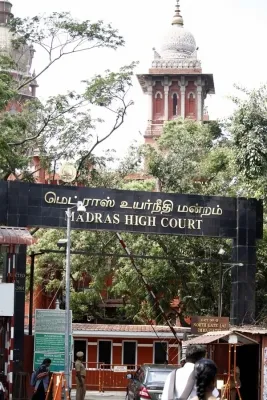
Madras High Court Dismisses Tax Evasion Charges Against Filmmaker Gautham Menon
Synopsis
In a significant legal victory, the Madras High Court has quashed the tax evasion case against filmmaker Gautham Menon, affirming his non-involvement due to his resignation prior to the alleged offenses. The court emphasizes continued prosecution for the remaining directors.
Key Takeaways
The Madras High Court quashed the tax evasion case against Gautham Menon.
Menon was not liable as he had resigned before the alleged offenses.
The prosecution against other directors will continue.
The ruling highlights the importance of corporate accountability.
The court has set a timeline for the remaining trial proceedings.
Chennai, April 6 (NationPress) The Madras High Court has dismissed the criminal proceedings initiated by the Income Tax Department against acclaimed filmmaker Gautham Vasudev Menon regarding the alleged failure to submit income tax returns by a production company located in Chennai.
Justice G.K. Ilanthiraiyan granted the quash petition submitted by Menon, which had been under consideration since 2023. The court made it clear that this relief was exclusively for the petitioner, and the prosecution against the other directors of the company will proceed as per legal norms.
The case involved Photon Kathas Production Private Limited, a firm engaged in film production and distribution, accused of not filing income tax returns for the assessment year 2013-14.
The Income Tax Department initiated prosecution under Section 276C of the Income Tax Act, 1961, which pertains to willful tax evasion.
Alongside the company, the department had also included several individuals as defendants, such as S. Venkatramanan, T.S.T. Ramanujam, Reshma Ghatala, and Gautham Menon, all identified as directors accountable for the financial compliance of the company during the relevant period.
During the proceedings, Menon’s attorney, Revathi Manivannan, contended that her client should not be held liable as he had resigned from the company prior to the period in question.
She informed the court that Menon was appointed as a director on June 1, 2010, and resigned on May 2, 2011.
To support this assertion, the defense presented Form 32 submitted to the Registrar of Companies, which recorded Menon’s resignation officially.
Furthermore, the attorney pointed out that the alleged offense was connected to the financial year 2012-13, commencing April 1, 2012, nearly a year after Menon had left his position as a director.
Upon reviewing the documents, including the statutory filings, the court recognized the argument that Menon was not affiliated with the company during the specified financial period.
Justice Ilanthiraiyan determined that continuing the prosecution against him would be unwarranted.
While providing relief to Menon, the court instructed the Additional District Court for Economic Offences in Egmore, Chennai, to hasten the proceedings against the remaining defendants and finalize the trial within three months.
Point of View
The ongoing prosecution of other directors serves as a reminder that accountability in financial matters is crucial. The court's decision reflects a balanced approach, ensuring justice is served while recognizing individual roles in corporate governance.
NationPress
16 Oct 2026
Frequently Asked Questions
What was the basis for the court's decision?
The court dismissed the case against Gautham Menon based on evidence that he had resigned from the company before the relevant financial period, thus not being responsible for the alleged non-filing of income tax returns.
What does this case signify for other directors?
The ongoing prosecution of the remaining directors indicates that accountability in financial compliance remains a serious issue, emphasizing the importance of due diligence in corporate governance.
What are the implications of this ruling?
This ruling sets a precedent regarding the legal responsibilities of directors and the conditions under which they can be held liable for corporate actions.
Who else is implicated in the ongoing prosecution?
Other directors named in the case include S. Venkatramanan, T.S.T. Ramanujam, and Reshma Ghatala, who remain under investigation by the Income Tax Department.
How long will the trial for the remaining accused take?
The court has directed the Additional District Court for Economic Offences to expedite the trial process for the remaining accused, aiming for completion within three months.