Maha Polls: Is Voting in BMC and 28 Local Bodies Changing the Game for 15,931 Candidates?
Click to start listening
Synopsis
As Mumbai's municipal elections unfold, 3.48 crore voters are set to determine the fate of 15,931 candidates across 29 corporations. With a significant focus on urban issues and political rivalries, these elections could redefine Maharashtra's political landscape.
Key Takeaways
- Polling commenced at 7:30 a.m. and ends at 5:30 p.m.
- 3.48 crore voters are eligible to vote.
- 68 candidates were elected unopposed, reducing total seats to 2,801.
- Major political coalitions are competing fiercely over urban issues.
- Counting of votes will occur on January 16.
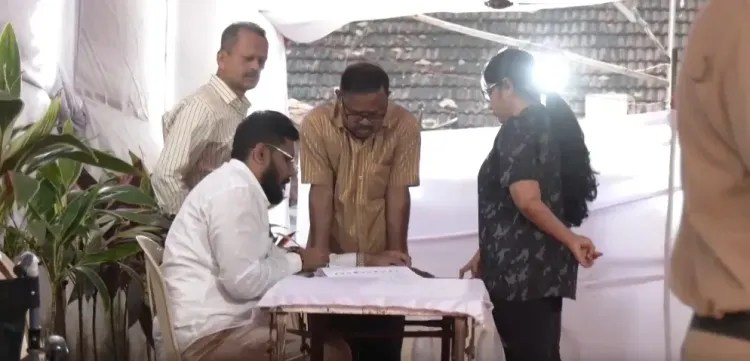
Mumbai, January 15 (NationPress) - The polling process for 29 municipal corporations, including the Brihanmumbai Municipal Corporation (BMC), began today at 7:30 a.m. and is set to wrap up by 5:30 p.m. Initially planned for 2,869 seats, which includes 227 in the BMC, the elections will now only be held for 2,801 seats as 68 candidates were declared elected unopposed.
No voting will occur for these 68 seats. A formidable total of 3.48 crore voters will choose from 15,931 candidates, with 1,729 candidates vying for seats in Mumbai. The counting of votes is scheduled for January 16.
As per the State Election Commission, there are 39,147 polling stations equipped with 43,958 Control Units and 87,916 Ballot Units. In Mumbai, 10,111 polling stations have 11,349 Control Units and 22,698 Ballot Units.
The elections cover a wide array of regions including Chhatrapati Sambhajinagar, Navi Mumbai, Vasai-Virar, Kalyan-Dombivli, Kolhapur, Nagpur, Solapur, Amravati, Akola, Nashik, Pimpri-Chinchwad, Pune, Ulhasnagar, Thane, Chandrapur, Parbhani, Mira-Bhayandar, Nanded-Waghala, Panvel, Bhiwandi-Nizampur, Latur, Malegaon, Sangli-Miraj-Kupwad, Jalgaon, Ahilyanagar, Dhule, Jalna, and Ichalkaranji. This election marks a significant event as it occurs after a hiatus of more than six years following the end of the prior tenures between 2020 and 2023. Notably, nine of these corporations are located in the Mumbai Metropolitan Region (MMR), recognized as India's most urbanized zone.
While Mumbai is conducting elections under a single-member ward system, the other 28 municipal corporations are operating under a multi-member ward structure. Each ward in Mumbai will elect one representative, while most wards in the other corporations are set to have four seats, with a few having three or five.
The electoral campaign showcased fierce competition between the state's major coalitions — Mahayuti (comprising BJP, Shiv Sena-Eknath Shinde, and NCP-Ajit Pawar) and Maha Vikas Aghadi (MVA) (including Shiv Sena-UBT, INC, and NCP-Sharad Pawar) — primarily focusing on issues like infrastructure, welfare initiatives, and urban redevelopment. The Mahayuti coalition emphasized the 'Ladki Bahin' scheme, proposing further bus concessions for women, metro expansion, and a redevelopment project. Conversely, the MVA, particularly the Thackeray brothers, centered their campaign around preserving Mumbai's identity, criticizing the government for delaying the polls (originally due in 2022) and pledging free medicines for the elderly alongside initiatives for a crime-free city.
Chief Minister Devendra Fadnavis has taken a leading role in campaigning for the ruling alliance, traversing the state to support Mahayuti candidates. Deputy CM Eknath Shinde also campaigned extensively for party nominees. Interestingly, NCP led by Ajit Pawar has been strategically sidelined to attract non-Hindu voters, as observed by analysts.
As the elections approach, estranged cousins Uddhav and Raj Thackeray have reunited after two decades to consolidate Marathi votes, while rival factions within the NCP have joined forces for elections in Pune, Pimpri-Chinchwad, and Parbhani. Significantly, this will be the first BMC election for Shiv Sena post the 2022 split, which saw party leader Eknath Shinde depart with a majority of legislators, along with the party name and symbol. The undivided Shiv Sena previously governed the wealthiest civic body for 25 years.
The Congress party is also asserting a potent presence in this election, stepping out of the shadows cast by its MVA allies Shiv Sena(UBT) and NCP(SP) in Mumbai. The historic party aligns with Prakash Ambedkar's Vanchit Bahujan Aghadi (VBA) and the Rashtriya Samaj Paksh in the capital, while opting for an independent approach in Nagpur. The NCP and Sharad Pawar-led NCP(SP) have rejoined forces in Pune and PCMC, stirring discussions of a potential merger. Although leaders from both parties remain tight-lipped, insiders suggest that the unification process may have commenced. The traditional battle lines of Maharashtra politics have become increasingly chaotic during these elections.
The ruling Mahayuti and the opposition Maha Vikas Aghadi (MVA) have not only failed to maintain a consistent political narrative across various regions, but neighboring cities are witnessing a political transformation, with an ally in one city becoming a rival in another. For instance, the BJP and the Eknath Shinde-led Shiv Sena have formed a coalition in Mumbai, Thane, and Kalyan-Dombivli, yet are opponents in Mira-Bhayander and Navi Mumbai. The BJP and the Ajit Pawar-led NCP will contest against each other in Pune and Pimpri-Chinchwad, but will form an alliance in Ahilyanagar and Kolhapur. The election in Thane, Navi Mumbai, and Kalyan-Dombivli was marked by violence between the Shinde-led Sena and the BJP.
In Pune, Deputy CM Ajit Pawar strongly challenged the BJP, prompting state BJP chief Ravindra Chavan to express regret over the decision to ally with Pawar in the state government. Similarly, an opposition party may criticize the government in one locality, yet seek votes alongside the ruling party elsewhere. For example, the Sharad Pawar-led NCP(SP) has partnered with the NCP in Pune, Pimpri-Chinchwad (PCMC), and Parbhani, while opposing the Congress and the Uddhav Thackeray-led Shiv Sena (UBT). Meanwhile, the Congress has distanced itself from the MVA in Mumbai, Thane, Nagpur, and Chandrapur, among other areas.
Key leaders from all parties have engaged in the campaign, with Chief Minister Devendra Fadnavis spearheading efforts for the BJP statewide. Shinde ensured his active participation by visiting over 51 locations. Ajit Pawar focused on consolidating his hold in Pune and Pimpri-Chinchwad Municipal Corporation (PCMC). From the opposition front, Maharashtra Congress chief Harshvardhan Sapkal held rallies across all municipal corporations involved in the elections. Ambedkar and his son Sujat also campaigned extensively, focusing on Akola, Amaravati, Solapur, and Mumbai.
The SEC has utilized the Assembly voter lists (as of July 1, 2025) for these elections. To avert electoral fraud, potential duplicate names in the ward-wise lists are denoted with double asterisks (**). These voters have undergone pre-verification through door-to-door visits. If a voter with a marked name arrives at a booth without prior verification, they must provide a formal undertaking (indemnity bond) and strict identification proof to be allowed to vote.
The SEC has introduced a mobile application (available on the Google Play Store) to assist citizens in locating their names, polling booths, and candidate information using their name or EPIC (Voter ID) number. Special provisions for senior citizens, persons with disabilities (PwD), pregnant women, and mothers with infants will ensure priority access. Ramps and wheelchairs are mandatory at all stations. In areas with a high density of female voters, exclusive 'Pink Booths' have been established, staffed entirely by women officers and police personnel. To maintain secrecy and prevent disputes, the SEC has strictly banned mobile phones within polling booths.
Point of View
It is imperative to approach the evolving political scenarios with a balanced perspective. The upcoming municipal elections serve as a litmus test for both ruling and opposition parties, showcasing the dynamic nature of local governance and voter sentiment. NationPress remains committed to delivering unbiased insights into these critical developments.
NationPress
15/01/2026
Frequently Asked Questions
What is the significance of the BMC elections?
The BMC elections are crucial as they determine the governance of India's richest municipal corporation and reflect broader voter sentiments in Maharashtra.
How many candidates are contesting in these elections?
A total of 15,931 candidates are contesting across 29 municipal corporations.
When will the counting of votes take place?
The counting of votes is scheduled for January 16.
What is the voter turnout expected?
With 3.48 crore voters eligible, the turnout is anticipated to be significant given the competitive nature of the elections.
What measures are in place to ensure a smooth voting process?
The SEC has implemented mobile apps for voter assistance, priority for vulnerable groups, and strict regulations against mobile phone use at polling booths.