Mahua Moitra flags SC roster manipulation in NSA, ECI cases

Synopsis
TMC MP Mahua Moitra publicly alleges that a Supreme Court plea was routed outside the established NSA roster to a bench whose judge's son serves as Election Commission standing counsel — raising a direct conflict-of-interest challenge against the apex court's case-allocation integrity.
Key Takeaways
TMC MP Mahua Moitra posted the allegation on 26 September 2026 , asserting the judiciary is 'not above scrutiny.' A Noida student's detention challenge was correctly listed before Justice B.V.
Nagaratna under the NSA roster, she says.
A separate plea by 'Gyanesh's daughter' on the same issue was allegedly assigned outside the roster to Justice Sharma's bench.
Moitra highlights that Justice Sharma's son is reportedly standing counsel for the Election Commission of India , raising a conflict-of-interest question.
The Supreme Court's roster system , controlled by the Chief Justice, came under similar scrutiny during the landmark 2018 press conference by four senior judges.
Specific details of both cases remain unverified; the Bar Council and court registry are the bodies that can formally respond.
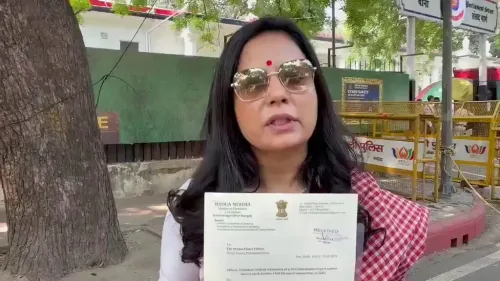
When the same procedural question lands before two different Supreme Court benches — one through the regular roster, one allegedly outside it — a sitting Lok Sabha MP is asking: who decides, and why? TMC MP Mahua Moitra fired a pointed allegation on Saturday, 26 September 2026, charging that a plea challenging a Noida student's detention was correctly listed before Justice B.V. Nagaratna under the National Security Act roster, while a separate plea filed by the daughter of a person named Gyanesh was assigned outside the roster to a different bench — one whose presiding judge's son allegedly serves as standing counsel to the Election Commission of India.
The two cases at the centre of Moitra's charge
Moitra's post draws a direct contrast between two matters she describes as raising 'the same issue.' The Noida student's detention challenge, she says, followed due process — it landed before Justice Nagaratna, the judge with jurisdiction under the NSA roster. The second plea, involving the daughter of someone she identifies only as 'Gyanesh,' was, she alleges, assigned to Justice Sharma — a bench that would ordinarily not have drawn that matter — and the conflict-of-interest flag she raises is the standing-counsel relationship between Justice Sharma's son and the Election Commission.
The allegation, if borne out, would go to the heart of the Supreme Court's internal case-allocation architecture. The Chief Justice of India controls the roster — the administrative instrument that assigns categories of cases to specific judges — and any deviation from it has, historically, been treated as a matter of institutional gravity. The research block notes these specific roster assignments are unverified from available data; what is established is that Moitra has publicly levelled the allegation.
Why roster integrity has been a fault line before
The Supreme Court's roster system came under formal internal challenge as far back as 2018, when four sitting senior judges held an extraordinary press conference flagging concerns over the assignment of sensitive cases. That moment — unprecedented in the court's history — underscored that bench composition and listing order are not administrative trivialities; they can shape outcomes in matters touching liberty, elections, and state power.
Preventive detention matters under the National Security Act are particularly time-sensitive: an illegal detention not heard quickly is a liberty already partially violated. When a litigant's counsel or civil society actor perceives that a matter has migrated away from the roster-designated judge to one with a potential conflict, the institutional legitimacy of the court's independence comes into question — regardless of the merits of any underlying order.
The ECI standing-counsel angle
The most explosive thread in Moitra's post is the conflict-of-interest implication: that a bench to which an election-related matter was allegedly routed out of roster happens to be presided over by a judge whose son holds a brief for the Election Commission. Standing counsel relationships bind a lawyer — not a judge — to an institution, and judicial recusal norms in India operate on the standard of a 'reasonable apprehension of bias.' Whether that threshold is crossed here is a legal question; whether it warrants scrutiny is the political and institutional question Moitra is placing on the table.
The Bar Council of India and the Supreme Court registry have the institutional tools to respond: an administrative clarification on roster adherence, or a formal recusal inquiry. Whether either body acts will be the immediate test of how seriously the court's administration treats the allegation.
India's judiciary may not be above the Constitution — but it is never above the questions a democracy asks of its institutions. That tension is now, loudly, in public view.
Point of View
One that is far harder for the court's administration to dismiss as political noise. If the registry does not respond with a clarification, the silence itself becomes part of the story — and precedent suggests it will fuel further pressure on the court's administrative leadership.
NationPress
26 Sept 2026
Frequently Asked Questions
What is the Supreme Court roster system in India?
The roster is an internal administrative framework managed by the Chief Justice of India that assigns specific categories of cases — such as NSA detention matters, tax disputes, or election petitions — to designated judges or benches, ensuring both equitable workload distribution and consistency in adjudication.
What is Mahua Moitra alleging about the Supreme Court roster?
She alleges that a plea concerning a Noida student's NSA detention was correctly listed before Justice Nagaratna on the NSA roster, while a separate plea on the same issue — filed by the daughter of a person she names as Gyanesh — was assigned outside the roster to Justice Sharma, whose son allegedly serves as standing counsel for the Election Commission of India.
Why does it matter if a case is listed outside the Supreme Court roster?
Out-of-roster assignments can raise questions of selective bench composition, especially in politically sensitive matters. If a party secures a more favourable bench through an irregular listing, it can compromise the appearance of impartiality — and in liberty cases under preventive detention laws, the consequences for the detainee are immediate.
What is the National Security Act (NSA) in India?
The National Security Act of 1980 is a preventive detention law that allows authorities to detain a person for up to 12 months without trial if they are deemed a threat to national security or public order. Challenges to such detentions are typically heard as habeas corpus petitions in High Courts or the Supreme Court.
Has the Supreme Court roster controversy come up before?
Yes. In January 2018, four of the Supreme Court's most senior judges held an unprecedented press conference warning that the roster system was being used to assign sensitive cases to select benches — a moment widely seen as the most serious internal institutional crisis in the court's modern history.