Mahua Moitra warns Delhi Police on selective noise enforcement
Synopsis
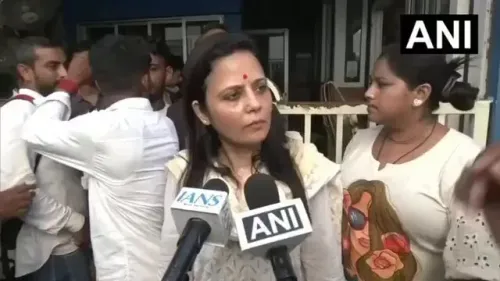
TMC MP Mahua Moitra publicly called out DCP South Delhi on October 19, vowing to archive the interaction and remind police of their selective inaction when DJs played all night during Kanwar Yatra processions, framing it as a demand for equal enforcement.
Key Takeaways
TMC MP Mahua Moitra addressed DCP South Delhi directly on X on October 19, 2026 .
She alleged police 'hid and ignored' all-night DJ music during Kanwar Yatra processions in South Delhi.
Moitra explicitly saved the tweet as evidence, setting a benchmark for consistent future enforcement.
The post fits a broader, recurring pattern of political criticism over selective noise-norm enforcement during religious events in Delhi-NCR .
No official response from Delhi Police or DCP South Delhi was recorded at time of publication.
A pointed warning to South Delhi's top cop — filed for future use. TMC MP Mahua Moitra on Monday, October 19, 2026, publicly addressed the DCP South Delhi on X, promising to hold the police to the same enforcement standard it apparently failed to apply during the Kanwar Yatra processions, when DJs played through the night without police intervention.
Posting directly at the official handle, Moitra wrote: 'I will save this tweet @DCPSouthDelhi. When DJ plays during Kanwar non stop all night and police hide and ignore it, we will remind you to be equally efficient in your duties. Thank you.' The tone is surgical — no raised voice, just a receipt kept and a standard set.The Kanwar angle: a recurring flashpoint over noise norms
The Kanwar Yatra, the annual Shravan-month Hindu pilgrimage that draws millions of devotees across North India, has long generated friction in urban neighbourhoods over nighttime DJ music, loudspeakers, and procession noise. Residents of Delhi-NCR have repeatedly flagged that noise pollution norms — already legally binding under the Environment (Protection) Act and the Noise Pollution (Regulation and Control) Rules, 2000 — are inconsistently enforced depending on which community or occasion is involved.
Delhi Police, under the administrative control of the Ministry of Home Affairs, has faced periodic criticism from citizens and elected representatives for looking the other way during major religious processions, even as it moves swiftly on noise complaints in other contexts. Moitra's post plants a marker squarely in that pattern.
Why 'I will save this tweet' is the whole move
The phrase is a well-understood social-media tactic: it converts a public official's future action into a test that can be re-litigated with evidence. By archiving the interaction, Moitra signals she will return to it the next time a noise-related enforcement drive is announced — asking, in effect, whether the same energy was present on Kanwar nights. It is less an accusation than a standing audit.
The broader question the post raises is durable: if the state's enforcement machinery applies rules selectively by community or occasion, it erodes the credibility of those rules for everyone. That is a governance argument, not a communal one — and Moitra frames it precisely that way, anchoring her demand to equal efficiency rather than to any particular group's conduct.
Whether DCP South Delhi responds publicly, or whether the post resurfaces during the next Kanwar season, will determine whether this is a moment that actually moves the needle on noise-norm enforcement in the capital.
Point of View
With the implicit threat of a future comparison. It plugs into a long-running governance debate about whether India's noise pollution rules are applied evenhandedly across religious communities, a question courts and civil society have raised repeatedly. For Delhi Police, the risk is reputational: silence now becomes a future liability if enforcement asymmetry recurs next Kanwar season. The move also reflects a broader opposition strategy of using social media as a watchdog mechanism when institutional redress feels slow.
NationPress
19 Oct 2026
Frequently Asked Questions
What did Mahua Moitra say about Delhi Police and Kanwar Yatra?
Mahua Moitra publicly told DCP South Delhi that she was saving the interaction on X, warning that she would hold police to the same enforcement standard they failed to apply when DJs played all night during Kanwar Yatra processions without police action.
Is playing DJ music all night during Kanwar Yatra legal in Delhi?
Under the Noise Pollution (Regulation and Control) Rules, 2000, nighttime noise limits apply across India including during religious processions. Enforcement, however, has been widely criticised as inconsistent in urban areas like Delhi.
Who is DCP South Delhi?
The Deputy Commissioner of Police (South Delhi) is the senior officer responsible for law and order in South Delhi district under the Delhi Police, which operates under the Ministry of Home Affairs.
Why is Kanwar Yatra associated with noise complaints in Delhi?
Kanwar Yatra is a large annual Shravan-month Hindu pilgrimage where processions routinely feature loud DJ music and loudspeakers, often through the night, generating recurring resident complaints about noise norm violations in Delhi-NCR.
What is the significance of Mahua Moitra saying 'I will save this tweet'?
It is a public accountability tactic: by archiving an official's handle in a post, Moitra signals she will resurface the interaction as evidence if the same enforcement enthusiasm she is being asked to support is not applied equally during future Kanwar or other religious events.