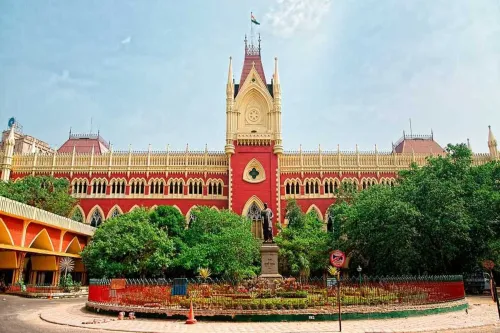
Trinamool's Mamata faction moves Calcutta HC against July 21 rally ban near Esplanade

Synopsis
For the first time in Trinamool Congress history, two rival factions are set to hold competing Martyrs' Day rallies on 21 July — and the Mamata Banerjee-led minority wing is now in court to reclaim its traditional venue after Kolkata Police slapped a 60-day prohibitory order on the CESC House site. The Calcutta High Court's verdict on 15 July could decide which faction controls the party's most symbolic annual event.
Key Takeaways
The Mamata Banerjee -led Trinamool Congress faction moved the Calcutta High Court on 14 July 2025 against a 60-day prohibitory order near CESC House , Esplanade.
Kolkata Police invoked Section 163 of the BNSS, 2023 , banning gatherings of four or more people at the traditional Martyrs' Day venue.
The ban period covers 21 July , the date of Trinamool's annual Martyrs' Day rally.
Senior advocate and Trinamool MP Kalyan Banerjee called the order 'arbitrary' and 'contrary to fundamental rights.' The rival Ritabrata Banerjee -led faction has secured permission for an alternative venue near the Mahatma Gandhi Statue on Jawaharlal Nehru Road .
The Calcutta High Court will hear the matter on 15 July .
The Mamata Banerjee-led faction of the Trinamool Congress on Monday, 14 July 2025, moved the Calcutta High Court challenging a 60-day prohibitory order imposed by Kolkata Police in front of CESC House near Esplanade Crossing in Central Kolkata — the traditional venue of the party's annual Martyrs' Day rally scheduled for 21 July. A single-judge bench of Justice Sougata Bhattacharya admitted the petition; the matter is listed for hearing on 15 July.
The Prohibitory Order in Question
Kolkata Police recently issued an advisory invoking Section 163 of the Bharatiya Nagarik Suraksha Sanhita (BNSS), 2023 — which replaces the erstwhile Code of Criminal Procedure, 1973 — barring the congregation of four or more people in the area in front of CESC House near Esplanade Crossing. Critically, the ban period covers 21 July, the date of Trinamool Congress's annual Martyrs' Day event.
What the Mamata Faction Argues
The petitioner's counsel, Kalyan Banerjee — a senior advocate and four-time Trinamool Congress Lok Sabha member — described the prohibitory order as 'arbitrary' and 'contrary to fundamental rights.' The petition specifically questions the justification for imposing restrictions during the period coinciding with the rally date, arguing that the order effectively denies the faction its traditional venue without adequate legal basis.
The Split That Complicates Everything
The legal battle is inseparable from a deeper internal rupture within Trinamool Congress. The party now has two competing factions: the minority wing led by Mamata Banerjee and Abhishek Banerjee, and a rebel but reportedly majority faction led by expelled party legislator Ritabrata Banerjee. Till 2025, the annual Martyrs' Day rally was held in front of CESC House without dispute. The split has now turned the choice of venue into a proxy battle for legitimacy.
Rival Faction's Parallel Rally Plans
The Ritabrata Banerjee-led faction has announced it has already secured permission to hold the 21 July rally at an alternative location — in front of the Mahatma Gandhi Statue on Jawaharlal Nehru Road. The Mamata Banerjee faction, however, remains firm on using the CESC House venue, making the Calcutta High Court's ruling on 15 July pivotal.
What Happens Next
The Calcutta High Court hearing on 15 July will determine whether the Mamata faction can proceed at its traditional venue or must seek an alternative site. The outcome could significantly shape the optics of which faction commands greater public legitimacy ahead of the rally. This is the first time in the history of Trinamool Congress's Martyrs' Day event that rival factions are set to hold competing programmes.
Point of View
Whatever its administrative rationale, lands at a moment of maximum factional vulnerability for the Mamata wing, and the optics are hard to separate from politics. The Calcutta High Court is now being asked to adjudicate not just a public-order question but, in effect, a succession battle. If the Mamata faction loses the venue, it loses the symbolism; if it wins, it hands its rivals a grievance. Either way, the 21 July split rally marks an institutional rupture that no court order can fully paper over.
NationPress
13 Jul 2026
Frequently Asked Questions
Why did the Mamata Banerjee faction approach the Calcutta High Court?
The Mamata Banerjee-led Trinamool Congress faction challenged a 60-day prohibitory order imposed by Kolkata Police under Section 163 of the BNSS, 2023, which bans gatherings of four or more people in front of CESC House near Esplanade Crossing — the traditional venue for the party's annual Martyrs' Day rally on 21 July. The petition argues the order is arbitrary and violates fundamental rights.
When will the Calcutta High Court hear the case?
Justice Sougata Bhattacharya admitted the petition on 14 July 2025, and the matter is scheduled for hearing on 15 July — six days before the planned Martyrs' Day rally on 21 July.
What is the Trinamool Congress Martyrs' Day rally?
Martyrs' Day is Trinamool Congress's most significant annual event, held on 21 July to commemorate the 1993 police firing on party supporters. It has traditionally been held in front of CESC House near Esplanade Crossing in Central Kolkata and draws large crowds.
Who is Ritabrata Banerjee and what is the rival faction planning?
Ritabrata Banerjee is an expelled Trinamool Congress legislator who leads a rebel faction that reportedly commands a majority within the party. His faction has already secured permission to hold a separate Martyrs' Day rally on 21 July at an alternative location in front of the Mahatma Gandhi Statue on Jawaharlal Nehru Road.
What is Section 163 of the BNSS, 2023?
Section 163 of the Bharatiya Nagarik Suraksha Sanhita (BNSS), 2023 is the successor provision to Section 144 of the Code of Criminal Procedure, 1973. It empowers authorities to impose prohibitory orders restricting the assembly of a specified number of people in a defined area, typically to prevent public disorder.