Mamata Banerjee Pays Tribute to Karunanidhi on Birth Anniversary
Synopsis
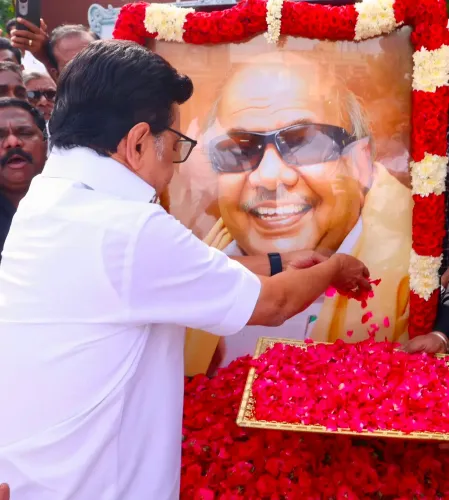
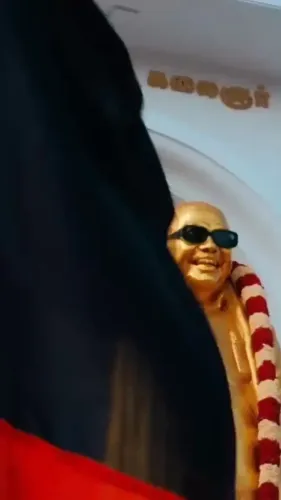
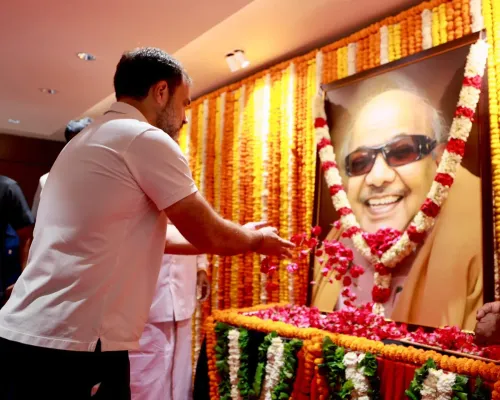
West Bengal Chief Minister Mamata Banerjee paid tribute to former Tamil Nadu Chief Minister M. Karunanidhi on his birth anniversary, calling him a poet, author and statesman loved by all. She also recalled sending a senior Trinamool Congress MP to his memorial in Tamil Nadu after his death in 2018, tagging Chief Minister M.K. Stalin and the DMK headquarters.
Key Takeaways
Mamata Banerjee paid tribute to M.
Karunanidhi on his birth anniversary via a post on X.
She described him as a 'poet, author, statesman, and great leader, loved by all'.
Banerjee recalled that the TMC had sent a senior MP to Karunanidhi's memorial meeting in Tamil Nadu after his death in 2018.
The post tagged Tamil Nadu Chief Minister M.K.
Stalin and the DMK headquarters handle Arivalayam.
The gesture extends a pattern of cross-state courtesies between non-BJP regional party leaders.
West Bengal Chief Minister Mamata Banerjee on Wednesday paid tribute to former Tamil Nadu Chief Minister M. Karunanidhi on his birth anniversary, hailing the Dravidian icon as 'a poet, author, statesman, and great leader, loved by all'. In a post on X, the All India Trinamool Congress chairperson also recalled that her party had sent a senior MP to Karunanidhi's memorial in Tamil Nadu after his death in 2018, tagging Tamil Nadu Chief Minister M.K. Stalin and the DMK headquarters handle.
Context
Karunanidhi, affectionately called 'Kalaignar' (the artist), was a five-time Chief Minister of Tamil Nadu and the long-serving president of the Dravida Munnetra Kazhagam. Beyond electoral politics, he was a prolific Tamil writer whose screenplays, novels and stage plays shaped a generation of Dravidian cultural expression.
He died in August 2018 in Chennai, prompting an outpouring of tributes from leaders across the political spectrum. Banerjee's post revives that moment, noting that the TMC had deputed a senior parliamentarian to attend the memorial meeting held in his honour in Tamil Nadu.
Policy backdrop
The tribute fits a decade-long pattern of public courtesies exchanged between heads of non-BJP regional parties, used to signal mutual respect and federal solidarity. The TMC, founded by Banerjee, and the DMK have coordinated in Parliament and in opposition forums on issues of state rights and social welfare since the mid-2010s.
Banerjee's gesture also reinforces her image as a custodian of pluralistic, regionalist politics beyond West Bengal. By tagging both @mkstalin and @arivalayam — the DMK's Chennai headquarters — she addresses the message directly to the Dravidian party's leadership and cadre.
Stakeholders and impact
For the DMK, such acknowledgements from allied regional leaders help frame Karunanidhi's legacy as a national, rather than purely Tamil, political reference point. M.K. Stalin, who succeeded his father as DMK president and later as Chief Minister, has actively curated this legacy through anniversary events at the party headquarters at Arivalayam.
For the TMC, the post underscores Banerjee's positioning within the broader opposition landscape. Cross-state homages of this kind have, in recent years, served as low-cost but visible markers of cooperation among parties that often differ on local issues but converge on questions of federalism and regional autonomy.
Banerjee's specific reference to dispatching a senior MP in 2018 is also a reminder that institutional ties between the two parties pre-date the current phase of opposition realignment. The TMC delegation's presence at Karunanidhi's last rites was widely noted at the time as a mark of solidarity.
What's next
Observers will watch for any follow-up joint statements or coordinated interventions by TMC and DMK members in Parliament's forthcoming sessions, particularly on issues touching Centre-state relations. With several state assembly elections on the horizon, public exchanges between regional leaders are likely to grow in frequency and visibility.
For now, Banerjee's brief note serves as both a personal tribute and a political signal — that the architecture of non-BJP regional cooperation, built in part on personal courtesies between leaders like Karunanidhi and Banerjee, remains a live element of India's opposition politics.
Point of View
She frames the relationship as institutional rather than episodic. Such public homages cost little but help knit together a regional opposition narrative that emphasises pluralism and state autonomy. Expect more such signalling as state polls approach and parliamentary alignments are tested.
NationPress
20 Sept 2026
Frequently Asked Questions
Who was M. Karunanidhi?
M. Karunanidhi was a five-time Chief Minister of Tamil Nadu and the long-serving president of the DMK. He was also a renowned Tamil writer, screenwriter and a central figure of the Dravidian movement, popularly known as 'Kalaignar'.
When did Karunanidhi pass away?
Karunanidhi passed away in August 2018 in Chennai. His death drew tributes from leaders across the political spectrum and prompted memorial events organised by the DMK in Tamil Nadu.
What did Mamata Banerjee say about Karunanidhi?
Mamata Banerjee called Karunanidhi a 'poet, author, statesman, and great leader, loved by all' in her birth anniversary tribute. She also noted that the TMC had sent a senior MP to his memorial meeting in Tamil Nadu in 2018.
Why did Mamata Banerjee tag M.K. Stalin and Arivalayam?
Stalin is Karunanidhi's son, the current Chief Minister of Tamil Nadu and DMK president, while Arivalayam is the DMK's Chennai headquarters. Tagging them addressed the tribute directly to the Dravidian party's leadership and cadre.
What does the tribute signal about TMC-DMK ties?
It signals continued warmth between the two regional parties, which have coordinated on issues of federalism and state rights for years. Such public courtesies often precede or accompany broader opposition coordination in Parliament and state politics.