Mandaviya addresses EPFO's 74th Foundation Day

Synopsis
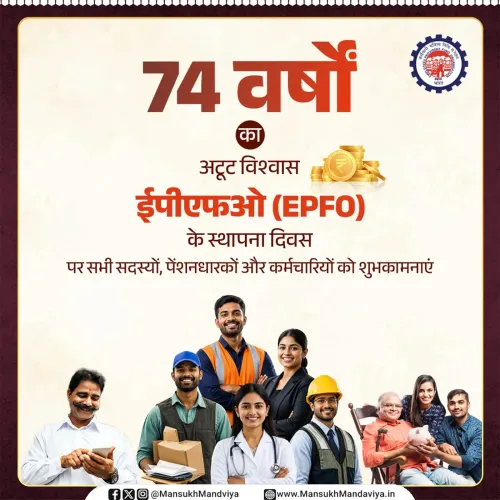
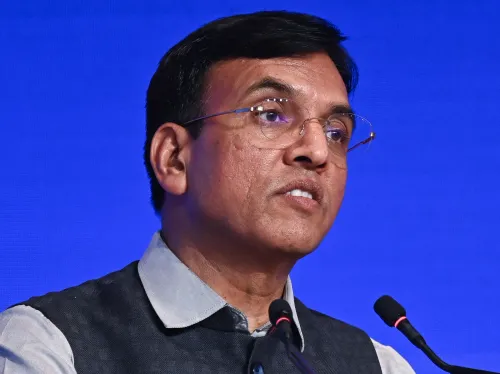
Union Labour Minister Mansukh Mandaviya addressed the 74th Foundation Day of EPFO on 1 November 2026, marking seven decades of India's flagship statutory social-security body for the formal workforce and signalling potential policy directions ahead.
Key Takeaways
Mansukh Mandaviya , Union Minister of Labour and Employment, addressed the 74th Foundation Day of EPFO on 1 November 2026 .
EPFO was established on 1 November 1952 under the Employees' Provident Funds and Miscellaneous Provisions Act, 1952 .
EPFO administers three core schemes: provident fund, pension ( Employees' Pension Scheme ), and insurance for the organised sector.
The Universal Account Number (UAN) has been a flagship digitisation reform enabling account portability across employers.
Policy watchers are monitoring signals on contribution ceilings, pension reforms, and integration with new consolidated labour codes.
Seventy-four years after India enacted the law that would shield millions of working families from financial ruin in retirement, Union Labour and Sports Minister Mansukh Mandaviya took the stage at the 74th Foundation Day of the Employees' Provident Fund Organisation (EPFO) on Sunday, 1 November 2026 — marking a milestone in the life of the country's largest statutory social-security body.
Seven decades of a social-security backbone
EPFO was born on 1 November 1952, when the Employees' Provident Funds and Miscellaneous Provisions Act came into force. What started as a modest provident-fund scheme for a narrow slice of the organised workforce has grown into a tri-pronged architecture covering provident fund, pension, and insurance for tens of millions of formal-sector employees across India.
The organisation functions as a statutory body under the Ministry of Labour and Employment — the ministry Mandaviya now heads — giving this Foundation Day address a direct ministerial weight rather than a ceremonial one.
The digitisation and portability push
Over successive administrations, EPFO's defining reform story has been its gradual shift from paper-heavy processes to a digital-first model. The Universal Account Number (UAN) — which allows a subscriber's provident-fund account to travel with them from employer to employer — has become the centrepiece of that transformation, reducing friction for India's increasingly mobile formal workforce.
Account portability, faster claim settlements, and integration with new labour-code frameworks have been the recurring themes as policymakers sought to make EPFO less bureaucratic and more responsive to the worker on the ground.
What the formal sector is watching
Organised-sector employees and their employers are keenly attentive to any signals that emerge from high-profile EPFO events — particularly on contribution-ceiling revisions, pension reform under the Employees' Pension Scheme, and how EPFO ultimately aligns with the four consolidated labour codes awaiting full implementation. Foundation Day addresses have historically served as a platform to flag the organisation's priorities for the year ahead.
With Mandaviya at the helm, the intersection of labour welfare and the government's broader formalization-of-employment agenda is sharper than ever. Seventy-four years in, EPFO remains both a promise to India's formal workforce and a measure of how seriously the state takes that promise.
Point of View
Unions, and formal-sector workers. Mandaviya's presence signals that the BJP-led government continues to project EPFO modernisation as a labour-welfare credential, particularly as the four consolidated labour codes await full roll-out. The timing also matters: with the formal workforce expanding and gig-economy classification debates intensifying, any hints about contribution-ceiling hikes or pension-scheme reforms could have outsized downstream consequences. Foundation Day addresses have a track record of quietly setting the legislative and administrative agenda for the months that follow.
NationPress
1 Nov 2026
Frequently Asked Questions
When was EPFO founded?
EPFO was established on 1 November 1952 under the Employees' Provident Funds and Miscellaneous Provisions Act, 1952, which is why its Foundation Day falls on 1 November every year.
What does EPFO do for employees?
EPFO administers three statutory schemes for organised-sector workers: a provident fund for retirement savings, the Employees' Pension Scheme, and the Employees' Deposit-Linked Insurance Scheme.
What is the Universal Account Number (UAN) in EPFO?
The Universal Account Number is a unique identifier assigned to every EPFO subscriber, allowing their provident-fund account to be carried seamlessly from one employer to another without fresh registration.
Who is Mansukh Mandaviya?
Mansukh Mandaviya is a senior BJP leader currently serving as India's Union Minister of Labour and Employment and Youth Affairs and Sports in the central government.
What reforms could EPFO announce at its 74th Foundation Day?
Policy observers are watching for possible announcements on raising the wage ceiling for EPFO contributions, changes to the Employees' Pension Scheme, and the organisation's roadmap for aligning with India's four consolidated labour codes.