CM Bhupendra Patel urges Gujaratis to tune into Mann Ki Baat in Gujarati via BHASHINI AI
Synopsis
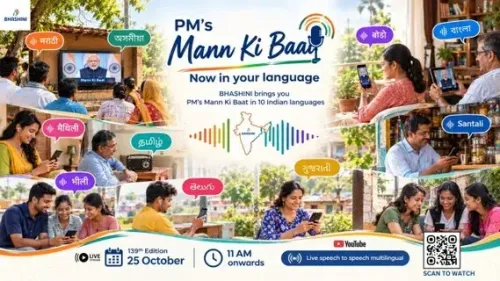
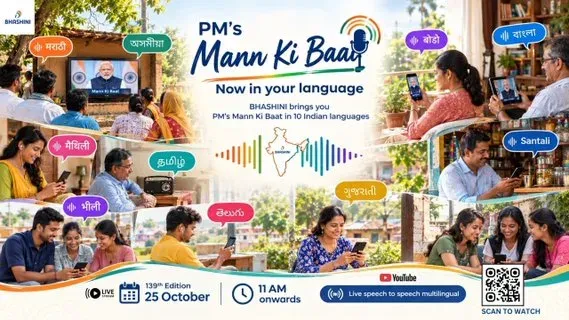
Gujarat CM Bhupendra Patel announced that PM Modi's Mann Ki Baat can now be heard live in Gujarati using BHASHINI AI voice translation, urging citizens to share the YouTube link so the address reaches every corner of the state.
Key Takeaways
Gujarat CM Bhupendra Patel on 25 October 2026 promoted the Gujarati-language live broadcast of PM Modi's Mann Ki Baat .
The broadcast is powered by the Central Government's BHASHINI AI platform , launched in 2022 under the Ministry of Electronics and IT.
Listeners hear PM Modi's own voice in Gujarati through AI voice synthesis — not a human dubber — in real time.
Mann Ki Baat has been running since October 2014 and is one of India's widest-reach government communication programmes.
The move is part of the Digital India multilingual outreach push targeting all 22 scheduled Indian languages .
A successful rollout could accelerate BHASHINI's extension to Tamil, Bengali, Marathi, Odia, and other major languages.
For the first time, Gujarati-speaking citizens can hear Prime Minister Narendra Modi's voice — not a translator's — deliver Mann Ki Baat in their mother tongue, thanks to a real-time AI voice-cloning and translation system. Gujarat Chief Minister Bhupendra Patel on Sunday, 25 October 2026 announced the live Gujarati-language broadcast of the monthly address, urging every resident of the state to tune in and share the YouTube link widely.
What BHASHINI does — and why this moment is different
The Central Government's BHASHINI (Bharatiya Bhasha Intelligence) platform, launched in 2022 under the Ministry of Electronics and Information Technology, is an AI-powered National Language Translation Mission that enables real-time speech translation across India's scheduled languages. What makes Sunday's broadcast notable is the method: listeners do not hear a human dubber — they hear the Prime Minister's own voice rendered in Gujarati through AI voice synthesis, preserving cadence and familiarity.
CM Patel's post in Gujarati captured the appeal directly: 'હવે આપણી માતૃભાષા ગુજરાતીમાં સાંભળવાનો એક સુઅવસર છે' — 'there is now an excellent opportunity to listen in our mother tongue, Gujarati.' He called the facility 'state-of-the-art' and asked citizens to push the YouTube link to the 'last person in Gujarat' so the Prime Minister's message reaches every corner of the state.
Mann Ki Baat at 12 years — from radio to AI-translated live-stream
Mann Ki Baat was launched by Prime Minister Modi in October 2014 as a monthly public address, initially broadcast on All India Radio and later simulcast on television and digital platforms. Over more than a decade it has become one of the most-distributed government communication programmes in the country, covering topics from health campaigns to local heroes.
The integration of BHASHINI into a live broadcast marks a structural upgrade: instead of post-production subtitles or delayed dubbed versions, the AI layer works in real time, meaning a Gujarati farmer in Kutch hears the address at the same moment as a Hindi-speaking listener in Delhi. The Digital India initiative's multilingual content push has been building toward exactly this kind of simultaneous multi-language delivery.
The bigger picture: AI closing India's language gap in governance
India has 22 scheduled languages and hundreds of dialects. Government outreach has historically defaulted to Hindi and English, leaving large populations dependent on secondary translations of varying quality. BHASHINI's roadmap targets all scheduled languages, and the Mann Ki Baat Gujarati live-stream is being watched as a proof-of-concept for what a fully multilingual AI broadcast infrastructure could look like across flagship programmes.
If this rollout is smooth, pressure will mount on the platform to extend the same real-time treatment to addresses in Tamil, Bengali, Marathi, Odia, and others — each with its own tens of millions of speakers who currently receive the Prime Minister's words at one remove.
The live YouTube link shared by CM Patel gives Gujarati speakers direct access — no intermediary, no delay, no loss of voice. That is a small but concrete shift in how a democracy of 1.4 billion people communicates with itself.
Point of View
The Centre signals that federal communication need not default to Hindi as the lowest common denominator. For Gujarat's BJP government, championing the rollout locally reinforces its alignment with the Centre's Digital India narrative ahead of any future electoral cycle. The broader implication is that BHASHINI, if scaled across all scheduled languages, could fundamentally reshape how an Indian government addresses a linguistically plural electorate.
NationPress
25 Oct 2026
Frequently Asked Questions
What is BHASHINI and how does it work for Mann Ki Baat?
BHASHINI is India's AI-powered National Language Translation Mission, launched in 2022, that translates speech into scheduled Indian languages in real time. For Mann Ki Baat, it renders PM Modi's voice in Gujarati live during the broadcast so listeners hear the address in their mother tongue without delay.
Where can I watch Mann Ki Baat in Gujarati live?
Gujarat CM Bhupendra Patel shared a YouTube live link in his post on 25 October 2026. The live-stream is available on the YouTube channel linked in his official X post.
When did Mann Ki Baat start?
Mann Ki Baat was launched by Prime Minister Narendra Modi in October 2014. It is a monthly public address broadcast on radio, television, and digital platforms.
Is Mann Ki Baat available in other regional languages besides Gujarati?
The BHASHINI platform is designed to support all 22 scheduled Indian languages. The Gujarati live-stream marks an early rollout; further language editions are expected as part of the Digital India multilingual content push.
Why is the Gujarati Mann Ki Baat broadcast significant?
Unlike earlier translated versions, this broadcast uses AI to deliver PM Modi's own voice in Gujarati in real time, making the address more accessible to Gujarati-speaking citizens — including those in rural areas — without any delay or quality loss from human dubbing.