Smriti Irani Hails Operation Trident's Northeast Drug Bust

Synopsis
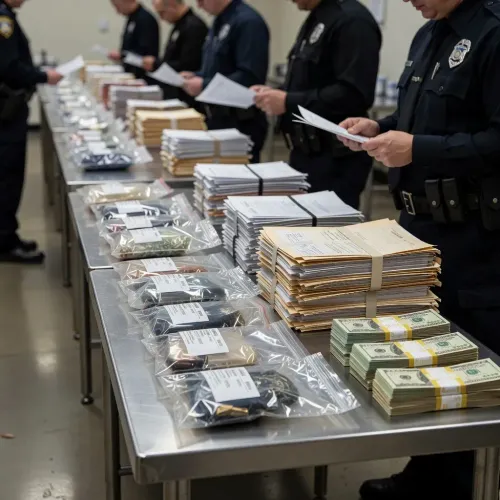
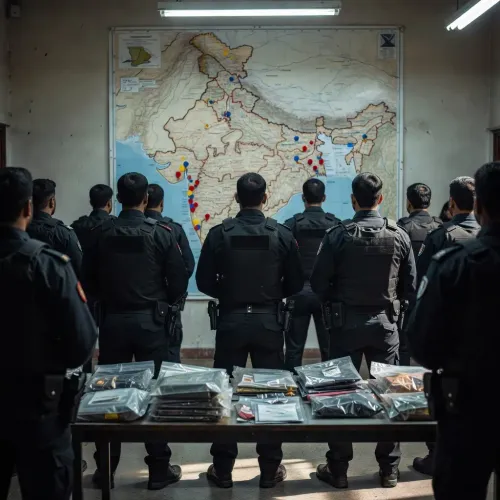
BJP leader Smriti Irani hailed Operation Trident on 25 October 2026 for dismantling a transnational narcotics syndicate operating through the Death Triangle Corridor, crediting unprecedented synergy between central agencies and the police forces of Assam, Mizoram and Manipur.
Key Takeaways
Operation Trident dismantled a transnational narcotics syndicate operating through the Death Triangle Corridor in Northeast India.
The operation targeted both trafficking routes and the illicit financial infrastructure sustaining the syndicate — reflecting expanded NDPS Act and PMLA mandates.
Police forces of Assam , Mizoram and Manipur coordinated with central enforcement agencies in the joint drive.
Irani linked the operation to the Nasha Mukt Bharat Abhiyan , launched in August 2020 by the Ministry of Social Justice and Empowerment.
The action was framed as evidence of the Modi government's border security resolve under PM Narendra Modi and HM Amit Shah .
Follow-up scrutiny is expected via NCB quarterly seizure reports and potential winter session legislation on precursor chemicals.
A transnational narcotics syndicate operating through what authorities are calling the Death Triangle Corridor has been dismantled — and BJP leader Smriti Irani is crediting the coordinated firepower of central and state agencies for breaking both the trafficking routes and the illicit financial web that kept the network alive. On Sunday, 25 October 2026, Irani took to X to commend the outcome of #OperationTrident, calling it proof of the Modi government's resolve to build a #NashaMuktBharat.
What Operation Trident Targeted — and Why the Corridor Matters
The Death Triangle Corridor is a cross-border narcotics route that runs through India's northeastern frontier — terrain that has historically been among the most porous and difficult to police in the subcontinent. Manipur borders Myanmar directly, making it a primary entry point for contraband that then fans out through Mizoram and Assam into the broader Indian heartland. Operation Trident, a central agency-led anti-narcotics drive, targeted precisely this geography — and, critically, the money trails that sustain it.
Irani's post specifically flags the 'illicit financial infrastructure' behind the syndicate — signalling that this was not just a seizure operation but an attempt to hollow out the economic engine of the network. That focus on finances reflects an expanded mandate given to enforcement agencies under amended NDPS Act and PMLA provisions, which now allow investigators to pursue assets alongside contraband.
Three State Police Forces, One Federal Push
Irani singled out the police forces of Assam, Mizoram and Manipur for their 'decisive action' — a notable detail. Getting three northeastern states, each with distinct security contexts and political landscapes, to operate in concert with central agencies is itself an achievement. The coordination is consistent with the Home Ministry's push, under Union Home Minister Amit Shah, to synchronise the Narcotics Control Bureau, central paramilitary forces and state police through joint intelligence sharing.
India's northeastern border districts have borne the public-health cost of proximity to major drug supply chains. Youth in these areas are disproportionately affected — a fact that has made anti-narcotics enforcement both a security and a social welfare priority for successive governments.
Nasha Mukt Bharat — From Abhiyan to Operational Yardstick
Irani frames Operation Trident explicitly within the Nasha Mukt Bharat Abhiyan, the national campaign launched in August 2020 by the Ministry of Social Justice and Empowerment. That campaign was initially focused on demand reduction — awareness drives, helplines, rehabilitation infrastructure. What Irani's post marks is a rhetorical shift: a kinetic interdiction operation is now being presented as a direct delivery of the Abhiyan's promise, connecting enforcement outcomes to the scheme's public-health mandate.
Whether that linkage holds will be tested in the numbers. The Narcotics Control Bureau's quarterly seizure reports and any follow-up legislation on precursor chemicals — expected to be taken up in the winter session of Parliament — will indicate how durable this disruption actually is.
One network down, a corridor under pressure — the real measure will be whether the financial dismantling sticks long enough to deny the syndicate the capital to rebuild.
Point of View
The Nasha Mukt Bharat Abhiyan. By emphasising the dismantling of financial infrastructure alongside physical trafficking routes, the government signals a maturation of its anti-narcotics doctrine: from seizure-count metrics toward network-disruption logic that mirrors global FATF-aligned enforcement standards. The political salience is equally clear — with Manipur's security environment under sustained scrutiny, a joint-agency success involving all three northeastern frontier states provides a useful counter-narrative. The durability test, however, will come in the NCB's next quarterly data.
NationPress
25 Oct 2026
Frequently Asked Questions
What is Operation Trident India?
Operation Trident is a central agency-led anti-narcotics operation targeting cross-border drug syndicates in Northeast India, specifically dismantling trafficking routes and financial networks along the Death Triangle Corridor spanning Assam, Mizoram and Manipur.
What is the Death Triangle Corridor in India?
The Death Triangle Corridor refers to a cross-border narcotics smuggling route running through India's northeastern frontier, particularly through Manipur's border with Myanmar, from where drugs are trafficked into the broader Indian territory via Mizoram and Assam.
What is Nasha Mukt Bharat Abhiyan?
Nasha Mukt Bharat Abhiyan is a national campaign launched in August 2020 by the Ministry of Social Justice and Empowerment aimed at reducing drug demand through awareness drives, rehabilitation infrastructure and community outreach across India.
Which states were involved in Operation Trident drug bust?
The police forces of Assam, Mizoram and Manipur coordinated with central enforcement agencies including the Narcotics Control Bureau in Operation Trident's action against the transnational narcotics syndicate.
What did Smriti Irani say about Operation Trident?
On 25 October 2026, BJP leader Smriti Irani praised Operation Trident on X for dismantling both the trafficking routes and the illicit financial infrastructure of a transnational narcotics syndicate, commending the synergy between central agencies and northeastern state police forces.