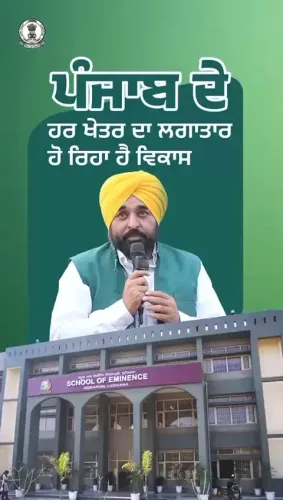
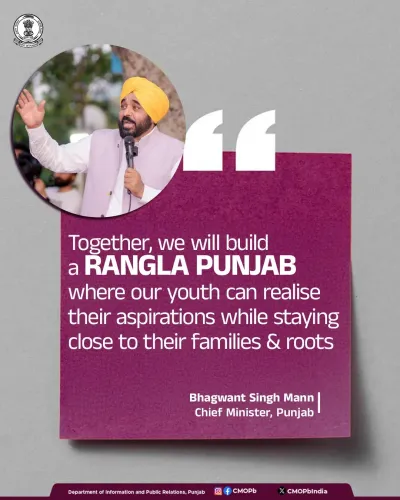
CM Bhagwant Mann: Punjab youth choosing home over abroad
Synopsis
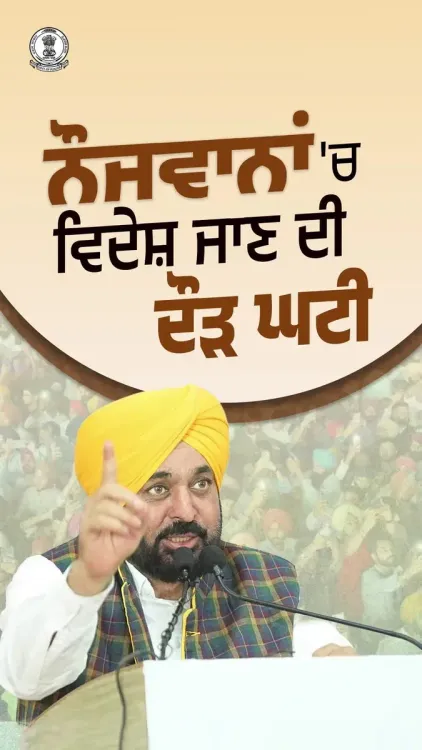
Chief Minister Bhagwant Mann, speaking at a 'Jashn-e-Inqalab' event at Punjab Agricultural University in Ludhiana on 29 September 2026, declared that Punjab's youth are increasingly choosing to build their futures within the state rather than migrating abroad.
Key Takeaways
CM Bhagwant Mann addressed the Jashn-e-Inqalab event at Punjab Agricultural University, Ludhiana on 29 September 2026 .
Mann claimed the 'race among Punjab's youth to go abroad is decreasing' and they are now focused on building a future within Punjab.
Punjab has seen two decades of heavy youth outmigration, primarily to Canada and Australia , making this claim politically and economically significant.
Punjab Agricultural University , founded in 1962 , served as the symbolic venue — one of India's foremost agricultural institutions and historically a talent launchpad.
The AAP government has been in power since March 2022 and has consistently cited local job creation as a strategy to stem outward migration.
No independent migration or employment data from Punjab government departments has yet been released to corroborate the claimed trend.
At a packed gathering on the grounds of Punjab Agricultural University, Ludhiana, Chief Minister Bhagwant Mann delivered a pointed message on Tuesday, 29 September 2026: the decades-long rush of Punjab's young people toward foreign shores is, he said, beginning to slow — and the state itself is becoming the destination of choice.
Addressing the audience at the 'Jashn-e-Inqalab' ('Celebration of Revolution') event, Mann said that 'the race among Punjab's youth to go abroad is decreasing, and they are now moving toward building a better future within their own state.' The choice of venue — one of India's most storied agricultural institutions — was pointed: PAU has long been both a symbol of Punjab's intellectual capital and a launchpad for young people who then left.
Why this claim carries weight — and what it has to prove
Punjab's outward migration story is among the most documented in modern India. Over the past two decades, cities like Jalandhar, Amritsar, and Ludhiana became synonymous with IELTS coaching centres and visa queues, as tens of thousands of young Punjabis headed to Canada and Australia each year. The state's villages hollowed out; entire families followed the first migrant abroad. The economic and emotional cost was vast.
Mann's Aam Aadmi Party government, in power since March 2022, has repeatedly flagged youth employment and skill development as pillars of its governance agenda, positioning local opportunity creation as the antidote to the migration pull. Tuesday's assertion at PAU is the most direct public claim yet that this approach is producing a measurable shift in behaviour.
PAU: the symbolic and practical centre of Punjab's talent pipeline
Punjab Agricultural University, established in 1962, remains one of South Asia's premier institutions for agricultural research and education. Hosting a youth-focused event here is a deliberate signal — that the state's own institutions can anchor ambition as effectively as any university in Toronto or Melbourne.
The event's name, Jashn-e-Inqalab, layers on an additional charge: 'revolution' in Punjab carries the unmistakable echo of the state's revolutionary political and social history, repurposed here as a call for an inward, economic transformation rather than an outward journey.
Whether the claim holds up will depend on data. Punjab government departments are yet to release updated emigration or youth employment figures that independently corroborate the trend Mann described. That number, when it arrives, will be the real test of a revolution in the making.
Point of View
Which has staked much of its Punjab identity on delivering opportunity at home after years of brain-drain rhetoric. Choosing PAU — an institution that shaped the Green Revolution — as the venue frames the message within Punjab's own tradition of transformative self-reliance. The claim, however, remains unverified by independent data; if corroborated, it would be a genuine governance milestone, but without numbers it risks reading as aspirational spin ahead of electoral cycles. The broader India pattern is clear: state governments that can demonstrably retain educated youth gain an outsized developmental dividend, making this a metric worth watching closely.
NationPress
29 Sept 2026
Frequently Asked Questions
What did CM Bhagwant Mann say about Punjab youth migration?
At a 'Jashn-e-Inqalab' event at Punjab Agricultural University on 29 September 2026, CM Bhagwant Mann said the rush among Punjab's youth to go abroad is decreasing and they are now moving toward building a better future within Punjab itself.
What is 'Jashn-e-Inqalab' in Punjab?
'Jashn-e-Inqalab' translates to 'Celebration of Revolution.' The event was held at Punjab Agricultural University in Ludhiana and addressed by Chief Minister Bhagwant Mann in September 2026.
Why do so many Punjab youth migrate abroad?
Punjab has seen heavy outmigration of youth, especially to Canada and Australia, over the past two decades, driven by prospects of higher wages, better education, and immigration pathways. Cities like Jalandhar and Ludhiana became hubs for overseas education consultants.
What is Punjab Agricultural University known for?
Punjab Agricultural University (PAU) in Ludhiana was established in 1962 and is one of India's most prominent agricultural research and education institutions, widely credited with contributions to the Green Revolution.
What is the AAP government doing to stop Punjab youth from going abroad?
The Aam Aadmi Party government under CM Bhagwant Mann, in power since March 2022, has emphasised local job creation, skill development programmes, and government recruitment drives as measures to retain talent within Punjab.