What is the Significance of Manohar Khattar's Launch of the Bhopal Metropolitan Region?
Click to start listening
Synopsis
Union Minister Manohar Lal Khattar's launch of the Bhopal Metropolitan Region marks a significant step toward sustainable urban development in Madhya Pradesh. This initiative aims to manage rapid urbanization, provide essential infrastructure, and support economic growth, ultimately transforming Bhopal into a well-planned metropolitan area.
Key Takeaways
- Bhopal Metropolitan Region launched to manage urban growth.
- Covers 9,600 square kilometers across five districts.
- Investment of Rs 5800 crore for development projects.
- Current population estimated at 3.5 million, with future projections of 6 million.
- Focus on sustainable urban planning and environmental conservation.
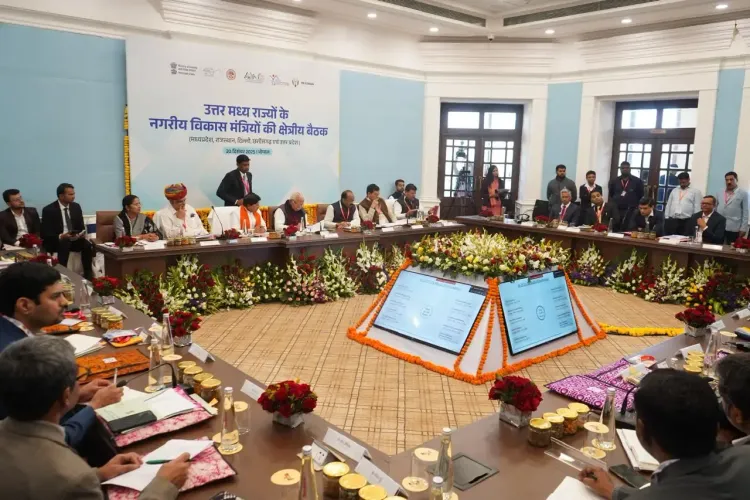
Bhopal, Dec 20 (NationPress) Union Minister for Housing and Urban Affairs Manohar Lal Khattar officially launched the Bhopal Metropolitan Region (BMR) on Saturday, marking a pivotal move to address the challenges of rapid urban growth surrounding Madhya Pradesh's capital.
The extensive region spans around 9,600 square kilometers, incorporating parts of five districts: Bhopal, Sehore, Raisen, Vidisha, and Rajgarh (including Biaora). This initiative aims to facilitate coordinated development planning while curbing rampant urban expansion.
During the inauguration, held alongside the launch of the Bhopal Metro, Minister Khattar highlighted that the BMR will alleviate the burden on central urban areas, enabling the state government to implement development schemes more effectively.
He assured that the Central Government would offer all necessary support to promote integrated growth, emphasizing the framework's importance for delivering infrastructure, housing, and services in a more efficient manner.
The establishment of the BMR aligns with the Madhya Pradesh Metropolitan Planning and Development Act, 2025, passed earlier this year, showcasing Bhopal's growth, often referred to as the City of Lakes due to its numerous water bodies.
Chief Minister Mohan Yadav remarked that this marks another milestone in the launch of several development projects, which will attract an investment of Rs 5800 crore in a phased approach, igniting economic activities across the entire state.
According to the 2011 Census, the Bhopal Urban Agglomeration had approximately 1.88 million inhabitants; current estimates indicate the broader area has around 2.7 million, with the metropolitan region now accommodating about 3.5 million residents.
Future plans envision sustainable accommodation for up to 6 million residents in the coming decades.
Governed by a newly formed Metropolitan Region Development Authority (MRDA) and a Metropolitan Planning Committee (MPC), both chaired by the Chief Minister, the BMR emphasizes coordinated land use, infrastructure development, industrial corridors (such as connecting Mandideep), environmental conservation of lakes and catchment zones, as well as the protection of heritage sites like Sanchi and Bhimbetka.
From an economic standpoint, Bhopal is recognized as an administrative, educational, and burgeoning IT hub.
The region's connectivity received a substantial enhancement with the concurrent inauguration of the Bhopal Metro's priority Orange Line corridor (6-7 km from Subhash Nagar to AIIMS), featuring modern, eco-friendly facilities.
This metropolitan framework represents a transformative advancement, positioning Bhopal as a planned, sustainable, and resilient urban center while effectively managing rapid growth alongside green spaces and cultural heritage preservation.
Point of View
It is crucial to recognize the impact of the Bhopal Metropolitan Region initiative on urban development and planning. This ambitious project underlines the government's commitment to addressing urban challenges while promoting sustainable growth. It is a significant step forward for Madhya Pradesh, showcasing a balanced approach to development that prioritizes both economic activity and environmental preservation.
NationPress
22/12/2025
Frequently Asked Questions
What is the Bhopal Metropolitan Region?
The Bhopal Metropolitan Region (BMR) is a newly established urban area aimed at managing rapid urbanization around the capital of Madhya Pradesh, Bhopal. It covers approximately 9,600 square kilometers and includes parts of five districts.
What are the key objectives of the BMR?
The BMR aims to facilitate coordinated development planning, reduce pressure on core urban areas, and ensure sustainable growth while protecting the environment and heritage sites.
What is the estimated population of the metropolitan region?
Current estimates suggest that the BMR houses around 3.5 million people, with projections for sustainable accommodation of up to 6 million in the coming decades.
What investment is being made for the BMR?
An investment of Rs 5800 crore is planned for various development projects within the BMR, which will be implemented in phases.
How does the BMR affect Bhopal's infrastructure?
The BMR focuses on enhancing infrastructure, housing, and services through better land use planning and development, ultimately improving connectivity and urban living standards.