Is Medaram Jatara Asia’s Largest Tribal Fair Set to Begin in Telangana?
Synopsis
Get ready for the grand celebration of tribal culture at the Sammakka Sarakka Jatara in Medaram, Telangana. Witness the convergence of millions of devotees as they honor legendary warriors and partake in vibrant traditions, rituals, and offerings.
Key Takeaways
Largest tribal fair in Asia.
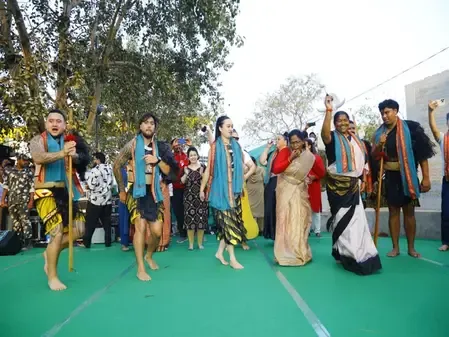
Celebration of tribal heritage .
Massive government arrangements for safety.
Devotees from across multiple states.
Unique traditions and rituals commemorating legendary warriors .
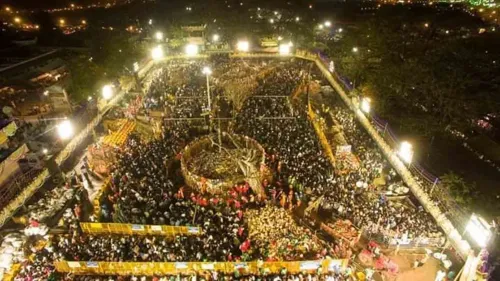
Hyderabad, Jan 27 (NationPress) Preparations are underway for the Sammakka Sarakka Jatara, recognized as the largest tribal fair in Asia, commencing in Medaram, situated in the Mulugu district of Telangana on Wednesday.
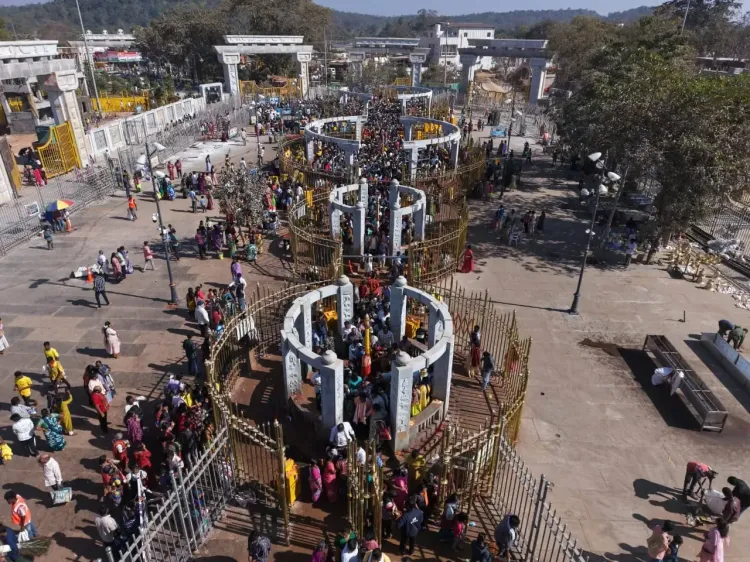
More than two crore devotees from different regions of the country are anticipated to participate in this four-day biennial celebration in Medaram village, located approximately 240 km from Hyderabad.
Enormous arrangements have been put in place for the event, often likened to Telangana’s Kumbh Mela. Participants from various parts of Telangana, Andhra Pradesh, Maharashtra, Karnataka, Chhattisgarh, Madhya Pradesh, Odisha, and other states will gather for this fair, which is a celebration of tribal customs.
This year, the state administration has allocated Rs 251 crore for the enhancement of Medaram and for establishing permanent facilities for the Jatara, also referred to as Sammakka Saralamma Jatara or Medaram Jatara.
Approximately 10 lakh devotees have already paid their respects to the revered tribal deities in recent days.
Adivasis residing in forest-adjacent areas across several states along the Godavari River convene every two years to honor the bravery of legendary warriors Sammakka and Sarakka.
The tribals revere them as goddesses, celebrating their courage in defending their community. This mother-daughter duo, belonging to the Koya tribe, perished fighting against the Kakatiya empire around eight centuries ago.
The tale recounts that Sammakka and Sarakka (Saralamma) opposed the tax imposition on tribals during droughts by the Kakatiya rulers in the 12th century.
The tribal king, Medaraju, governed the tribal settlements along the Godavari River and was required to pay tribute to the Kakatiya king. However, due to severe drought, Medaraju could not fulfill this obligation. Perceiving this as rebellion, the Kakatiya king invaded the area. In the ensuing battle, Medaraju and his kin were killed, including his daughter Sammakka and granddaughter Sarakka.
Local legends state that a weary Sammakka retreated to the Chilukalagutta hillocks and vanished. Adivasis searching for her only discovered a casket of vermilion beneath a bamboo tree.
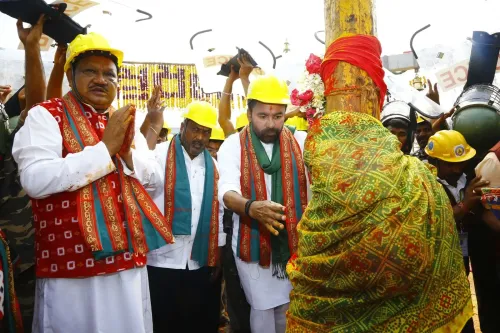
Every two years, tribal priests conduct rituals at the bamboo grove, offering prayers and bringing a casket of vermilion along with a bamboo stick wrapped in red cloth, symbolizing Sammakka, whom they worship.
The day prior, a priest performs a similar ceremony in Kannepalli village, located four kilometers from Medaram, to bring the deity Sarakka. Both deities are enshrined beneath the Indian Elm tree at Medaram village, heralding the start of the Jatara. After three days, the deities are returned to the forest until the next celebration.
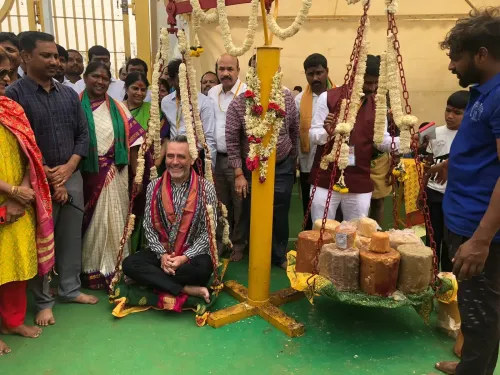
Devotees offer jaggery equivalent to their weight, viewing it as gold, along with red blouse pieces, vermilion, and turmeric in abundance. They take a portion of the offerings back home as prasadam.
Devotees also immerse themselves in Jampanna Vagu, a tributary of the Godavari River. Jampanna was a tribal warrior and son of Sammakka. Upon learning about his family’s demise in battle against the Kakatiya army, he took his own life by jumping into the stream, which is now known as Jampanna Vagu. Tribals believe that a dip in this stream absolves their sins.
The state government has made extensive preparations for the Jatara. Over 42,000 officers and employees from 21 departments have been assigned to ensure all amenities for the devotees.
Approximately 2,000 Adivasi volunteers will also assist attendees.
Comprehensive security measures are in place for the fair, with 13,000 police personnel deployed to ensure the biennial event proceeds smoothly.
The police will utilize an AI-based drone policing system for effective crowd monitoring. Control rooms have been established at various locations to manage the crowd.
The entire Medaram region has been divided into eight zones and 42 sectors to control the crowd. A district-level official will oversee each zone, while a mandal-level official will manage each sector.
Parking facilities have been arranged at 42 locations across 1,418 acres.
More than 200 expert swimmers will be stationed at Jampanna Vagu to avert any incidents.
The Medical and Health Department has established 30 health camps and deployed 5,192 medical staff.
Authorities have assigned 5,000 sanitation workers and arranged 5,700 temporary toilets.
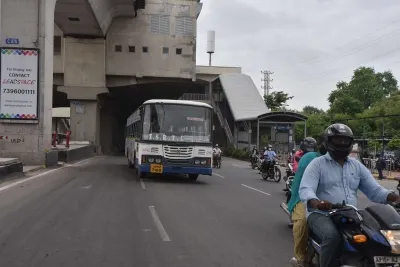
The Telangana State Road Transport Corporation (TSRTC) has announced plans to operate over 4,000 buses for Medaram.
The South Central Railway (SCR) will run 28 special train services to accommodate the influx of pilgrims from January 28 to 31.
Special trains will be available from various locations, including Secunderabad, Nizamabad, Adilabad, Kazipet, and Khammam, to the nearest railway station in Warangal, which provides access to Medaram.
The Tourism Department has introduced helicopter services for pilgrims flying from Hanamkonda to Medaram, operated by Thumby Aviation.
Travelers can enjoy VIP darshan, including a round trip, for Rs 35,999 per person, with aerial rides over the fair priced at Rs 4,800 per individual.
Point of View
It is vital to recognize the significance of the Sammakka Sarakka Jatara, not just as a tribal fair but as a celebration of cultural heritage that resonates with millions across India. The extensive preparations underscore the commitment to preserving and honoring these traditions while ensuring the safety and well-being of all attendees. This event exemplifies the unity and diversity of India's tribal communities.
NationPress
15 Sept 2026
Frequently Asked Questions
What is the Sammakka Sarakka Jatara?
The Sammakka Sarakka Jatara is the largest tribal fair in Asia, celebrated biennially in Medaram, Telangana, honoring the legendary warriors Sammakka and Sarakka.
When does the Jatara take place?
The Jatara begins on January 27 and lasts for four days.
What arrangements have been made for the event?
Extensive arrangements include security, medical facilities, sanitation, transportation, and infrastructure development funded by the state government.
How many devotees are expected to attend?
Over two crore devotees from various states are expected to participate in the event.
What offerings do devotees make at the Jatara?
Devotees offer jaggery of their weight, red blouse pieces, vermilion, and turmeric, among other items, as part of their rituals.