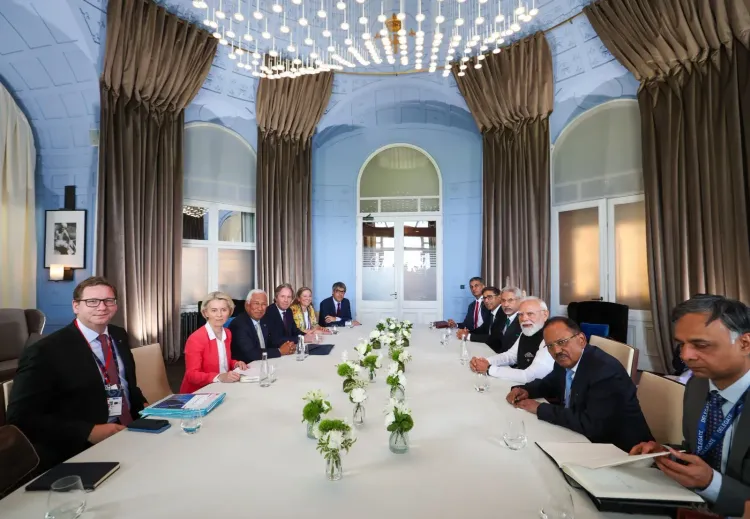
Modi meets EU leaders at G7 Evian, FTA signing by year-end confirmed
Synopsis
On the sidelines of the G7 in Evian, Modi secured a public commitment from EU Council President Costa that the India-EU Free Trade Agreement — already hailed as 'the mother of all trade deals' — will be signed by year-end. With IMEC also back on the table and a Joint Strategic Agenda in motion, India-EU ties are moving faster than at any point in the partnership's two-decade history.
Key Takeaways
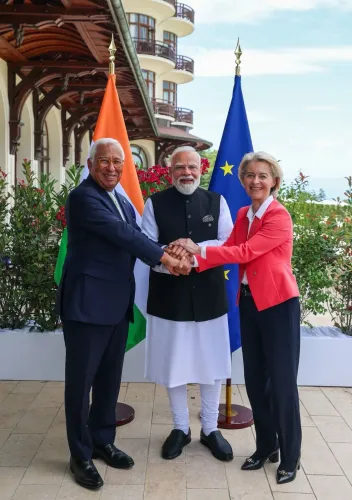
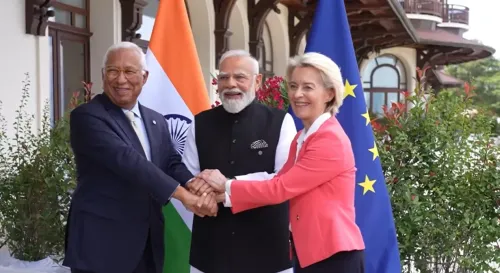
PM Modi met European Council President Antonio Costa and European Commission President Ursula von der Leyen on 18 June at the G7 Summit in Evian, France .
The India-EU Free Trade Agreement will be signed by the end of 2025 , Costa confirmed; a parallel investment agreement is also being accelerated.
FTA negotiations concluded at the 16th India-EU Summit in New Delhi on 27 January 2026 .
Leaders discussed West Asia developments and committed to advancing the India–Middle East–Europe Corridor (IMEC) .
This is India's 13th G7 participation and Modi's seventh consecutive attendance at the summit.
The Joint India-EU Comprehensive Strategic Agenda , endorsed in January 2026 , was reviewed and reaffirmed.
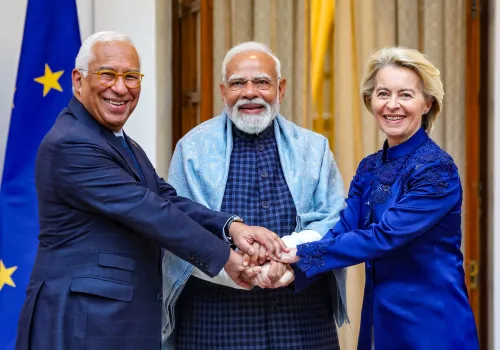
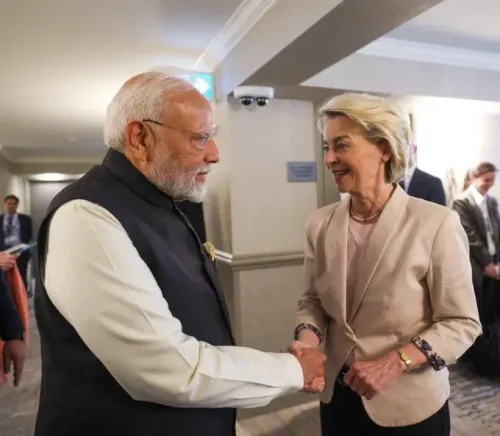
Prime Minister Narendra Modi held bilateral talks with European Council President Antonio Costa and European Commission President Ursula von der Leyen on the sidelines of the G7 Summit in Evian, France on 18 June, with the three leaders reaffirming the historic India-EU Free Trade Agreement as a turning point in bilateral ties and committing to its signing before the close of 2025. The Ministry of External Affairs (MEA) confirmed the meeting in an official statement, describing the discussions as covering trade, connectivity, security, and regional stability.
FTA Signing and What It Unlocks
The India-EU Free Trade Agreement, whose negotiations concluded at the 16th India-EU Summit in New Delhi on 27 January 2026, was described by the leaders as a 'historic achievement.' The MEA statement said the three leaders 'emphasised the recent conclusion of negotiations for the India-EU Free Trade Agreement as a historic achievement and stressed its expeditious signing and implementation, which would unlock huge opportunities for trade and investment and contribute towards diversification of supply chains, particularly in the current turbulent geopolitical context.'
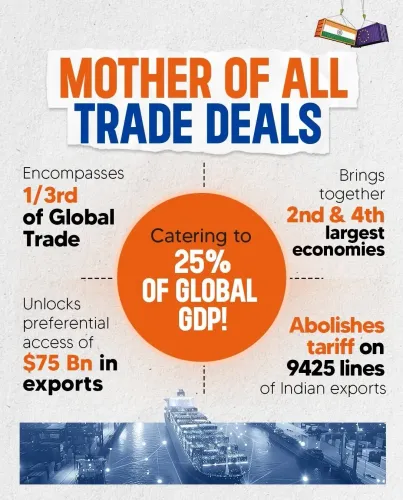
Costa confirmed on X that the FTA will be signed by the end of the year and that both sides will accelerate work on a parallel investment agreement. He called the deal 'the mother of all trade deals' — a phrase that has now entered diplomatic shorthand for the agreement's scale and ambition.
West Asia, IMEC, and the Multipolar Order
Beyond trade, the leaders exchanged views on West Asia, with the MEA noting they 'welcomed the developments' in the region without elaborating on specifics. The three leaders also discussed advancing the India–Middle East–Europe Corridor (IMEC), a connectivity initiative that Costa flagged as a priority area for joint effort. Modi and the two EU presidents reiterated their 'shared commitment to shaping a resilient multipolar global order that contributes to peace and stability, prosperity and sustainable development,' the MEA said.
Strategic Agenda and Shared Values
The leaders reviewed progress on the Joint India-EU Comprehensive Strategic Agenda endorsed in January 2026, expressing confidence that it would 'further reinforce India-EU strategic partnership and deliver mutually beneficial and transformative outcomes.' The MEA underscored the foundational character of the relationship: 'As the world's two largest democracies, with open market economies and pluralistic societies, India and the EU share a relationship based on trust, shared values and a common vision for the future.'
Modi's Own Words and India's G7 Presence
Modi described the meeting as 'wonderful' in a post on X, noting that the growing India-EU cooperation 'can play an important role in strengthening peace, stability and prosperity in today's global environment.' He also recalled that Costa and von der Leyen were the Chief Guests at India's 77th Republic Day celebrations earlier this year, underscoring the personal warmth that has accompanied the diplomatic momentum.
This marks India's 13th participation in the G7 and Modi's seventh consecutive attendance at the summit, reflecting India's sustained engagement with the grouping despite not being a formal member. The G7 Summit is being hosted by France in Evian under France's Presidency. With the FTA timeline now publicly confirmed and IMEC back on the agenda, the Evian sideline meeting is expected to set the pace for India-EU deliverables through the rest of 2025.
Point of View
Converting political momentum into a trackable commitment. What mainstream coverage underplays is the supply-chain subtext: both sides explicitly framed the deal in terms of 'diversification' amid geopolitical turbulence, which is diplomatic code for reducing dependence on China. The IMEC reference is equally significant; the corridor had stalled after the Israel-Gaza conflict complicated its Gulf routing, and its reappearance on the Evian agenda suggests both sides see a path forward. India's challenge now is ratification speed — the EU's trade deals have historically taken years to move from signing to implementation, and the investment agreement Costa mentioned remains unstarted.
NationPress
17 Sept 2026
Frequently Asked Questions
What was decided at the Modi-EU leaders meeting at G7 Evian?
PM Modi, European Council President Antonio Costa, and European Commission President Ursula von der Leyen met on 18 June at the G7 Summit in Evian and reaffirmed the India-EU Free Trade Agreement as a historic milestone. Costa publicly confirmed the FTA will be signed by the end of 2025, and both sides agreed to accelerate work on a parallel investment agreement and advance the India–Middle East–Europe Corridor (IMEC).
When was the India-EU Free Trade Agreement concluded?
Negotiations for the India-EU FTA were concluded at the 16th India-EU Summit held in New Delhi on 27 January 2026. PM Modi, von der Leyen, and Costa described it as a 'historic achievement' and 'the mother of all trade deals' at the time.
What is the India–Middle East–Europe Corridor (IMEC)?
IMEC is a multi-modal connectivity initiative linking India to Europe via the Middle East, intended to boost trade and reduce logistics costs. At the Evian meeting, EU Council President Costa said both sides would 'join forces for better connectivity by advancing IMEC,' signalling renewed momentum for the project.
Why does the India-EU FTA matter for trade and supply chains?
The MEA statement said the FTA would 'unlock huge opportunities for trade and investment and contribute towards diversification of supply chains, particularly in the current turbulent geopolitical context.' It is seen as one of the most significant bilateral trade deals either side has concluded, given the scale of both economies.
How significant is India's participation in the G7 Summit?
India is not a formal G7 member but has been invited as a partner nation. This year marks India's 13th participation in the G7 and PM Modi's seventh consecutive attendance, reflecting the country's growing role in shaping global economic and security discussions.