Kashmir's Vaghu mat revival: PM Modi hails Srinagar artisans on Mann Ki Baat
Synopsis
A centuries-old Kashmiri mat woven from reeds and paddy straw had nearly vanished — until a father-daughter team from Srinagar refused to let it die. PM Modi's Mann Ki Baat shoutout to Ghulam Hussain and Tanzila is the latest signal that indigenous crafts with a sustainability story can travel far beyond the Valley.
Key Takeaways
PM Modi highlighted the Vaghu mat revival during the 136th episode of Mann Ki Baat on 26 July .
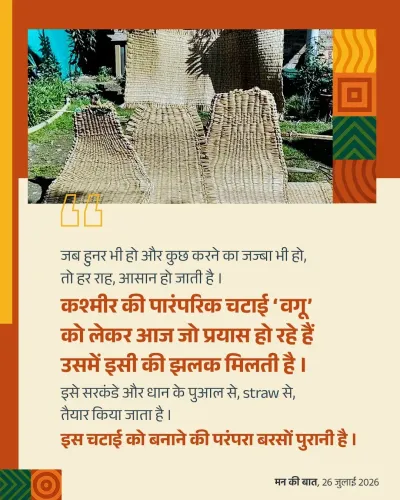
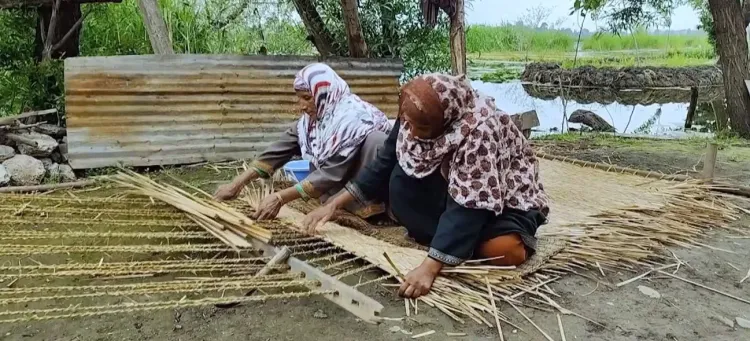
The Vaghu is hand-woven from reeds and paddy straw from Kashmir's marshy wetlands; it takes two artisans four days to complete one mat.
Ghulam Hussain and his daughter Tanzila from Srinagar are credited with spearheading the craft's comeback, with local government support.
The mat, once present in every Kashmiri home, had seen declining use before the revival effort began.
Modi urged citizens to adopt the Vaghu under the 'Vocal for Local' initiative, noting it is now reaching other parts of India.
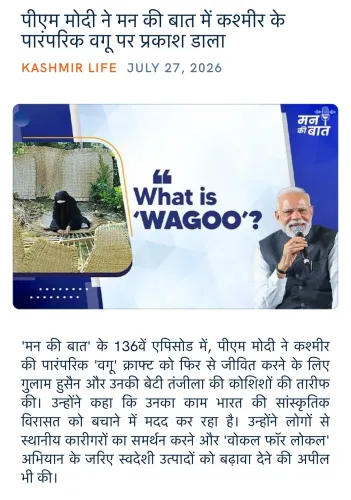
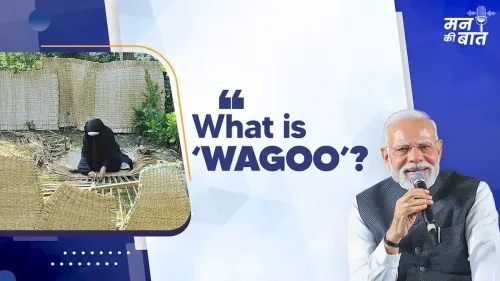
Prime Minister Narendra Modi on Sunday, 26 July spotlighted the resurgence of Kashmir's centuries-old 'Vaghu' mat during the 136th episode of his monthly radio programme 'Mann Ki Baat', crediting a Srinagar-based father-daughter duo for spearheading the craft's revival. Modi described the eco-friendly mat as a distinctive cultural emblem of the Kashmir Valley and urged listeners to adopt it under his 'Vocal for Local' campaign.
What Is the Vaghu Mat
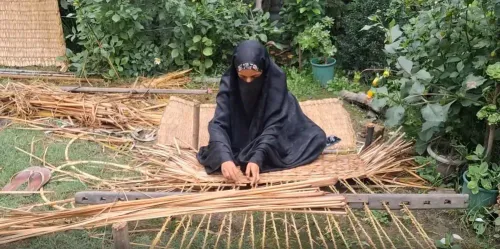
The Vaghu is a hand-woven mat crafted from reeds and paddy straw harvested from the marshy wetlands of Kashmir. The production process begins with sun-drying and sorting the raw materials before skilled weavers begin the intricate hand-weaving. According to Modi, it takes approximately four days for two artisans to complete a single mat.
A defining characteristic of the Vaghu is its natural thermal property — it reportedly provides coolness in summer and warmth in winter. Once a fixture in virtually every Kashmiri home, the mat had seen a sharp decline in use over recent years, edged out by machine-made alternatives.
The Artisans Behind the Revival
Modi singled out Ghulam Hussain and his daughter Tanzila from Srinagar as the driving force behind the craft's comeback. 'When one possesses both talent and the passion to achieve something, every path becomes easy,' Modi said, framing their story as a model of grassroots cultural preservation.
Ghulam Hussain, described by Modi as coming from a 'very humble background,' faced significant obstacles in his mission but remained committed. His persistence eventually drew wider community participation, and he also secured local government support for the initiative. Modi noted that Hussain 'significantly advanced this craft' through his sustained efforts.
Growing National Reach
The revival has moved well beyond the Valley. Modi stated that the Vaghu is now 'rapidly gaining popularity and reaching other parts of the country,' reflecting broader consumer interest in indigenous, sustainable home products. The mat's eco-friendly credentials align closely with growing demand for natural alternatives to synthetic furnishings.
This comes amid a sustained government push under the 'Vocal for Local' and Atmanirbhar Bharat frameworks, which have sought to bring traditional Indian crafts into mainstream commerce. Notably, the Vaghu revival mirrors similar government-backed efforts for crafts such as Pashmina and Kani shawls from the same region.
Modi's Appeal to Citizens
'Today, we are all emphasising local products; we are moving forward with the mantra of Vocal for Local. In this context, do consider making Kashmir's Vaghu a part of your home as well,' Modi said during the broadcast. He expressed pride in all those associated with the revival effort, underscoring the cultural and economic significance of preserving such crafts.
With artisan communities gaining visibility and government backing, the Vaghu mat's trajectory will be watched as a test case for how traditional Kashmiri crafts can be scaled without losing their handmade identity.
Point of View
But its long-term viability hinges on market access, not just a Mann Ki Baat mention. Past craft revivals spotlighted on the programme have struggled to sustain momentum without a structured supply chain and e-commerce integration. The father-daughter angle and the eco-friendly narrative give the Vaghu strong consumer appeal in urban markets — but that appeal needs to be converted into consistent orders, not just goodwill. The government's 'Vocal for Local' framing is useful optics; what Kashmiri artisans actually need is verified GI tagging, fair pricing mechanisms, and direct-to-consumer platforms that cut out intermediaries.
NationPress
24 Oct 2026
Frequently Asked Questions
What is the Vaghu mat from Kashmir?
The Vaghu is a traditional hand-woven mat made from reeds and paddy straw harvested from the marshy wetlands of Kashmir. It is known for its eco-friendly properties, providing coolness in summer and warmth in winter, and was once a common fixture in Kashmiri homes.
Who is reviving the Vaghu mat tradition?
Ghulam Hussain and his daughter Tanzila, both from Srinagar, have led the revival of the Vaghu mat craft. Despite coming from a humble background and facing numerous challenges, Ghulam Hussain's commitment drew community participation and local government support.
Why did PM Modi mention the Vaghu mat on Mann Ki Baat?
PM Modi highlighted the Vaghu revival during the 136th episode of Mann Ki Baat on 26 July as an example of grassroots cultural preservation aligned with his 'Vocal for Local' campaign. He praised the artisans and urged citizens across India to adopt the mat in their homes.
How long does it take to make a Vaghu mat?
It takes approximately four days for two artisans working together to complete a single Vaghu mat, reflecting the labour-intensive nature of the hand-weaving process.
Is the Vaghu mat available outside Kashmir?
According to PM Modi, the Vaghu mat is now rapidly gaining popularity and reaching other parts of India, driven by the revival efforts of Srinagar artisans and growing interest in eco-friendly, indigenous home products.