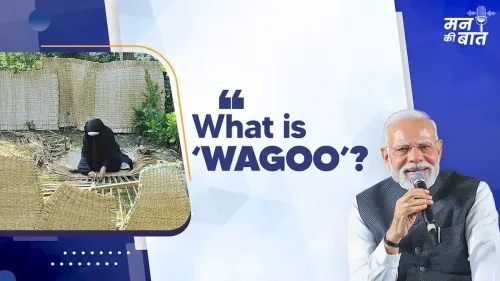
Giriraj Singh hails Kashmir's 'Vagoo' mat weavers under Vocal for Local
Synopsis
Union Textiles Minister Giriraj Singh on 26 July 2026 highlighted the revival of Kashmir's traditional 'Vagoo' mat by artisans Ghulam Hussain and his daughter Tanjila, invoking the Vocal for Local campaign and Mann Ki Baat to amplify grassroots craft preservation.
Key Takeaways
Union Textiles Minister Giriraj Singh spotlighted the revival of Kashmir's Vagoo mat on 26 July 2026 .
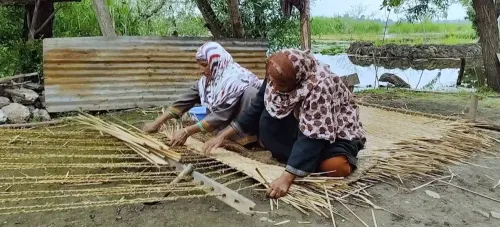
Artisans Ghulam Hussain and his daughter Tanjila are credited with leading the craft's revival.
The post invokes the Vocal for Local campaign, a pillar of the Atmanirbhar Bharat package launched in May 2020 .
The #MannKiBaat hashtag links the story to PM Modi's monthly radio programme, which has featured artisan stories since October 2014 .
The Local for Global framing positions traditional Kashmiri crafts as potential export products, not just cultural heritage.
Ministerial visibility for individual artisans can signal forthcoming policy support such as cluster scheme inclusion or GI recognition.
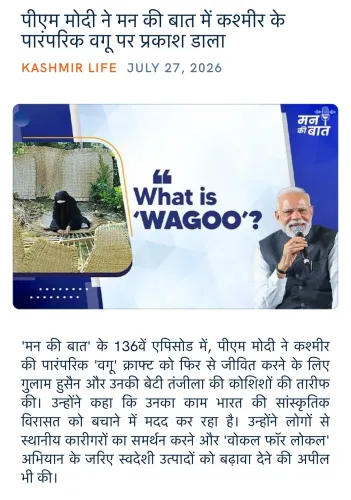
Union Textiles Minister Giriraj Singh on Sunday, 26 July 2026, spotlighted the revival of Kashmir's traditional 'Vagoo' mat, praising artisan Ghulam Hussain and his daughter Tanjila for their efforts to breathe new life into the centuries-old craft. The minister shared the story on X, invoking the Vocal for Local campaign and the Mann Ki Baat hashtag to amplify the artisans' work.
Context
In his post, Singh wrote — 'जब परंपरा, कौशल और संकल्प एक साथ आगे बढ़ते हैं, तो विरासत को नई पहचान मिलती है' ('When tradition, skill and resolve advance together, heritage finds a new identity'). He called the efforts of Ghulam Hussain and Tanjila to revive the traditional 'Vagoo' mat 'inspiring', and urged citizens to adopt local products to encourage artisans. The post was accompanied by a video and tagged #VocalForLocal, #Handicrafts, #Kashmir, and #LocalForGlobal.
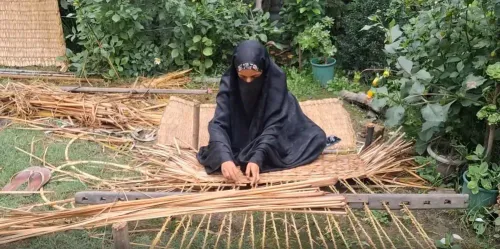
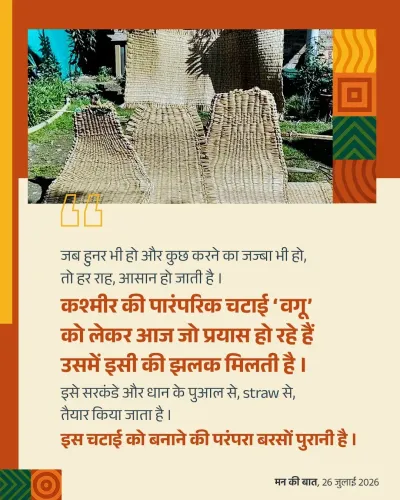
The Vagoo is a handwoven reed mat native to Kashmir, historically used in homes across the valley. Like many traditional crafts of Jammu and Kashmir, it has faced pressure from cheaper machine-made alternatives, making revival efforts by local artisans particularly significant.
Policy Backdrop
The Vocal for Local campaign was launched as a cornerstone of the Atmanirbhar Bharat economic self-reliance package announced in May 2020. It calls on Indian consumers to prefer domestically produced goods, with handicrafts and handlooms positioned as key beneficiaries. As Union Textiles Minister, Giriraj Singh oversees both the handloom and handicrafts portfolios, giving his endorsement of Kashmiri craft revival direct policy weight.
Mann Ki Baat, the monthly radio programme hosted by Prime Minister Narendra Modi since October 2014, has repeatedly featured stories of local artisans and traditional crafts, making it a consistent platform for amplifying grassroots cultural enterprise. Singh's use of the #MannKiBaat hashtag signals that the Vagoo revival story aligns with the programme's recurring theme of citizen-led heritage preservation.
Stakeholders and Impact
Kashmiri artisans and handicraft producers stand at the centre of this narrative. Jammu and Kashmir is home to a rich ecosystem of traditional crafts — from Pashmina shawls and Kani weaves to willow basketry and papier-mâché — many of which are supported through central government cluster development and artisan welfare schemes administered by the Textiles Ministry. Ministerial visibility for individual artisans like Ghulam Hussain and Tanjila can translate into wider market access and consumer awareness.
The Local for Global framing, also reflected in Singh's hashtags, reflects a broader government ambition to position Indian traditional crafts as export-worthy products on the world stage, not merely cultural artefacts. This dual positioning — domestic pride and global branding — is increasingly central to how the Textiles Ministry communicates about heritage crafts.
What's Next
Ministerial attention of this kind often precedes or accompanies formal policy moves — such as the inclusion of a craft cluster in a central scheme, a GI (Geographical Indication) push, or a feature in an upcoming Mann Ki Baat episode. The Textiles Ministry has in the past used social media spotlights on individual artisans as a precursor to broader scheme announcements for Jammu and Kashmir handicraft clusters. Whether the Vagoo mat revival attracts dedicated institutional support will be a key indicator of how far this spotlight translates into sustained policy action.
Point of View
The minister simultaneously aligns with the Prime Minister's communication ecosystem and frames Kashmiri crafts within an export-ambition narrative. For the Textiles Ministry, such social media moments serve a dual purpose: building political goodwill in Jammu and Kashmir while keeping the Atmanirbhar Bharat brand alive in public discourse. The real test will be whether this spotlight is followed by measurable institutional support for Vagoo weavers.
NationPress
25 Oct 2026
Frequently Asked Questions
What is the Vagoo mat from Kashmir?
The Vagoo is a traditional handwoven reed mat native to Kashmir, historically crafted and used in homes across the valley. It is one of several indigenous crafts of Jammu and Kashmir that face competition from machine-made alternatives.
What is the Vocal for Local campaign?
Vocal for Local is a government campaign urging Indian consumers to prefer domestically produced goods. It was launched as part of the Atmanirbhar Bharat self-reliance package in May 2020 and is a key theme promoted by the Textiles Ministry for handlooms and handicrafts.
Who are Ghulam Hussain and Tanjila?
Ghulam Hussain and his daughter Tanjila are Kashmiri artisans highlighted by Union Textiles Minister Giriraj Singh for their efforts to revive the traditional Vagoo mat craft in Kashmir.
What is Mann Ki Baat and why is it relevant here?
Mann Ki Baat is a monthly radio programme hosted by Prime Minister Narendra Modi since October 2014 that highlights citizen initiatives and cultural stories. Giriraj Singh tagged #MannKiBaat in his post, linking the Vagoo revival story to the programme's recurring theme of grassroots heritage preservation.
What role does Giriraj Singh play in handicraft policy?
As Union Textiles Minister, Giriraj Singh oversees India's handloom and handicrafts portfolios, including central schemes for artisan welfare and cluster development in states like Jammu and Kashmir. His endorsement of specific crafts carries direct policy significance.