Khattar Hails PM Modi's ₹13,000 Cr Jaipur Metro, Solar Push
Synopsis
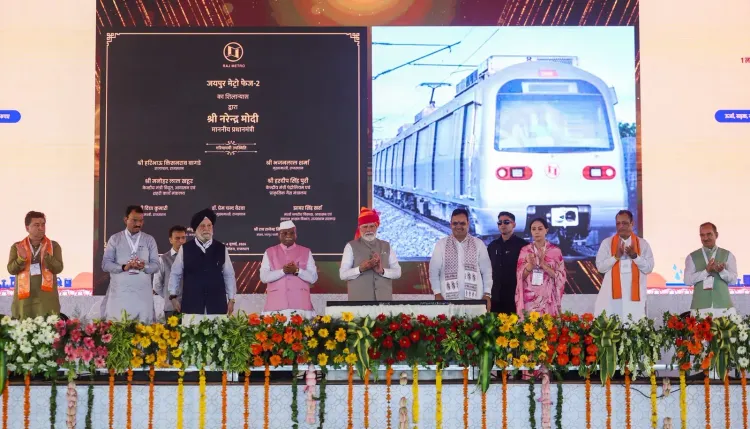
Prime Minister Narendra Modi visited Rajasthan on 4 July 2026 to lay the foundation stone of the over ₹13,000 crore Jaipur Metro Phase-2 and dedicate 1,300 MW of new solar capacity at Bikaner, along with inaugurating a ₹1,900 crore transmission line and launching a 530-km power corridor.
Key Takeaways
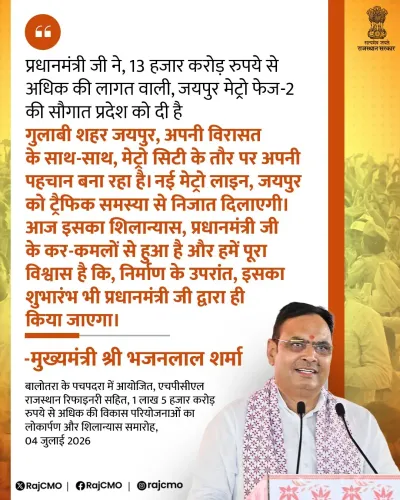
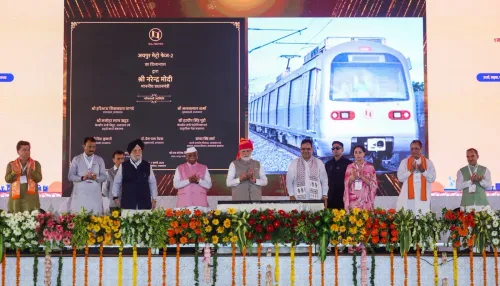
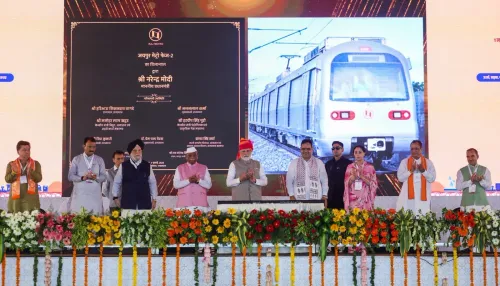
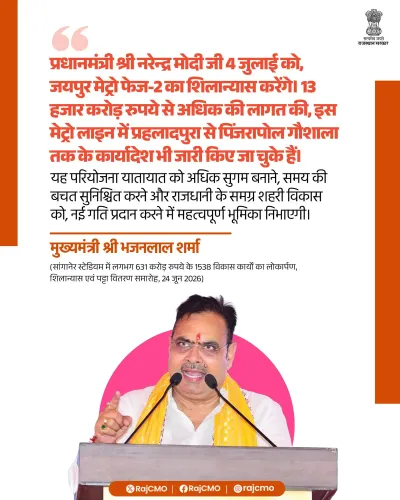
PM Modi laid the foundation stone of Jaipur Metro Phase-2 , valued at more than ₹13,000 crore , to expand urban rail connectivity across residential, industrial, and commercial zones.
SJVN Limited's 1,000 MW Bikaner Solar Energy Project was dedicated to the nation, marking a major milestone for the central PSU's solar expansion.
NHPC's 300 MW Karnisar Bikaner Solar Power Plant was also commissioned, reflecting NHPC's diversification beyond hydropower.
A transmission line worth over ₹1,900 crore was inaugurated alongside the foundation stone for a new 530-km power transmission system to ease renewable energy evacuation from Rajasthan.
Union Power Minister Manohar Lal Khattar publicly credited PM Modi for advancing the 'Viksit Bharat' development agenda through modern infrastructure and clean energy.
The projects reinforce Rajasthan's position as India's primary hub for utility-scale solar generation under the national 500 GW non-fossil capacity target by 2030.
Union Power Minister Manohar Lal Khattar on Saturday, 4 July 2026, took to X to highlight a series of major infrastructure and clean-energy project launches by Prime Minister Narendra Modi during the PM's visit to Rajasthan, including the laying of the foundation stone for Jaipur Metro Phase-2 and the dedication of over 1,300 MW of new solar capacity to the nation.
Context
In his post, Minister Khattar described PM Modi's Rajasthan tour as a landmark day for both urban mobility and renewable energy. He noted that the Prime Minister laid the foundation stone of the Jaipur Metro Rail Project Phase-2, estimated to cost more than ₹13,000 crore, which is designed to strengthen connectivity across the city's key residential, industrial, and commercial zones. The minister said the project would give citizens 'fast, safe and convenient public transport' — ('तेज, सुरक्षित एवं सुविधाजनक सार्वजनिक परिवहन').
Jaipur Metro Phase-1 became operational in 2015 and has since served as the backbone of the capital's urban rail network. Phase-2 is expected to extend the network's reach significantly, addressing long-standing gaps in east-west and peripheral connectivity in one of India's fastest-growing state capitals.
Policy Backdrop
On the energy front, PM Modi dedicated two major solar installations to the nation: SJVN Limited's 1,000 MW Bikaner Solar Energy Project and NHPC's 300 MW Karnisar Bikaner Solar Power Plant. SJVN Limited is a central public sector enterprise that has been aggressively expanding from its hydropower origins into large-scale solar parks, while NHPC Limited, India's largest hydropower PSU, has similarly diversified into solar generation as part of the government's clean-energy push.
Alongside the solar dedications, PM Modi inaugurated a transmission line built at a cost of more than ₹1,900 crore and laid the foundation stone for a new 530-kilometre power transmission system. Khattar said this infrastructure would provide 'new strength to uninterrupted transmission of renewable energy from Rajasthan and reliable power supply' — ('नवीकरणीय ऊर्जा के निर्बाध प्रसारण और विश्वसनीय बिजली आपूर्ति को नई मजबूती'). These moves align with India's broader goal of building dedicated renewable energy evacuation corridors, a key pillar of the National Infrastructure Pipeline framework launched in 2019.
Rajasthan holds the country's highest solar irradiance levels and has consistently been the primary destination for utility-scale solar parks under the National Solar Mission, whose targets have been revised upward multiple times since its 2010 launch. The state is central to India's ambition of achieving 500 GW of non-fossil fuel capacity by 2030.
Stakeholders and Impact
Urban commuters in Jaipur stand to benefit most directly from Phase-2, with improved last-mile connectivity to residential colonies, industrial estates, and commercial hubs that Phase-1 did not serve. For the broader power sector, the addition of over 1,300 MW of solar generation capacity in Bikaner and the new 530-km transmission backbone are expected to ease grid congestion and reduce curtailment of renewable power in the region.
Central PSUs — particularly SJVN and NHPC — continue to serve as the government's primary vehicles for delivering both generation assets and grid-strengthening infrastructure in high-priority states, a pattern that reflects the Centre's preference for PSU-led execution in the energy transition.
What's Next
Attention will now turn to the pace of civil works on Jaipur Metro Phase-2 and land acquisition progress for the 530-km transmission corridor, both of which involve complex state-central coordination. Follow-up meetings between Rajasthan state authorities and Union ministries on tariff approvals and grid integration timelines will be closely watched by project developers and urban planners alike. Minister Khattar's public acknowledgement of the PM's role signals continued political momentum behind these projects, but the real test will be execution speed on the ground.
Point of View
Solar generation, and transmission infrastructure — on a single Rajasthan visit reflects a deliberate political optics strategy of bundling urban and energy wins ahead of state electoral cycles, while also serving genuine policy objectives. For Minister Khattar, publicly amplifying these projects reinforces his dual portfolio relevance: urban transit falls under Housing and Urban Affairs, while solar evacuation infrastructure sits squarely within his Power Ministry mandate. The use of central PSUs like SJVN and NHPC as execution vehicles signals the Centre's preference for accountability within its own ecosystem over private-sector-led delivery in politically sensitive states. The 530-km transmission corridor, if built on schedule, could become a template for renewable evacuation corridors in other high-irradiance states such as Gujarat and Madhya Pradesh.
NationPress
3 Oct 2026
Frequently Asked Questions
What is Jaipur Metro Phase 2 and when was its foundation stone laid?
Jaipur Metro Phase-2 is the second stage of the urban rail transit network in Rajasthan's capital, aimed at connecting key residential, industrial, and commercial areas not covered by Phase-1. Its foundation stone was laid by Prime Minister Narendra Modi on 4 July 2026 during his Rajasthan visit, with the project estimated to cost more than ₹13,000 crore .
What is the SJVN 1000 MW Bikaner solar project?
SJVN Limited's 1,000 MW Bikaner Solar Energy Project is a large-scale utility solar park developed by the central public sector enterprise SJVN in the Bikaner district of Rajasthan. It was dedicated to the nation by PM Modi on 4 July 2026 as part of India's push to expand renewable energy capacity.
What did PM Modi inaugurate in Rajasthan related to power transmission?
PM Modi inaugurated a power transmission line built at a cost of more than ₹1,900 crore and laid the foundation stone for a new 530-kilometre power transmission system in Rajasthan, designed to enable uninterrupted evacuation of renewable energy from the state to the national grid.
What is the NHPC Karnisar Bikaner solar plant?
NHPC's 300 MW Karnisar Bikaner Solar Power Plant is a solar energy project developed by NHPC Limited — India's largest hydropower PSU — at the Karnisar site in Bikaner, Rajasthan. It was commissioned and dedicated to the nation by PM Modi on 4 July 2026.
Why is Rajasthan important for India's solar energy goals?
Rajasthan has the highest solar irradiance levels in India, making it the country's most suitable state for large-scale solar parks. It is a central location in India's plan to achieve 500 GW of non-fossil fuel energy capacity by 2030 , with multiple utility-scale solar projects and dedicated transmission corridors being developed there.