PM Modi meets Australia FM Penny Wong on strategic ties
Synopsis
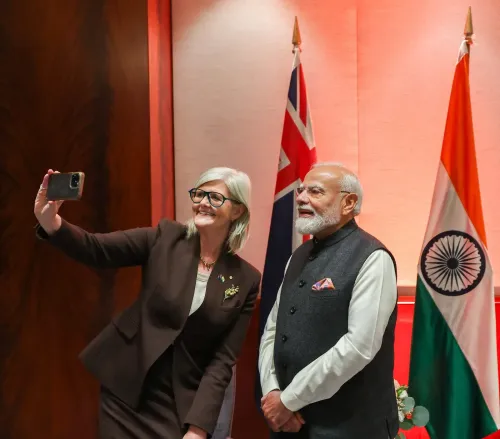
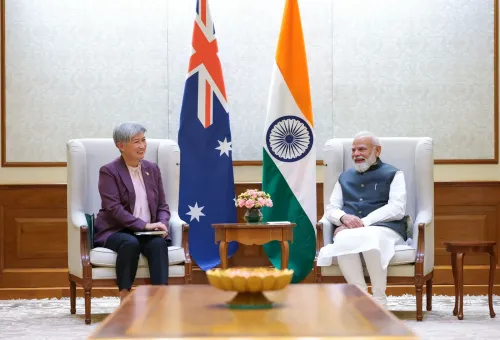
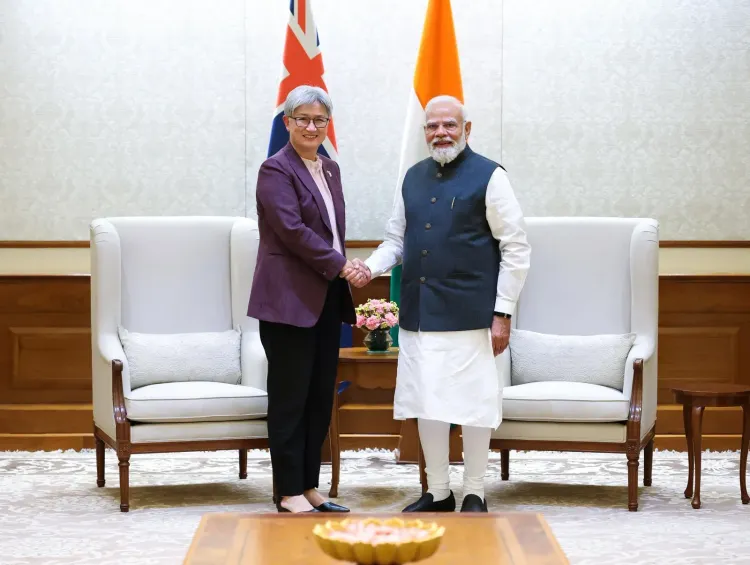
Prime Minister Narendra Modi received Australian Foreign Minister Senator Penny Wong in New Delhi on 26 May 2026. Their talks covered defence, trade, technology and supply chain resilience under the India-Australia Comprehensive Strategic Partnership, reinforcing one of the Indo-Pacific's most active bilateral frameworks.
Key Takeaways
PM Modi met Australian FM Senator Penny Wong in New Delhi on 26 May 2026 .
Talks covered the India-Australia Comprehensive Strategic Partnership , elevated to that status in June 2020 .
Key agenda items included defence , trade , technology , and supply chain resilience .
The partnership gained economic depth with the signing of the Economic Cooperation and Trade Agreement (ECTA) in April 2022 .
Both countries are active Quad members and conduct joint exercises including AUSINDEX and Malabar .
Critical minerals, semiconductors, and clean energy supply chains are central to the bilateral strategic agenda.
Prime Minister Narendra Modi met Senator Penny Wong, Australia's Minister for Foreign Affairs, in New Delhi on Tuesday, 26 May 2026, for discussions on the full breadth of the India-Australia Comprehensive Strategic Partnership. The two leaders reviewed cooperation across defence, trade, technology, and supply chain resilience, signalling continued momentum in one of Asia's most consequential bilateral relationships.
Context
In his post on X, PM Modi said he was 'happy to receive Senator Penny Wong' and that the two sides 'discussed the growing India-Australia Comprehensive Strategic Partnership in areas such as defence, trade, technology and ensuring supply chain resilience.' The post, accompanied by two photographs from the meeting, confirmed that both nations 'will continue to work' together — a phrase that signals an ongoing, structured engagement rather than a one-off visit.
Senator Wong is the principal architect of Australia's foreign policy under the Albanese government and has been a consistent advocate for deepening Canberra's engagement with New Delhi. Her visit to India underscores the priority Australia places on the bilateral relationship at a time of heightened Indo-Pacific strategic competition.
Policy Backdrop
The Comprehensive Strategic Partnership was elevated in June 2020 during a virtual leaders' summit between PM Modi and then-Prime Minister Scott Morrison, establishing annual leaders' meetings and structured dialogues across multiple domains. The framework was given economic teeth in April 2022 when both countries signed the Economic Cooperation and Trade Agreement (ECTA), which reduced tariffs on a wide range of goods and boosted bilateral trade volumes.
On the security side, the two countries have expanded joint military exercises, including the naval exercise AUSINDEX and the multilateral Malabar exercise conducted under the Quad — the Quadrilateral Security Dialogue grouping India, Australia, the United States, and Japan. The emphasis on supply chain resilience in Tuesday's talks reflects a shared strategic interest in diversifying critical minerals, semiconductors, rare earths, and clean-energy supply chains away from single-country dependence.
Stakeholders and Impact
The meeting holds direct relevance for India's defence establishment, which has been deepening logistics and technology-sharing arrangements with Australia as part of broader 2+2 ministerial dialogues between the two countries' foreign and defence ministers. Indian exporters and technology firms stand to benefit from any further tariff rationalisation or investment facilitation measures that flow from sustained high-level engagement under ECTA.
For Australia, India represents a large and growing market as well as a critical partner for securing supply chains in critical minerals — a sector where India is both a consumer and, increasingly, a processor. People-to-people links, including a large Indian diaspora in Australia, add a further dimension to the partnership that both governments have sought to leverage through education and mobility frameworks.
What's Next
Attention will now turn to whether the Wong visit produces a joint statement or accelerates pending agreements on defence logistics and technology sharing. Progress on these fronts is likely to be reviewed at the next Quad leaders' meeting and at the annual bilateral leaders' summit envisaged under the Comprehensive Strategic Partnership framework.
With both India and Australia committed to a free, open, and rules-based Indo-Pacific, the trajectory of the partnership — from trade and defence to clean energy and critical minerals — will remain a key indicator of how middle and major powers are reshaping regional architecture in the years ahead.
Point of View
Reflecting the urgency both capitals attach to supply-chain diversification and Indo-Pacific security architecture. For PM Modi, receiving Wong reinforces his government's 'Act East' and Quad-centric foreign policy posture, which frames Australia as a tier-one partner rather than a peripheral ally. The explicit mention of supply chain resilience — rather than just trade or investment — points to a shared strategic calculus that goes beyond commerce and into the realm of economic security. If the visit produces tangible movement on defence logistics or technology-sharing pacts, it will mark a qualitative step up from the framework agreements already in place.
NationPress
10 Oct 2026
Frequently Asked Questions
What did PM Modi and Penny Wong discuss?
They discussed the India-Australia Comprehensive Strategic Partnership, focusing on defence, trade, technology, and supply chain resilience during their meeting in New Delhi on 26 May 2026.
What is the India-Australia Comprehensive Strategic Partnership?
It is a bilateral framework elevated in June 2020 that covers defence, trade, technology and people-to-people links, with annual leaders' meetings and structured ministerial dialogues.
What is ECTA between India and Australia?
The Economic Cooperation and Trade Agreement, signed in April 2022, reduced tariffs on a wide range of goods and has helped grow bilateral trade volumes between India and Australia.
Is Australia part of the Quad with India?
Yes. Australia is a member of the Quad — the Quadrilateral Security Dialogue — alongside India, the United States, and Japan, focused on Indo-Pacific stability and supply-chain security.
Why is supply chain resilience important for India and Australia?
Both countries are working to diversify critical minerals, semiconductors, rare earths, and clean-energy supply chains away from single-country dependence, making bilateral cooperation strategically significant.