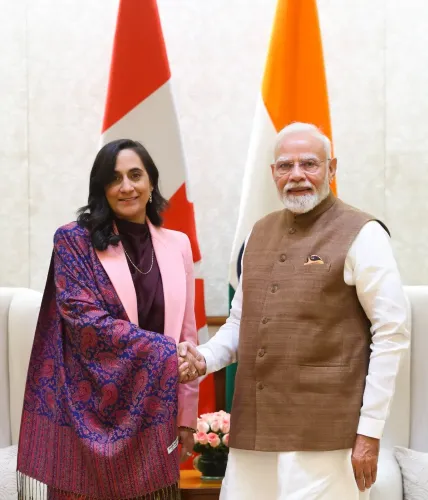
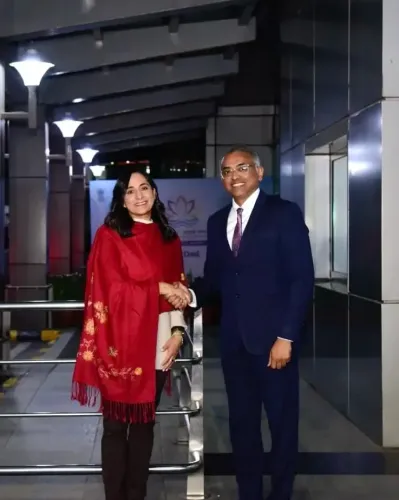
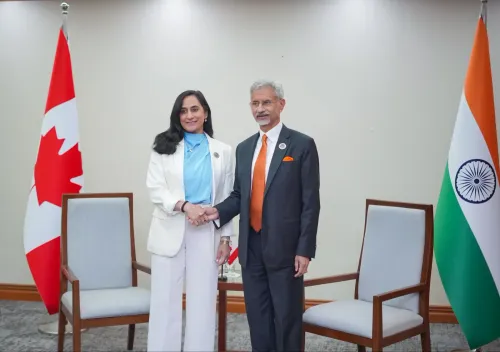
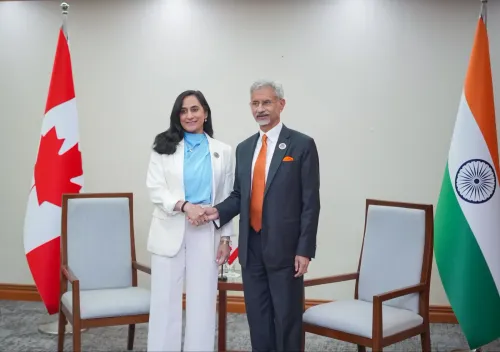
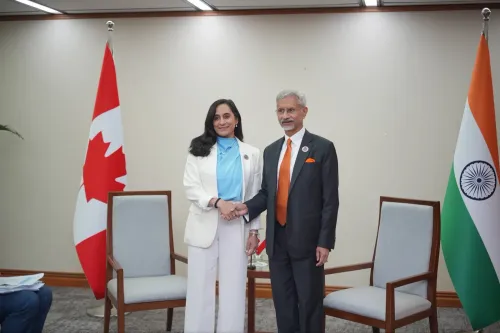
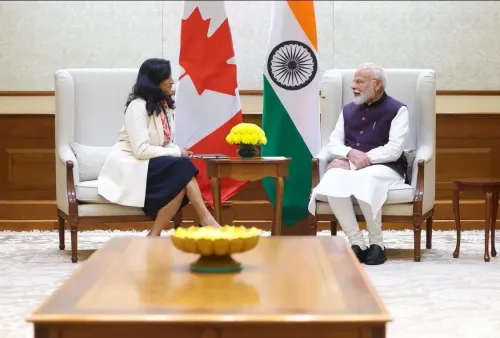
PM Modi meets Canadian FM Anita Anand, eyes stronger bilateral ties
Synopsis
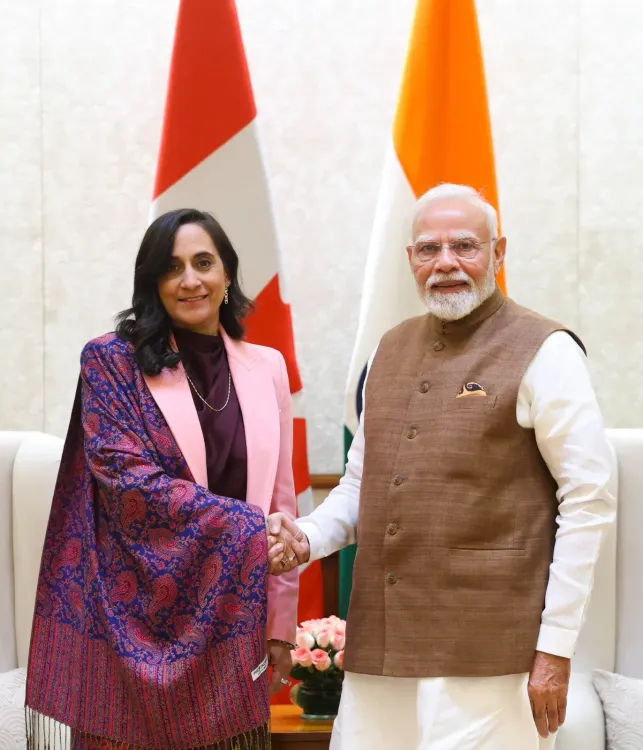
Prime Minister Narendra Modi met Canadian Foreign Minister Anita Anand on October 14, 2026, holding talks on trade, technology, security, energy, education and people-to-people ties — a significant step toward restoring a relationship strained by the 2023 Nijjar affair and diplomatic expulsions.
Key Takeaways
PM Modi met Canadian Foreign Minister Anita Anand on October 14, 2026 , describing talks as productive.
Discussions covered trade, technology, security, energy, education and people-to-people exchanges .
The meeting follows a serious diplomatic rupture in 2023 , when reciprocal diplomat expulsions were triggered by the Nijjar affair.
India-Canada CEPA negotiations, relaunched in 2022 after stalling since 2010 , remain a key benchmark for restored ties.
The engagement fits India's broader multi-alignment strategy of maintaining productive ties with Western partners.
Analysts will watch for signals on CEPA resumption or a reciprocal high-level visit as proof of sustained momentum.
A diplomatic handshake that carries the weight of a bruised relationship — Prime Minister Narendra Modi met Canadian Foreign Minister Anita Anand on Wednesday, October 14, 2026, describing the encounter as productive and signalling India's readiness to build a 'constructive and forward-looking' partnership with Ottawa.
The two leaders covered a wide agenda: trade, technology, security, energy, education and people-to-people exchanges. That breadth is deliberate. When a bilateral relationship has been knocked off course, a wide table of shared interests is precisely the mechanism diplomats use to find common ground — and to avoid the fault lines.
From expulsions to engagement: the road back
The backdrop to this meeting is anything but routine. In 2023, Canadian Prime Minister Justin Trudeau publicly alleged the involvement of Indian agents in the killing of Khalistani activist Hardeep Singh Nijjar on Canadian soil. The fallout was severe: reciprocal diplomat expulsions, a deep freeze in high-level contact, and a shadow cast over a relationship that had been gathering momentum. That the two sides are now back at the same table — at foreign-minister-to-prime-minister level — marks a meaningful, if cautious, step toward normalisation.The CEPA clock and what trade negotiators are watching
The economic stakes are real. India and Canada relaunched Comprehensive Economic Partnership Agreement (CEPA) negotiations in 2022, reviving a process that first began in 2010 before stalling over market-access differences. The political turbulence of 2023 effectively froze those talks again. Any signal emerging from Wednesday's meeting about resuming CEPA negotiations — or about scheduling a follow-up ministerial visit ahead of a multilateral forum — will be closely parsed by trade negotiators on both sides. Canada is a G7 economy and home to one of the world's largest Indian diaspora communities, a constituency that gives the relationship both its warmth and its friction. The Sikh separatist question has never been resolved; it runs beneath every trade corridor and technology partnership like a fault line. Both governments appear to have calculated, for now, that the economic and strategic upside of engagement outweighs the political cost of unresolved differences.Modi's multi-alignment at work
India's foreign policy posture under Modi is built on multi-alignment — cultivating productive ties with Western partners without being anchored exclusively to any one bloc. A re-engagement with Ottawa fits that architecture precisely, especially as New Delhi deepens technology and defence cooperation with the broader democratic world. The meeting with Anand sends a signal to Washington, London and other capitals that India is willing to manage friction and keep institutional channels open. The post's careful phrasing — 'pleased to meet,' 'productive discussion,' 'constructive and forward-looking' — is the language of managed optimism. It claims progress without overpromising outcomes. Diplomacy at its most precise. The real test is not this meeting — it is what follows. Watch for a resumption of CEPA talks, a reciprocal visit to New Delhi, or a bilateral pull-aside at the next G20 summit. Those will be the true measure of whether October 2026 marks a genuine thaw or simply a courtesy call that history will footnote.Point of View
Technology and people-to-people ties, both sides are signalling a preference for functional engagement over public confrontation — without formally resolving the underlying Nijjar dispute. For India, it reinforces the multi-alignment doctrine: Western partners are engaged on their merits, friction managed rather than allowed to calcify. The real geopolitical test will come if and when CEPA talks formally resume or a Canadian prime-ministerial visit to New Delhi is announced — milestones that would signal the reset has genuine institutional depth.
NationPress
14 Oct 2026
Frequently Asked Questions
Why did India-Canada relations deteriorate?
Relations sharply deteriorated in 2023 after Canadian Prime Minister Justin Trudeau publicly alleged Indian government involvement in the killing of Khalistani activist Hardeep Singh Nijjar in Canada, prompting reciprocal diplomat expulsions by both countries.
What did PM Modi and Canadian FM Anita Anand discuss?
PM Modi described the talks as productive, covering trade, technology, security, energy, education and people-to-people exchanges, with India committing to a constructive and forward-looking partnership.
What is the India-Canada CEPA?
The Comprehensive Economic Partnership Agreement (CEPA) is a proposed free-trade deal between India and Canada. Negotiations began in 2010, were relaunched in 2022, but effectively stalled again amid the 2023 diplomatic crisis.
What is India's multi-alignment foreign policy?
Multi-alignment is India's strategic approach of building productive bilateral relationships with multiple global powers — including Western democracies, the Global South and others — without formal exclusive alliances, allowing New Delhi to pursue its interests across blocs.