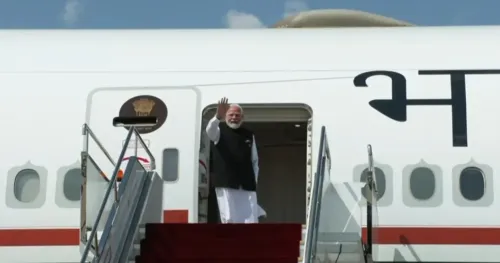
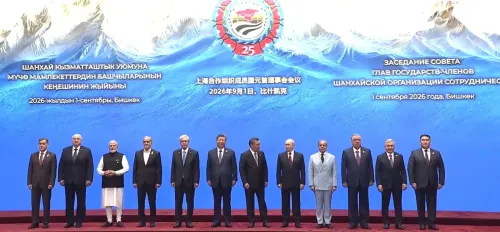
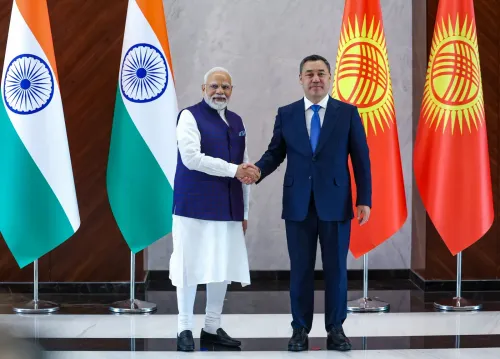
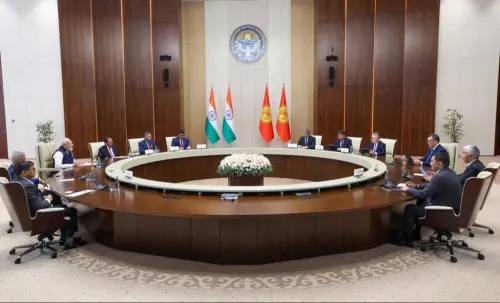
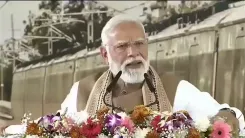
PM Modi Meets Kyrgyz President Zhaparov in Bishkek
Synopsis
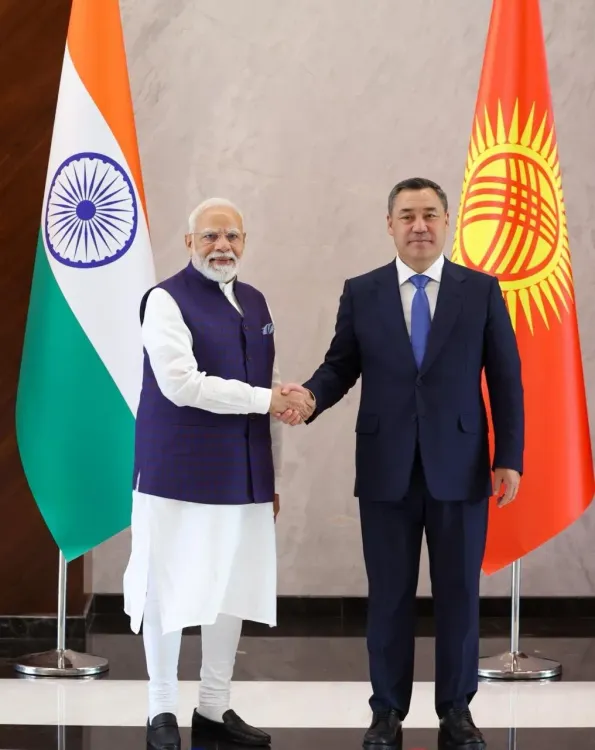
Prime Minister Narendra Modi met Kyrgyz President Sadyr Zhaparov in Bishkek on August 31, 2026, conveying Independence Day greetings, congratulating Kyrgyzstan on its SCO chairmanship, and discussing ways to strengthen bilateral ties within India's broader Central Asia engagement strategy.
Key Takeaways
PM Modi held a bilateral meeting with Kyrgyz President Sadyr Zhaparov in Bishkek on August 31, 2026 .
Modi conveyed India's Independence Day greetings to Zhaparov and the Kyrgyz people.
He congratulated Kyrgyzstan on its successful SCO Chairmanship .
India has been a full member of the Shanghai Cooperation Organisation since 2017 .
The meeting aligns with India's Connect Central Asia policy of sustained high-level engagement with Central Asian republics.
Specific outcomes from the bilateral discussion are yet to be officially detailed.
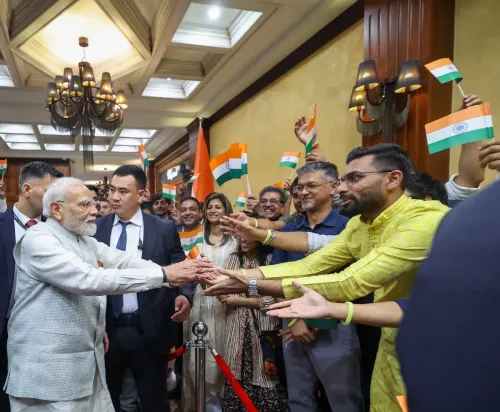
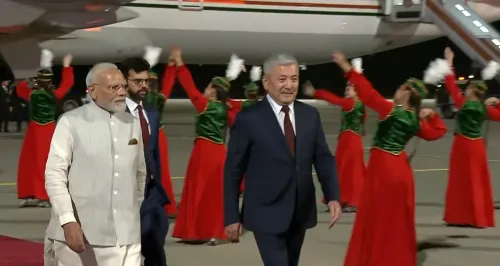
On the sidelines of diplomacy in Central Asia, Prime Minister Narendra Modi held a bilateral meeting with President Sadyr Zhaparov of the Kyrgyz Republic in Bishkek on Monday, August 31, 2026 — carrying India's Independence Day greetings across the Tian Shan mountains and into the heart of SCO country.
Modi described the meeting as 'very fruitful,' conveying Independence Day wishes to Zhaparov and the Kyrgyz people, and congratulating the Central Asian nation on its successful stewardship of the Shanghai Cooperation Organisation (SCO) chairmanship. The two leaders then turned to how the bilateral relationship could be deepened further — though the specific agenda items discussed remain to be detailed officially.
India and Kyrgyzstan inside the SCO framework
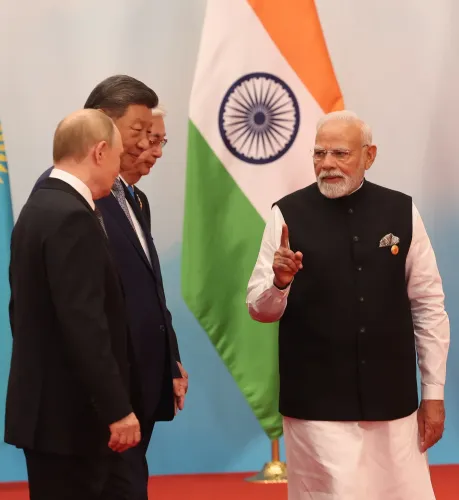
India became a full member of the SCO in 2017, opening a structured diplomatic channel with Central Asian republics that had previously operated largely at arm's length. Since then, New Delhi has used the organisation's summits and margins as a platform for exactly this kind of bilateral stock-taking — covering trade, connectivity, security cooperation, and people-to-people ties.
The Kyrgyz Republic, a landlocked Central Asian state with longstanding cultural links to India, held the rotating SCO chairmanship this cycle — a tenure Modi publicly acknowledged. Bishkek's successful run at the chair gave the meeting a natural diplomatic warmth beyond routine protocol.
India's Connect Central Asia push
The Bishkek meeting fits a deliberate pattern. India's Connect Central Asia policy has driven sustained high-level engagement with all five Central Asian republics, treating the region not as a peripheral concern but as a strategic neighbourhood worth cultivating. Regular leader-level meetings — whether on SCO sidelines or standalone visits — are the policy's most visible output.
For Kyrgyzstan specifically, the relationship encompasses educational exchanges, pharmaceutical trade, and security dialogue. The SCO framework gives both sides a ready institutional home for any agreements that follow.
The next test will be whether the 'fruitful' conversation in Bishkek translates into concrete deliverables — on connectivity corridors, trade facilitation, or security cooperation — when officials sit down to draft the follow-up.
Point of View
Low-cost, and symbolically rich. Modi's public acknowledgment of Kyrgyzstan's chairmanship is a small but deliberate gesture of institutional respect that Central Asian capitals notice. Sustained leader-level contact is the connective tissue of India's Connect Central Asia policy, and each such meeting incrementally normalises New Delhi as a serious partner in a region historically dominated by Russian and Chinese influence. The real measure will come in the follow-through: whether trade corridors, pharmaceutical partnerships, or security dialogues advance in the months after Bishkek.
NationPress
16 Oct 2026
Frequently Asked Questions
Why did PM Modi meet Kyrgyz President Zhaparov in Bishkek?
PM Modi met President Sadyr Zhaparov in Bishkek on August 31, 2026, to convey India's Independence Day greetings, congratulate Kyrgyzstan on its SCO chairmanship, and discuss ways to strengthen bilateral ties.
What is the SCO and why does it matter for India?
The Shanghai Cooperation Organisation (SCO) is a multilateral grouping of Eurasian states. India became a full member in 2017, giving it a structured platform for engagement with Central Asian republics on trade, connectivity, and security.
What is India's Connect Central Asia policy?
Connect Central Asia is India's strategic framework for deepening ties with the five Central Asian republics — Kazakhstan, Kyrgyzstan, Tajikistan, Turkmenistan, and Uzbekistan — through trade, connectivity, and people-to-people links.
Who is Sadyr Zhaparov?
Sadyr Zhaparov has been the President of the Kyrgyz Republic since 2021. His country held the rotating SCO chairmanship in the current cycle, which PM Modi publicly acknowledged during their Bishkek meeting.
What could come out of the Modi-Zhaparov bilateral meeting?
While specific outcomes have not been officially detailed, such meetings under the SCO framework typically advance discussions on trade facilitation, connectivity corridors, security cooperation, and educational or cultural exchanges.