Mangal Pandey birth anniversary: PM Modi, top leaders pay tribute to 1857 hero
Synopsis
On Mangal Pandey's birth anniversary, Prime Minister Modi and four senior Union ministers — including Home Minister Amit Shah, Defence Minister Rajnath Singh, and Health Minister J.P. Nadda — posted tributes on X, collectively framing the 1857 revolutionary's defiance at Barrackpore as the spark that lit India's freedom movement.
Key Takeaways
PM Narendra Modi paid tribute to revolutionary Mangal Pandey on his birth anniversary on 19 July , calling his life a source of pride for every Indian.
Lok Sabha Speaker Om Birla described Pandey's act at Barrackpore Cantonment on 29 March 1857 as 'a decisive moment in Indian history.' Home Minister Amit Shah credited Pandey with awakening public consciousness toward the struggle for self-respect and national interest.
Defence Minister Rajnath Singh called Pandey an 'immortal symbol of unparalleled courage and patriotism.' Health Minister J.P.
Nadda said Pandey's resistance laid the foundation of India's broader freedom struggle.
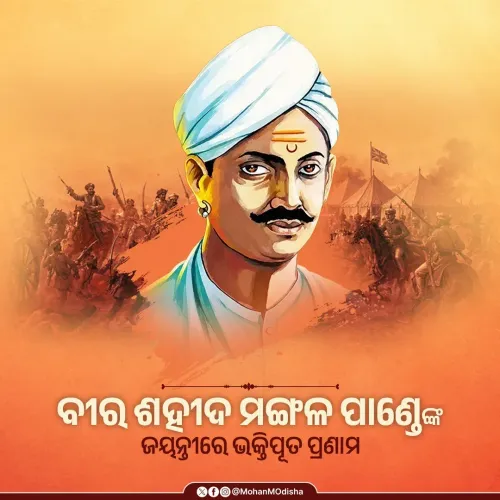
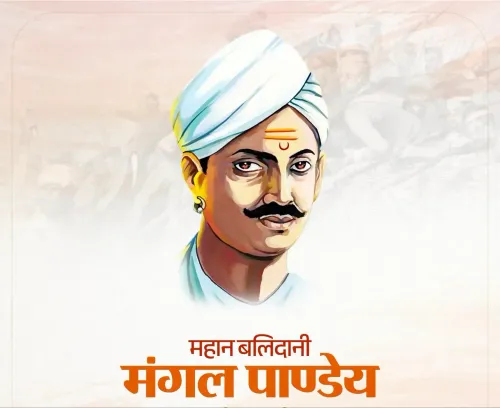
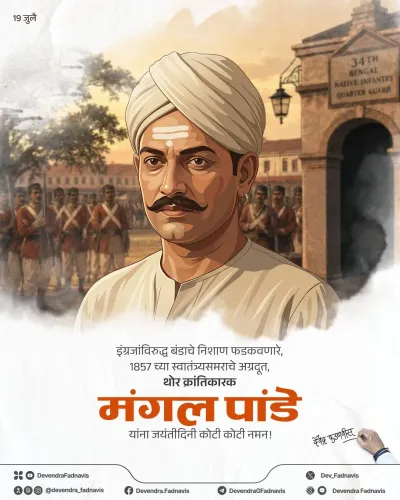
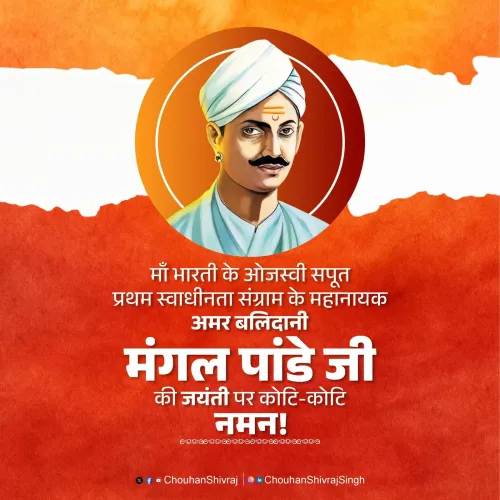
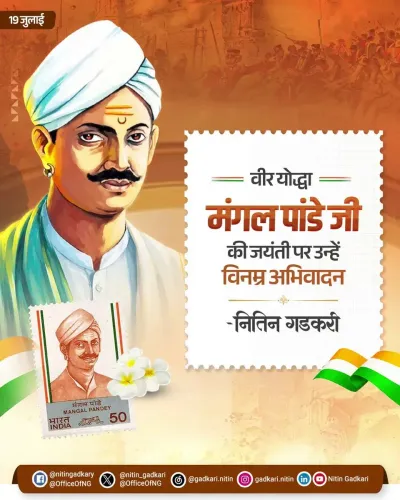
Prime Minister Narendra Modi on Sunday, 19 July paid tribute to revolutionary martyr Mangal Pandey on his birth anniversary, saying that Pandey's courageous life continues to fill every Indian with pride. Senior Union ministers also joined in honouring the soldier whose act of defiance at Barrackpore Cantonment on 29 March 1857 is widely regarded as a catalytic moment in India's freedom struggle.
PM Modi's Tribute
Taking to X, Prime Minister Modi wrote: 'Heartfelt salutations to the great revolutionary Mangal Pandey ji on his birth anniversary. For the protection of the pride and honour of the motherland, he sacrificed everything he had. His courageous life continues to fill every Indian with pride even today. His saga of valour, imbued with patriotism, will keep inspiring every generation of the nation.'
Lok Sabha Speaker and Home Minister Weigh In
Lok Sabha Speaker Om Birla, in a post on X, described Pandey as 'an immortal warrior of the First War of Independence of 1857' and 'a symbol of indomitable courage and patriotism.' Birla noted that Pandey's actions at Barrackpore Cantonment on 29 March 1857 'challenged the foundations of foreign rule and gave a new direction to the freedom movement,' adding that his sacrifice remained a source of inspiration for countless revolutionaries for decades to come.
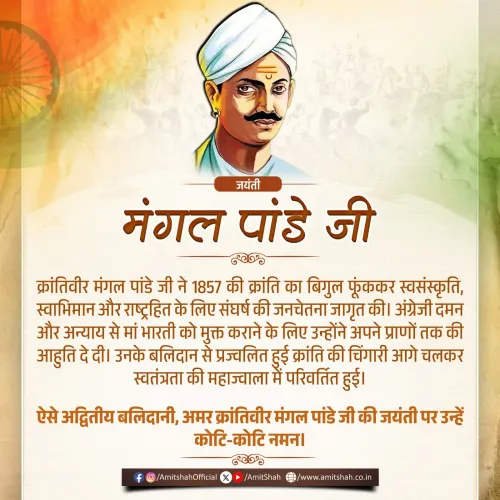
Union Home Minister Amit Shah, also posting on X, said Pandey 'sounded the bugle for the Revolution of 1857' and 'awakened public consciousness to the struggle for our own culture, self-respect, and national interest.' Shah described the spark of revolution ignited by Pandey's sacrifice as one that 'later transformed into the mighty flame of independence.'
Defence and Health Ministers Pay Homage
Defence Minister Rajnath Singh called Pandey a 'hero of the 1857 War of Independence' and an 'immortal symbol of unparalleled courage and patriotism.' In his post on X, Singh said: 'The fearlessness with which Mangal Pandey sounded the bugle of revolution against foreign rule ignited a spirit of patriotism across India and inspired countless countrymen to struggle for the freedom of the motherland.'
Union Health and Family Welfare Minister J.P. Nadda offered his 'humble salutations' to Pandey, crediting him with laying 'the foundation for our freedom struggle' and igniting 'the flame of independence across the nation' through his resistance against British rule in 1857.
Why Mangal Pandey Remains Significant
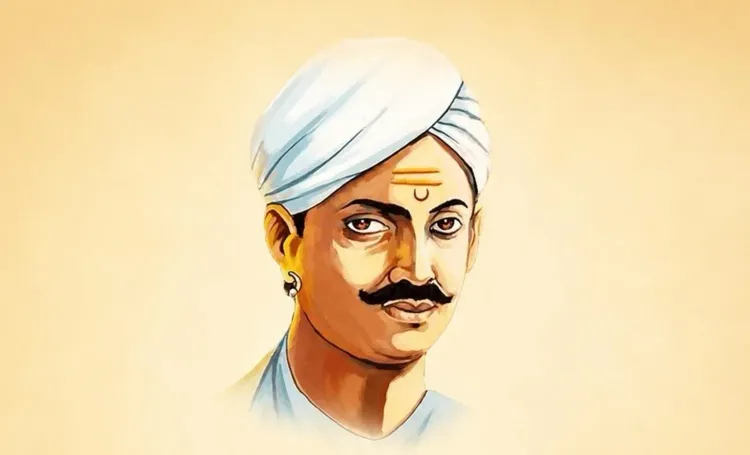
Mangal Pandey was a sepoy in the 34th Bengal Native Infantry of the British East India Company. His open revolt at Barrackpore — months before the broader Revolt of 1857 swept across northern and central India — made him one of the earliest and most recognisable symbols of armed resistance to colonial rule. He was executed on 8 April 1857. Historians continue to debate the precise triggers of the 1857 uprising, but Pandey's role as a flashpoint is broadly acknowledged across scholarly accounts. His birth anniversary is observed each year as an occasion to reaffirm the nation's debt to early freedom fighters.
The coordinated tributes from across the Union Cabinet reflect a broader political emphasis on celebrating pre-Independence revolutionary figures as touchstones of national identity — a trend that has intensified in recent years.
Point of View
The Lok Sabha Speaker, and four Cabinet ministers on a single day signal more than ceremonial remembrance — they reflect a deliberate political effort to anchor national identity in pre-1947 revolutionary figures. Mangal Pandey's story is particularly potent because it predates the organised nationalist movement, offering a narrative of individual sacrifice that transcends party lines. What is less often examined is the historiographical complexity around 1857: the revolt was as much a mutiny of grievances — religious, economic, agrarian — as a proto-nationalist uprising. Honouring Pandey is unimpeachable; flattening that complexity into a clean patriotic arc is where official commemoration and historical scholarship sometimes diverge.
NationPress
18 Oct 2026
Frequently Asked Questions
Who was Mangal Pandey?
Mangal Pandey was a sepoy in the 34th Bengal Native Infantry of the British East India Company who staged an open revolt at Barrackpore Cantonment on 29 March 1857, months before the wider Revolt of 1857 erupted. He was executed on 8 April 1857 and is widely regarded as one of the earliest martyrs of India's freedom struggle.
Why is Mangal Pandey's birth anniversary observed?
His birth anniversary is observed to honour his role as a symbol of armed resistance against British colonial rule. His act of defiance at Barrackpore is considered a catalytic moment that helped ignite the broader 1857 uprising across northern and central India.
What did PM Modi say about Mangal Pandey?
PM Modi posted on X that Pandey 'sacrificed everything he had' for the pride and honour of the motherland, and that 'his courageous life continues to fill every Indian with pride even today.' He added that Pandey's saga of valour 'will keep inspiring every generation of the nation.'
Which other leaders paid tribute to Mangal Pandey on his birth anniversary?
Lok Sabha Speaker Om Birla, Home Minister Amit Shah, Defence Minister Rajnath Singh, and Health Minister J.P. Nadda all posted tributes on X. Each highlighted Pandey's role in igniting the 1857 revolt and his enduring legacy as a symbol of patriotism.
What happened at Barrackpore Cantonment in 1857?
On 29 March 1857, Mangal Pandey attacked British officers at Barrackpore Cantonment near present-day Kolkata, in an act of open defiance against the East India Company. The incident is seen as one of the earliest flashpoints of the First War of Indian Independence.