Giriraj Singh Shares PM Modi's Visit to President Murmu's Village
Synopsis
Union Textiles Minister Giriraj Singh amplified PM Modi's visit to President Droupadi Murmu's in-laws' village in Odisha on June 21, 2026, where the Prime Minister engaged with Adivasi traditions — part of the BJP government's sustained tribal outreach since 2014.
Key Takeaways
PM Modi visited the in-laws' village of President Droupadi Murmu in Odisha on June 21, 2026 , engaging with tribal traditions and the indigenous way of life.
Union Textiles Minister Giriraj Singh shared the news on social media, amplifying the visit's cultural and political significance.
President Murmu , elected in 2022 , is the first person from a Scheduled Tribe community to serve as India's President.
Odisha has an Adivasi population exceeding 22 per cent , making it a key state for tribal welfare and political outreach.
The visit aligns with the BJP-led government 's long-standing tribal engagement strategy, including the Vanbandhu Kalyan Yojana launched in 2014 .
Eastern India's large Scheduled Tribe electorate makes such visits significant both culturally and electorally.
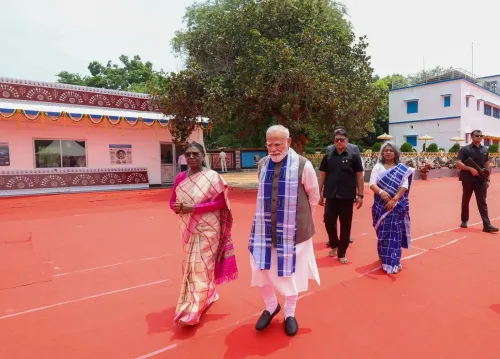
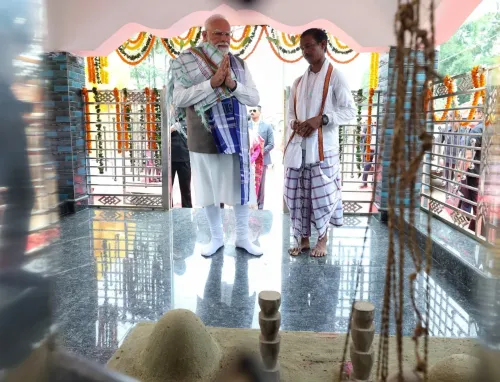
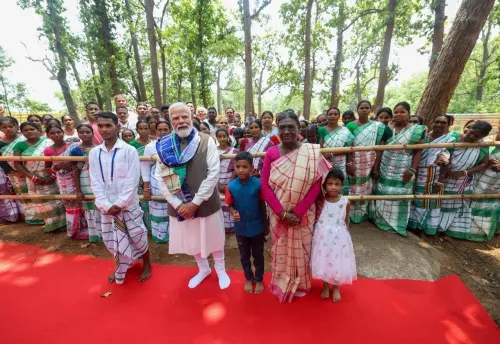
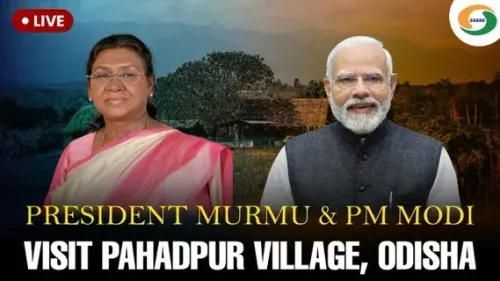
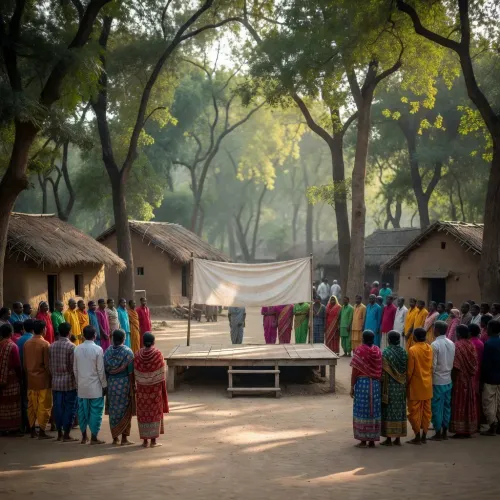
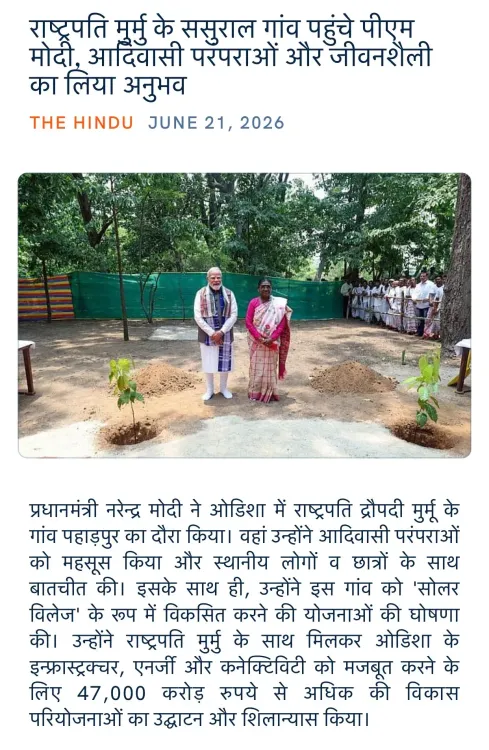
Union Textiles Minister Giriraj Singh on Sunday, June 21, 2026, shared a post highlighting Prime Minister Narendra Modi's visit to the in-laws' village of President Droupadi Murmu in Odisha, where the Prime Minister engaged with Adivasi traditions and the indigenous way of life.
Context
PM Modi visited the village in Odisha associated with President Murmu's marital family, experiencing tribal customs and cultural practices firsthand. The visit drew attention to the living traditions of Odisha's Adivasi communities, which form over 22 per cent of the state's population. Giriraj Singh, a senior BJP leader and Lok Sabha MP from Begusarai, Bihar, amplified the visit through his social media channels.
The post, shared in Hindi, translates as: 'राष्ट्रपति मुर्मु के ससुराल गांव पहुंचे पीएम मोदी, आदिवासी परंपराओं और जीवनशैली का लिया अनुभव' ('PM Modi reaches President Murmu's in-laws' village, experiences tribal traditions and way of life'). The amplification by a Union Cabinet minister underscores the political and cultural weight the government attaches to such outreach.
Policy Backdrop
The visit fits within the BJP-led government's sustained engagement with tribal communities since 2014, including through the Vanbandhu Kalyan Yojana, a flagship scheme focused on development and cultural preservation in forested and tribal regions. The election of President Droupadi Murmu in 2022 — the first person from a Scheduled Tribe community to hold the office — gave fresh symbolic momentum to this outreach. Visits to villages personally linked to the President carry layered significance, combining cultural documentation with the government's broader narrative of inclusive development.
Odisha has been a consistent focus of tribal welfare initiatives, and engagements in the state's indigenous heartland are seen as reinforcing the administration's commitment to Adivasi representation at the highest levels of the republic.
Stakeholders and Impact
Tribal communities across Odisha and the wider Adivasi belt stand at the centre of this visit's symbolic impact. For Scheduled Tribe populations, the Prime Minister's personal engagement with village life and local customs sends a signal of recognition that goes beyond policy announcements. Cultural practitioners, village elders, and local communities who hosted the visit gain national visibility for traditions that often remain outside mainstream public discourse.
The political dimension is equally significant: eastern India, with its large Scheduled Tribe electorate, remains a key arena for the ruling party's outreach strategy. Moments like this visit are closely watched by opposition parties and tribal rights organisations alike, who assess whether symbolic gestures translate into substantive policy gains for indigenous communities.
What's Next
The government's pattern of high-profile tribal outreach is expected to intensify as Odisha and other eastern states with significant ST populations remain electorally important. Policy watchers will look for any follow-up announcements on tribal welfare, cultural preservation funding, or infrastructure in the region that may accompany or follow such visits. The broader question of whether visible cultural engagement translates into measurable improvements in Adivasi livelihoods, land rights, and education will continue to shape the political conversation around tribal welfare in India.
Point of View
The Prime Minister signals continuity between symbolic representation — embodied by President Murmu — and ground-level outreach. For Giriraj Singh, sharing the moment serves dual purpose: aligning a senior Cabinet minister with the party's tribal welfare optics ahead of future electoral cycles in eastern India. The real test, as observers note, remains whether such high-visibility engagements are matched by measurable policy outcomes for Scheduled Tribe communities.
NationPress
20 Sept 2026
Frequently Asked Questions
Why did PM Modi visit President Murmu's in-laws' village in Odisha?
PM Modi visited the village to engage with Adivasi traditions and the tribal way of life, as part of the BJP-led government's sustained outreach to Scheduled Tribe communities, particularly following the election of President Droupadi Murmu — India's first tribal President — in 2022.
Who is President Droupadi Murmu and why is she significant?
Droupadi Murmu , elected President of India in 2022 , is the first person from a Scheduled Tribe community to hold the office. She has roots in Odisha 's tribal districts and her election was widely seen as a landmark moment for Adivasi representation in Indian governance.
What is the Vanbandhu Kalyan Yojana?
The Vanbandhu Kalyan Yojana , launched in 2014 , is a central government scheme focused on the holistic development of tribal areas, covering livelihoods, education, health, and cultural preservation for Scheduled Tribe communities across India.
Why did Giriraj Singh share this post about PM Modi's tribal village visit?
Giriraj Singh , Union Textiles Minister and a senior BJP leader, shared the post to amplify the Prime Minister's cultural outreach to tribal communities in Odisha , consistent with the party's emphasis on Adivasi welfare and inclusive development messaging.
What is the tribal population of Odisha?
Odisha has one of India's largest Scheduled Tribe populations, accounting for over 22 per cent of the state's total population, making it a significant state for tribal welfare policy and political outreach by the central government.