India-Netherlands Strategic Partnership: Modi's The Hague visit yields 15+ pacts
Synopsis
PM Modi's two-day visit to The Hague delivered far more than diplomatic optics — it produced a formal Strategic Partnership, Dutch backing for India's UN Security Council bid, Netherlands joining the Indo-Pacific Oceans Initiative, and a clutch of agreements tying ASML's semiconductor ecosystem directly to India's IITs and ISM. The breadth of the pact signals India is systematically locking in European technology partnerships ahead of a geopolitically turbulent decade.
Key Takeaways
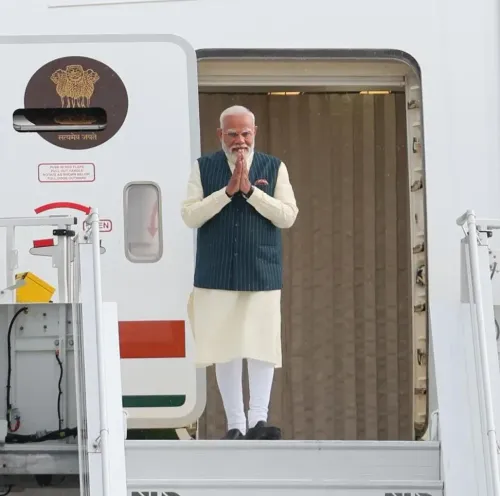
PM Narendra Modi concluded a two-day visit to the Netherlands on 17 May 2025 , his second visit to the country.
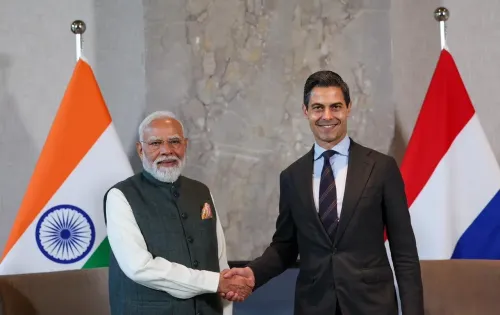
India and the Netherlands elevated bilateral ties to a Strategic Partnership , backed by a comprehensive Strategic Partnership Roadmap .
More than 15 agreements were signed covering semiconductors, defence, green hydrogen, critical minerals, water, health, education, and culture.
The Netherlands joined the Indo-Pacific Oceans Initiative (IPOI) and will co-lead the Capacity Building and Resource Sharing pillar with Germany and the EU.
PM Jetten backed India's permanent membership of a reformed UN Security Council and condemned the April 2025 Pahalgam terrorist attack .
Both leaders reaffirmed the India-EU Free Trade Agreement (concluded January 2026 ) and a new India-EU Security and Defence Partnership .
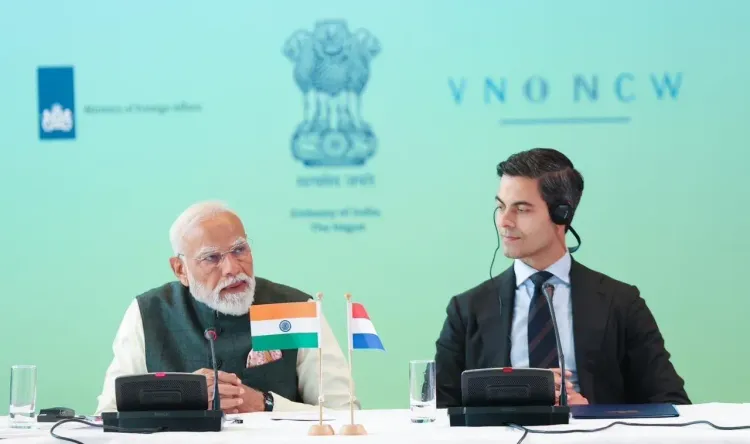
Prime Minister Narendra Modi concluded a landmark two-day official visit to the Netherlands on 17 May 2025, culminating in the elevation of bilateral ties to a Strategic Partnership — a first for the two nations — and the signing of more than 15 agreements spanning semiconductors, defence, green hydrogen, water management, health, and education. The visit, held at the invitation of Dutch Prime Minister Rob Jetten, also reinforced the newly concluded India-EU Free Trade Agreement and a parallel India-EU Security and Defence Partnership.
Royal Audience and Summit Talks
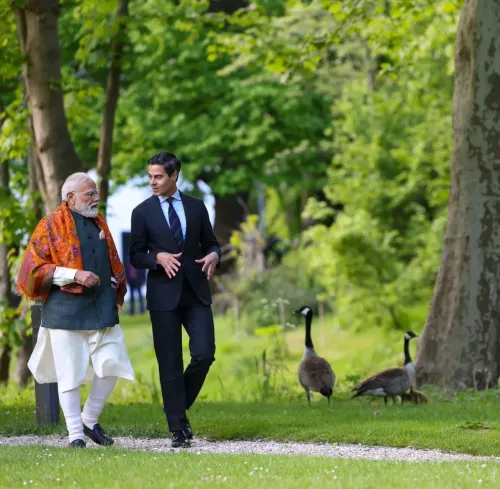
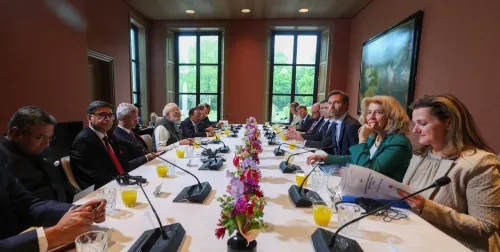
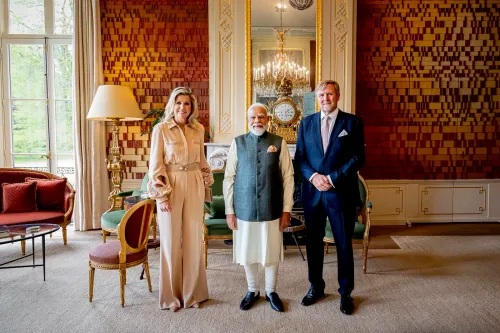
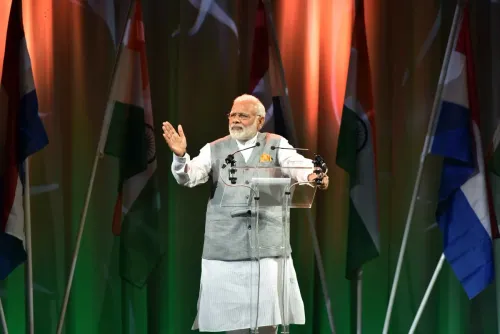
On the morning of 16 May, Prime Minister Modi was received by King Willem-Alexander and Queen Máxima at the Royal Palace Huis ten Bosch in The Hague for a bilateral meeting and luncheon — a rare honour that underscored the diplomatic weight of the visit. Later that day, Modi and Jetten held restricted and delegation-level talks, followed by a formal dinner.
This was Modi's second visit to the Netherlands. Both leaders described the atmosphere as 'friendly and cordial' and agreed to work through a Strategic Partnership Roadmap covering political, economic, defence, cyber, technology, sustainability, health, and cultural cooperation.
Strategic Partnership and Key Agreements
The centrepiece of the visit was the formal upgrade of the bilateral relationship to a Strategic Partnership, backed by a structured roadmap. Among the agreements signed or welcomed:
Semiconductors: An MoU on Semiconductors and Related Emerging Technologies was signed, linking the Dutch Semicon Competence Centre to India's Indian Semiconductor Mission (ISM). A brain-bridge MoU was also adopted between Eindhoven University of Technology, University of Twente, and six Indian institutions — IISc Bangalore, IIT Bombay, IIT Delhi, IIT Gandhinagar, IIT Guwahati, and IIT Madras — with industry participation from NXP, ASML, TATA, and CG Semi.
Defence: A Letter of Intent on Defence Cooperation was signed, with both sides agreeing to explore a Defence Industrial Roadmap covering co-development, technology transfer, and joint ventures for co-production.
Green Hydrogen: The two leaders launched an India-Netherlands Roadmap on Green Hydrogen Development, backed by a new Joint Working Group on Renewable Energy and a PhD Fellowship Programme on Hydrogen between India's Department of Science and Technology and the University of Groningen (RUG). RUG also signed an MoU with 19 Indian Institutes of Technology (IITs).
Water: A Centre of Excellence on Water will be established at IIT Delhi under the Ministry of Jal Shakti, building on the existing Strategic Partnership on Water that includes collaboration on the Namami Gange Mission and the Kalpasar Project in Gujarat.
Critical Minerals: An MoU on Critical Minerals was signed to build resilient supply chains across exploration, research, and circularity.
Other agreements covered higher education, migration and mobility, maritime cooperation, health (including an MoU renewal and a new Letter of Intent between RIVM and ICMR), food safety (between NVWA and FSSAI), horticulture (between Naktuinbouw and the National Horticulture Board), dairy (establishment of an Indo-Dutch Centre of Excellence on Training in Dairy in Bengaluru), and customs enforcement.
Geopolitics: UN Reform, Indo-Pacific, and Terrorism
Prime Minister Jetten formally backed India's bid for permanent membership of a reformed and expanded UN Security Council, calling for text-based negotiations within a fixed timeframe. The Netherlands also announced it would join the Indo-Pacific Oceans Initiative (IPOI) and co-lead the Capacity Building and Resource Sharing pillar alongside Germany and the European Union.
On terrorism, Jetten strongly condemned the April 2025 Pahalgam attack in Jammu and Kashmir and expressed the Netherlands' 'unwavering support' for India's fight against cross-border terrorism. Both leaders called for a zero-tolerance approach and renewed support for India's push to establish a UN Comprehensive Convention on International Terrorism (CCIT).
On Ukraine, both sides called for a 'comprehensive, just, and lasting peace' through dialogue based on UN Charter principles. On West Asia, they welcomed the ceasefire announced on 8 April 2026 and called for freedom of navigation through the Strait of Hormuz.
Trade, Innovation, and People-to-People Ties
The Netherlands remains one of India's largest trade and investment partners in Europe, with the Port of Rotterdam serving as a strategic gateway for Indian exporters. Both leaders noted that the India-EU Free Trade Agreement, concluded in January 2026, would deepen economic ties between the world's second and fourth largest economies.
On culture, both governments welcomed the return of Chola Era Copper Plates from the University of Leiden to Indian authorities, and signed an MoU for cooperation on the National Maritime Heritage Complex (NMHC) in Lothal, Gujarat with the National Maritime Museum of Amsterdam. The Amrita Sher-Gil exhibition at the Drents Museum was also highlighted as a milestone in bilateral cultural exchange.
Prime Minister Modi extended a formal invitation to Jetten to visit India at the earliest opportunity. With the Strategic Partnership Roadmap now in place, both governments are expected to operationalise joint working groups across sectors in the months ahead.
Point of View
A green hydrogen roadmap, and Dutch entry into the Indo-Pacific Oceans Initiative all point to India successfully converting European anxiety about China-dependent supply chains into concrete bilateral architecture. The Netherlands' endorsement of India's UNSC permanent membership — and its unambiguous condemnation of the Pahalgam attack — also signals a closer alignment on security that goes beyond trade. The real test will be execution: India has signed numerous MoUs with European partners over the past decade, and the gap between signing ceremonies and operational joint ventures remains wide. Whether the new Joint Trade and Investment Committee and the Defence Industrial Roadmap translate into factory floors and research labs, rather than shelf documents, will determine the actual weight of this partnership.
NationPress
30 Sept 2026
Frequently Asked Questions
What is the India-Netherlands Strategic Partnership announced in May 2025?
It is a formal upgrade of bilateral relations agreed upon during PM Modi's visit to The Hague on 16-17 May 2025, backed by a Strategic Partnership Roadmap covering defence, semiconductors, green hydrogen, water management, trade, health, and culture. The partnership replaces the previous framework with structured, regular cooperation across all major sectors.
What agreements were signed during PM Modi's Netherlands visit?
More than 15 agreements were signed or welcomed, including MoUs on semiconductors, critical minerals, higher education, migration and mobility, renewable energy, health, food safety, horticulture, dairy, and maritime cooperation. A Letter of Intent on Defence Cooperation and a Green Hydrogen Development Roadmap were among the headline outcomes.
How does the visit connect to the India-EU Free Trade Agreement?
Both leaders reaffirmed the India-EU Free Trade Agreement concluded in January 2026 and a simultaneous India-EU Security and Defence Partnership. The Netherlands, as a major EU economy and Europe's largest port hub via Rotterdam, is positioned as a key implementation partner for the FTA.
What did the Netherlands say about India's UN Security Council membership?
Prime Minister Rob Jetten expressed the Netherlands' continued support for India's permanent membership of a reformed and expanded UN Security Council, calling for text-based negotiations within a fixed timeframe. This was formally acknowledged by PM Modi in the joint statement.
What is the significance of the Netherlands joining the Indo-Pacific Oceans Initiative?
The Netherlands announced it would join the Indo-Pacific Oceans Initiative (IPOI) and co-lead its Capacity Building and Resource Sharing pillar alongside Germany and the EU. This marks a concrete step by a major European maritime nation into India's Indo-Pacific security architecture.